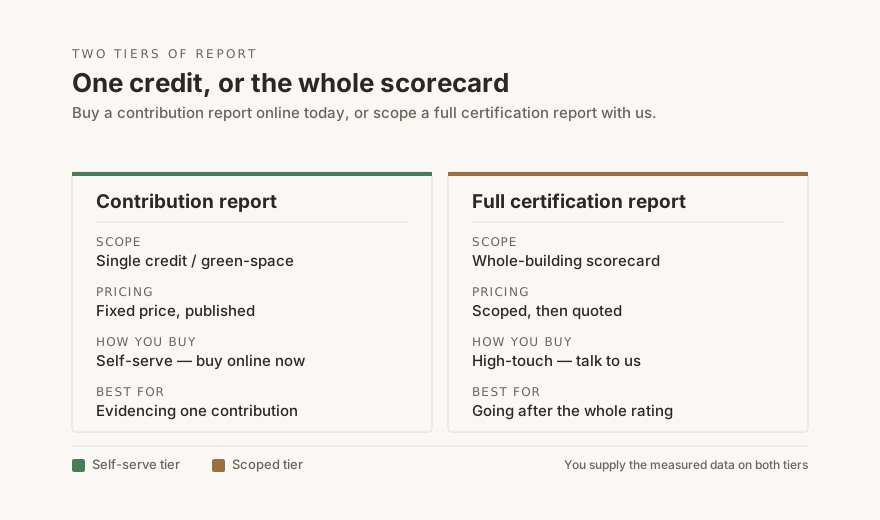
The two report tiers explained: what a farm contribution report covers, what a full certification scorecard covers, what each costs you, and a simple rule for choosing between them.
Quick answer: A contribution report documents one thing — your farm or green space — as evidence against the credits it qualifies for. It is fixed-price and self-serve: you can price it and buy it without talking to anyone. A full certification scorecard covers your building’s entire submission across every credit in scope; it is quote-based and high-touch. Choose the contribution report if you want the green space you already have to start earning credits. Choose the full scorecard if you are pursuing the whole certification.
Two tiers is a deliberately small menu, but the line between them is not self-evident from the names. Here is what each actually contains and how to pick without a sales call.
The contribution report
Scope: one green asset, documented properly.
If you have a rooftop farm, an urban farm at grade, or a managed green space, it is almost certainly qualifying for credits it currently is not claiming — because nothing has ever written the argument down. A contribution report is that argument, narrowed to the asset.
It states the credits your green space qualifies for, the requirement and threshold for each, and the evidence that proves it. An on-site farm is a directly qualifying compliance path in every system we cover — LEED SSc5 Heat Island, WELL N12 Food Production, Fitwel OS1 Garden, BOMA BEST’s green roof provision at ≥30%, BREEAM LE04 ecology, GRESB TC4 Community — so the credits are not hypothetical. They are published, numbered, and available to a building that documents them.
It is fixed-price and self-serve. You see the price before you buy. No scoping call, no proposal, no procurement cycle.
The full certification scorecard
Scope: the whole submission.
Every credit in scope for your building, at your version and typology — not just the ones your green space touches. Energy, water, materials, indoor environmental quality, the lot. The complete credit-by-credit spine with the evidence register behind it.
This tier is quote-based and high-touch, for the honest reason that scope genuinely varies. A single office building pursuing one certification and a mixed-use asset pursuing three are not the same job, and a fixed price would either overcharge the first or under-serve the second.
Side-by-side
|
Contribution report |
Full scorecard |
| Covers |
Your farm / green space |
Every credit in scope |
| Pricing |
Fixed, shown up front |
Quoted after scoping |
| Buying |
Self-serve checkout |
Request a scoped quote |
| Account needed to browse |
No |
No |
| Best when |
You have green space that is not credited |
You are pursuing the full certification |
| Typical trigger |
“We have a farm — does it count?” |
“We are going for LEED Gold.” |
The rule for choosing
Ask what you are trying to finish.
If you are trying to get a building certified, you need the full scorecard. The contribution report is one section of that argument; buying it alone leaves you with a strong paragraph and no essay.
If you are trying to make an asset you already own start counting, the contribution report is the whole job. This is the more common situation than people expect: the green roof went in for stormwater or amenity reasons years ago, nobody documented it against a standard, and it has been quietly earning zero credits ever since.
If you are not sure yet, start with the contribution report. Which brings us to the useful part.
Starting small is a legitimate strategy
The tiers are not a ladder you are pressured up. Starting self-serve is a real answer, for two reasons.
First, it de-risks the vendor. You get a finished artefact for a known price and can judge the quality before committing to anything larger. That is a reasonable thing to want from someone you have not worked with.
Second, it de-risks the certification. A contribution report tells you concretely which credits your site already reaches — which is exactly the input you need to decide whether the full certification is worth pursuing at all. Some buildings discover they are closer than they thought. Others find out early, and cheaply, that they are not — which is a good outcome at contribution-report prices and a painful one at scorecard prices.
Bundling
If you are pursuing more than one certification — common, since LEED, WELL and a disclosure framework like CSRD or GRESB often run in parallel across a portfolio — the reports can be bundled rather than bought one at a time.
Which one is yours?
The fit-finder settles it in eight questions: country, asset type, project stage, what is growing on site, portfolio size, and what is driving the work. It returns the reports your building actually qualifies for, marks the best fit first, and shows you both tiers where both apply. No account needed to look.
See what your building unlocks →
Not sure what a report contains at all? Start with what is actually inside an audit-ready certification report. For the wider reporting strategy, see our pillar guide to ESG-aligned urban farming.