
Green BuildingsESG
Das Botanische Bento ist eine Immobiliennotwendigkeit
Biophiles Design am Arbeitsplatz geht über Ästhetik hinaus. Erfahren Sie, wie MicroHabitats Botanisches Bento ESG-Werte, Mieterbindung und Immobilienwert steigert.
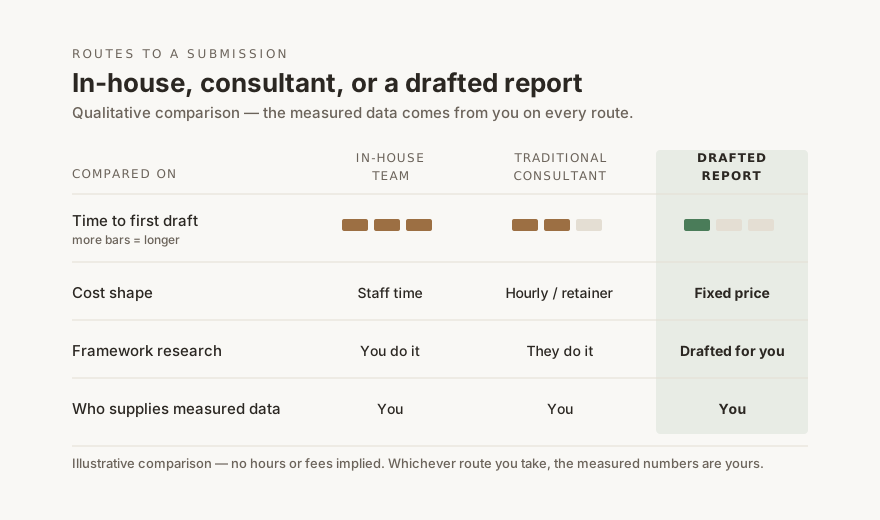
Three ways to resource a green building certification submission, compared honestly: what each costs you in time and money, where the risk sits, and which one fits your building.
Quick answer: There are three ways to get a certification submission written: your own team does it, you retain a consultant to do all of it, or you buy a drafted report and supply your building’s measured data. In-house is cheapest in cash and most expensive in senior time. Full consulting is right for complex new-build projects with design decisions still in play. A drafted report fits the large middle case — an existing building with real performance that simply needs documenting properly.
Nobody chooses a resourcing model on the merits. They default to whatever they did last time, or to whichever vendor emailed them in the right week. Then the sunk cost sets in. Since this decision determines both the cost and the calendar of the entire certification, it deserves twenty minutes of actual thought.
Here is the honest comparison, including the cases where you should not buy anything from us.
In-house. A sustainability manager, facilities lead, or ESG analyst reads the manual and assembles the submission. Cash cost is near zero. The real cost is that a senior person spends weeks becoming a temporary expert in a rulebook they will use once, then loses that knowledge before the recertification cycle comes round.
Full consultant. You retain a firm that manages the whole process — often from design stage — attends the charrettes, models the options, writes the submission, and handles review correspondence. You buy expertise and accountability, priced accordingly.
Drafted report. The credit-by-credit requirements, thresholds and recommended approaches are researched and drafted against the authority’s current manual, then reviewed by a specialist. You supply your building’s measured inputs. You submit.
| In-house | Full consultant | Drafted report | |
|---|---|---|---|
| Who learns the rulebook | Your team, from scratch | The consultant | Already done for you |
| Who supplies measured data | You | You | You |
| Who influences design | You | The consultant | Nobody — building is as-built |
| Cost shape | Senior salary time | Retainer / project fee | Fixed price (contribution) or quoted (full scorecard) |
| Speed to first draft | Weeks of reading | Scoped engagement | Minutes |
| Where version risk sits | With you | With the consultant | Validated against the live manual |
| Best fit | Simple, repeat, in-house expertise exists | Complex new-build, design in play | Existing building, real performance, needs documenting |
If you have a sustainability lead who has already run this exact certification, at this version, on a comparable asset — let them. The rulebook knowledge is already paid for, and a second run is dramatically cheaper than the first. This is a real scenario and we will not pretend otherwise.
It stops being true the moment the version moves. Credit counts, point values and category structures are version- and typology-specific, and the editions turn over. Last cycle’s knowledge is a starting point, not an answer.
If the building is not built yet, hire the consultant.
When design decisions are still live, the value is not in the documentation — it is in someone shaping the glazing spec, the mechanical strategy and the site plan toward the credits before the concrete is poured. No report, however well drafted, can retrofit a decision that has already been made. Complex new construction chasing a high certification level is consulting work, and we would tell you the same on a call.
The middle case is the biggest one, and it is the worst served.
You have an existing building. It performs — there is a green roof, or a farm, or a genuinely efficient plant — and that performance is currently earning you nothing because it is not documented against a standard. There are no design decisions left to influence. You do not need a strategist; you need the rulebook applied to the building you already have.
This is also the recertification case. You were certified in, say, 2021. You still qualify — being certified proves it — but the standard has moved and the evidence needs restating against the current edition. That is documentation work, not strategy work, and paying strategy rates for it is how certification budgets quietly disappear.
The tell is simple: if the answer to “what should we change about the building?” is “nothing,” you do not need a consultant. You need the report.
Three questions, in order:
If you land on the third: answer eight questions about your building and you will see which of the 17 certifications and disclosure frameworks it qualifies for, and what each report covers, before you spend anything. No account needed to look.
See what your building unlocks →
If you are at design stage, or you want someone to shape the strategy rather than document it, talk to our team instead — that is a different conversation and we would rather have the right one. For the wider reporting picture, see our pillar guide to ESG-aligned urban farming.
Biophiles Design am Arbeitsplatz geht über Ästhetik hinaus. Erfahren Sie, wie MicroHabitats Botanisches Bento ESG-Werte, Mieterbindung und Immobilienwert steigert.

MicroHabitat stellt das Botanische Bento vor — ein präzisionsgefertigtes modulares Ökosystem, das statische Dachflächen in die produktivsten Vermögenswerte verwandelt.

Vancouvers Rain City Guide setzt den Standard für urbane Resilienz. So verwandelt MicroHabitat diese Ziele in produktive, lebendige Dachflächen.
Nächster Schritt
Schließen Sie sich über 250 Immobilien an, die bereits mit MicroHabitat anbauen. Unser Team kümmert sich um alles, vom Design bis zur Ernte.
Mehr entdecken