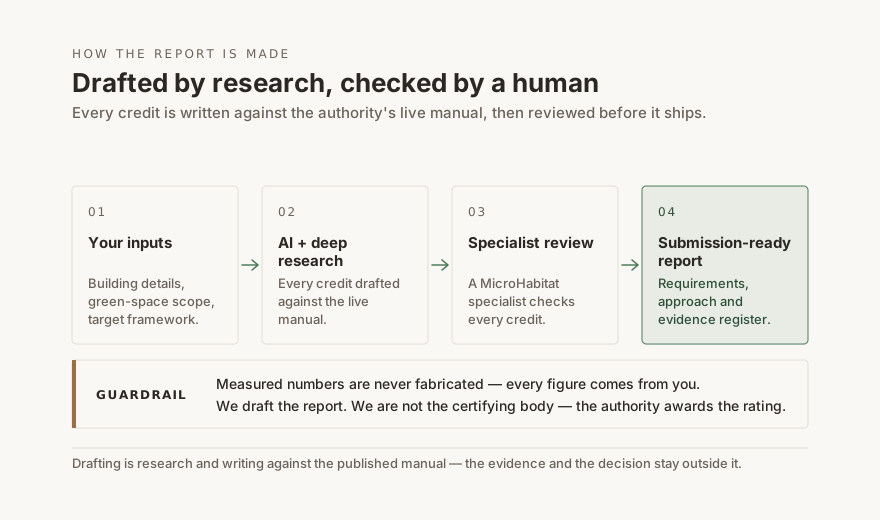
How an audit-ready certification report actually gets produced: what AI and deep research draft, what a specialist checks, what you supply — and the one line we won't cross.
Quick answer: AI and deep research draft each credit’s requirement, threshold and recommended approach against the certifying authority’s current manual. A specialist then reviews and validates every figure before it reaches you. You supply your building’s measured inputs — energy models, metered data, test results, policies. The division is not arbitrary: AI is used where the source of truth is a published rulebook, and never where the source of truth is your building.
If your first reaction to “AI-drafted certification report” is suspicion, that is the correct instinct. A submission to USGBC or BRE is not a place for a confident machine to improvise. Plenty of vendors are quietly running your compliance work through a language model and not mentioning it.
We would rather tell you exactly what the AI does, what it does not, and where the human sits. Judge the process, not the buzzword.
Why AI is involved at all
Certification rulebooks are enormous, numbered, and public. LEED, WELL, BREEAM, GRESB, BOMA BEST, Fitwel and the rest publish their requirements in exhaustive detail across hundreds of credits, each with its own threshold, documentation requirement and compliance path — and each versioned by typology.
Assembling that by hand is weeks of specialist reading, most of which is retrieval rather than judgement. It is the single biggest reason certification documentation is slow and expensive, and it is the part of the job that is genuinely, legitimately automatable — because the answer is written down in a manual, not inferred.
That is the whole thesis. Use the machine where the truth is published. Use the human where it is not.
What gets drafted
For every credit in scope:
- The requirement, in the standard’s own terms, at your version and typology.
- The threshold — the number or condition that separates earning from missing.
- The recommended approach for your building specifically, given what is on site.
All of it researched against the authority’s live manual, not against a training-set memory of what LEED said three years ago. That distinction is the entire ballgame, and it is the failure mode of anyone who just asks a chatbot: models are fluent about superseded versions and will state a retired point value with total confidence.
What a specialist checks
Credit counts, point values and category structures are version- and typology-specific. Every figure is validated against each authority’s current manual before it is quoted to you. Not spot-checked — validated.
The specialist is also there for the part that is not retrieval: whether the recommended approach is actually sensible for your asset, whether the credit is worth pursuing given what else is in scope, and whether the evidence you would need is realistically obtainable. That is judgement, and it stays with a person.
What you supply
Your building’s measured inputs. Energy models. Metered data. Test results. Policies.
These are facts about your property that no amount of research can produce, because they do not exist in any manual. They exist in your BMS, your commissioning reports, and your filing system.
The line we do not cross
We never fabricate a measured number.
This is the most important sentence on this page. If a value is not measured, the report says it is not measured, and names what is needed to get it. It does not estimate, interpolate, or produce a plausible-looking figure.
The reason is not squeamishness. A fabricated number does not fail at review — it passes, and then fails during audit or verification, after you have built a public claim on top of it. The downside is not a rejected credit; it is a retracted certification and a governance problem. Any system that will invent a measurement to fill a gap is worse than useless for compliance work, however good the prose.
The same principle sets the honest boundary on the outcome: we do not guarantee certification. The certifying authority — USGBC/GBCI, BRE, IWBI, GRESB, BOMA Canada, the Center for Active Design, ILFI, GBI, DGNB, Cerway, GBCA, BCA — reviews your submission and awards the level. We produce the report you submit, built to maximise your odds. Anyone selling you a guaranteed outcome on a review they do not control is selling you something they cannot deliver.
Why version-tracking is the real work
The unglamorous truth: the hardest part of certification documentation is not writing. It is staying current.
Standards move. LEED has moved through v4, v4.1 and v5. WELL moved to v2. Editions differ by typology, credits get retired, thresholds shift, whole categories restructure. A report assembled against last year’s manual is confidently, invisibly wrong — and it looks exactly like a correct one until review.
This is where continuous research beats institutional memory, and it is also why recertification is its own product rather than a copy-paste of your old submission. You were certified in 2021; you still qualify; but the standard you are re-submitting against is not the standard you passed. The report has to be rebuilt against the current edition, and that is a research problem before it is a writing problem.
What this means for you
Minutes to a first drafted credit, instead of weeks of reading. Every figure validated against the live manual. A specialist between the draft and your inbox. Your measured data, never invented.
You can see the whole thing before spending anything: eight questions about your building returns the reports it qualifies for, with the reason for each. No account needed to look.
See what your building unlocks →
Want the anatomy of the deliverable itself? See what is actually inside an audit-ready certification report. For the wider reporting strategy, see our pillar guide to ESG-aligned urban farming.