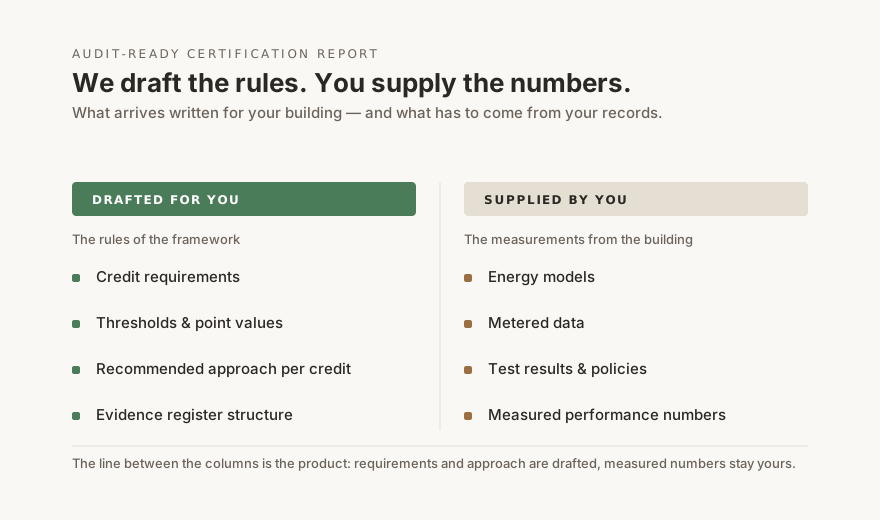
What you receive when you buy a certification report: the credit-by-credit structure, the evidence register, what we draft versus what you supply — and what a report deliberately is not.
Quick answer: An audit-ready certification report is a credit-by-credit document that states, for every credit you are pursuing, what the standard requires, what threshold you must hit, and the recommended approach to hitting it — assembled against the certifying authority’s current manual and paired with an evidence register that lists exactly which of your building’s documents prove each claim. It is the thing you submit. It is not a certificate, and it is not a promise that you will get one.
Most people buying a certification report for the first time have never seen one. They have seen the plaque in a lobby, and they have seen a consultant’s invoice, but the artefact in between is a black box. That vagueness is expensive: it is why teams over-buy consulting they do not need, and why others stall for a year because nobody can say what “getting certified” concretely requires. This post opens the box.
What a certification report actually is
A certification body — USGBC/GBCI for LEED, IWBI for WELL, BRE for BREEAM, BOMA Canada for BOMA BEST, and so on — does not walk your building and decide if it feels sustainable. It reviews a submission. The submission is a structured argument that your building meets named, numbered requirements, with evidence attached to each one.
The report is that argument, written down. Everything else — the site visit, the review cycle, the award letter — happens downstream of it.
This is why the report is the leverage point. A building that genuinely performs but documents badly fails review. A building that documents precisely gets credited for what it actually does. The physical asset sets your ceiling; the report determines how much of that ceiling you actually reach.
The credit-by-credit spine
The body of the report walks each credit in scope. For every one, three things are stated:
- The requirement — what the standard asks for, in the standard’s own terms, at the version and typology that applies to you. LEED v4.1 BD+C: New Construction is a different rulebook from LEED O+M for a building in operation, and being graded against the wrong edition is a common and entirely avoidable failure.
- The threshold — the specific number, percentage, or condition that separates earning the credit from missing it. Not “improve biodiversity,” but the actual bar.
- The recommended approach — how your building, specifically, should go about meeting it, given what is already on site.
Worked examples from systems where an on-site farm is a directly qualifying compliance path: LEED SSc5 (Heat Island Reduction), WELL N12 (Food Production), Fitwel OS1 (Garden), BOMA BEST’s green roof provision at ≥30% coverage, BREEAM LE04 (ecology), GRESB TC4 (Community). In each case the credit exists, the threshold is published, and a farm is a recognised way to reach it — the report’s job is to prove yours does.
The evidence register
Alongside each credit sits the evidence: which document, which page, which measurement proves the claim. Energy models. Metered data. Test results. Policies. Photographs with dates. Species counts and harvest logs, for the ecology and community credits.
The register is what makes a report audit-ready rather than merely well-written. A reviewer should never have to hunt. Where evidence does not exist yet, the register says so and names what is needed — which is far more useful than a confident sentence with nothing behind it.
What we draft versus what you supply
This is the cleanest way to understand the product:
| Part of the report |
Drafted for you |
Supplied by you |
| Credit requirements |
✓ |
|
| Thresholds and point values |
✓ |
|
| Recommended approach per credit |
✓ |
|
| Evidence register structure |
✓ |
|
| Energy models, metered data |
|
✓ |
| Test results, policies |
|
✓ |
| Measured performance numbers |
|
✓ |
The dividing line is not arbitrary. We research and draft the rules — the parts that are knowable from the authority’s live manual and that take a specialist weeks to assemble by hand. You supply the measurements, because they are facts about your building that only your building can produce.
We never fabricate a measured number. If a value is not measured, the report says it is not measured. A report that invents data does not fail at review — it fails afterwards, more expensively.
What a certification report deliberately is not
Three honest exclusions, because they are the questions everyone asks second:
- It is not a certificate. The certifying authority reviews your submission and awards the level. We are not the certifying body.
- It is not a guarantee. No one can sell you a guaranteed outcome on a review they do not control. What a good report does is maximise your odds by making the argument complete, current, and evidenced.
- It is not a substitute for the work. The report documents performance; it does not create it. If nothing is growing on the roof yet, the report will tell you so — and installing it is a separate, solvable problem.
How to get yours
The route depends on scope. If you want the evidence report for a farm or green space specifically, that is the fixed-price, self-serve tier — you can see it, price it, and buy it without talking to anyone. If you want the entire scorecard for a building, that is the full report: scoped, quoted, and high-touch.
Either way, the starting point is the same. Answer eight questions about your building — country, asset type, project stage, what is growing on site — and you will see which of the 17 certifications and disclosure frameworks you actually qualify for, with the plain-language reason for each. No account needed to look.
See what your building unlocks →
Further reading: our pillar guide to ESG-aligned urban farming covers the wider reporting strategy, and LEED v5 sites credits for urban farms goes deep on one system.