LEED v5 Sites Credits for Urban Farms
How urban farms support a LEED v5 sites credit: which Sustainable Sites credits on-site farms reinforce and what documentation buildings need to earn them.
On this page
Quick answer: Under LEED v5, an on-site urban farm can contribute to a LEED v5 sites credit by supplying the vegetated area, pollinator habitat, accessible outdoor space and site programming that the Sustainable Sites category rewards. A managed rooftop or ground-level farm generates the ecological and habitat evidence reviewers look for, with maintenance and species records serving as documentation.
Part of our guide: Green Certification: Turning Properties into Green Assets.
For sustainability officers and property managers, the Sustainable Sites category is one of the places where LEED v5 most rewards a physical, on-the-ground intervention — and a working farm is among the clearest ways to earn a LEED v5 sites credit on contribution rather than intention. LEED v5, released by the U.S. Green Building Council (USGBC) in April 2025, reorganized the rating system around three impact areas, one of which is ecological conservation and restoration. That shift moves site ecology from a peripheral concern to a scored priority, and an operating urban farm produces exactly the habitat, vegetation and outdoor-space evidence those credits reward. This guide explains what changed, which credits a farm supports, the documentation reviewers expect, and how to design the installation to maximize its contribution. For the wider strategy, see our pillar guide to ESG-aligned urban farming.
What changed in LEED v5 Sites credits?
LEED v5 elevated site ecology by rebuilding the Sustainable Sites category around biodiversity, habitat restoration and resilient outdoor space, making it materially easier for vegetated interventions like urban farms to contribute. The U.S. Green Building Council released LEED v5 in April 2025, with project registration opening April 28, 2025 — the most significant update to the standard in over a decade. Crucially, USGBC organized the new version around three impact areas: decarbonization, quality of life, and ecological conservation and restoration. The third pillar is where a LEED v5 sites credit now carries real weight.
The practical change is one of emphasis and evidence. In LEED v4, on-site vegetation and open space earned points, but the criteria were comparatively narrow. LEED v5 broadens and sharpens them: the Sustainable Sites category now centers on credits such as Biodiverse Habitat, Accessible Outdoor Space, heat island reduction and rainwater management, alongside a minimized-site-disturbance prerequisite. According to industry analysis of the rating system, roughly a quarter of the new credits in LEED v5 are dedicated to native restoration and biodiversity conservation. The "open space" framing many teams remember from v4 has effectively evolved into a richer set of ecology- and access-focused credits — which is precisely the territory a managed farm occupies.
How does urban agriculture qualify for LEED?
Urban agriculture qualifies for LEED because a managed farm is, by definition, an implemented and documented ecological program — it adds vegetated area, creates pollinator habitat, provides usable outdoor space and runs on a recorded schedule, which is the form of evidence the Sustainable Sites category credits. LEED v5 does not award points for "having a garden" as a line item; points flow through the specific credits below when a project supplies qualifying design features and documentation. A farm concentrates that qualifying evidence in a handful of credits rather than spreading thin influence across the whole scorecard.
The qualification logic rewards what a farm already does. The Biodiverse Habitat credit, which enhances LEED v4's "Protect or Restore Habitat," focuses on restoring vegetation and soils and explicitly aims to boost pollinator populations by requiring designated pollinator habitat — a feature an edible landscape with flowering crops provides naturally. The Accessible Outdoor Space credit rewards barrier-free, community-oriented outdoor areas, which a rooftop or ground-level farm with seating and programming directly supports. Understanding how on-site urban farms work operationally is the first step to mapping a specific installation onto these credits with your LEED consultant. The eligibility and point value of any single credit depend on the project type and rating system (BD+C, ID+C or O+M), so confirm applicability against the current USGBC rating system before scoping.
Which Sites credits does an on-site farm support?
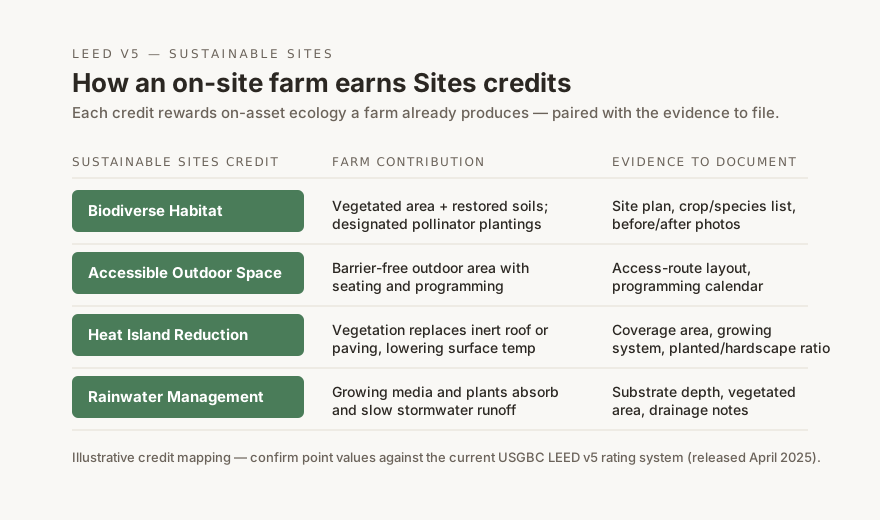
An on-site farm most directly supports the LEED v5 Sustainable Sites credits tied to biodiversity, outdoor space and site resilience — primarily Biodiverse Habitat, Accessible Outdoor Space, Heat Island Reduction and Rainwater Management — because each rewards documented, on-asset ecological features a farm provides. Rather than touching every credit weakly, a farm supplies strong, defensible evidence to the cluster of Sites credits below. The table maps each credit to the farm contribution and the evidence you can actually file.
| LEED v5 Sustainable Sites credit | How an on-site farm contributes | Evidence to document |
|---|---|---|
| Biodiverse Habitat | Adds vegetated area, restores planted soils, and creates designated pollinator habitat through flowering and edible crops | Site plan with farm footprint (m²/ft²), crop/species list, pollinator-planting notes, before/after photos |
| Accessible Outdoor Space | Provides usable, barrier-free outdoor area with seating and community programming for occupants | Layout showing access routes and gathering space, programming calendar, participation records |
| Heat Island Reduction | Replaces inert roof or paved surface with vegetation that lowers surface temperature | Coverage area, substrate/growing-system type, planted vs. hardscape ratio |
| Rainwater Management | Growing media and vegetation absorb and slow stormwater runoff on site | Substrate depth, vegetated area, integration notes with the building's drainage |
| Quality of Life / occupant outcomes | Delivers access to nature, fresh produce and tenant engagement that support the human-health impact area | Tenant-participation counts, harvest/distribution records, survey results |
Two cautions keep the contribution credible. First, the magnitude of any single farm's point impact depends on the rating system, project type and which credits the design already pursues — a farm reinforces the Sites credits it touches rather than guaranteeing a tier upgrade on its own. Second, LEED is documentation-driven: a feature only counts when the design intent and as-built evidence are submitted in the form reviewers expect. Treat an on-site farm as a high-evidence contributor to several Sites credits, scoped in partnership with your LEED reviewer — not a standalone point.
What documentation do LEED reviewers expect?
LEED reviewers expect dated, quantified, verifiable evidence that the farm's vegetated area, habitat features and outdoor space exist as designed — captured continuously, not reconstructed at submission. The most common reason a strong site intervention underperforms in review is thin documentation, so build the paper trail as the installation is designed and operated. Use this checklist as the operating standard for an on-site farm tied to a LEED v5 sites credit.
Farm-to-LEED v5 Sites documentation checklist
- Footprint & design: site or roof plan showing the farm's vegetated area in m²/ft², location, and growing-system or substrate type.
- Biodiversity record: crop and plant species list, designated pollinator plantings, and any habitat features installed.
- Accessible-space layout: drawing showing barrier-free access routes, seating, and the community/gathering area.
- Stormwater & substrate data: growing-media depth and vegetated coverage for rainwater-management and heat-island calculations.
- Programming calendar: dated schedule of harvest days, workshops, and tenant sessions held on site.
- Engagement metrics: attendance counts and tenant-participation totals supporting quality-of-life outcomes.
- Visual evidence: date-stamped before/after and in-season photography of the installation.
- Operating partner: the service agreement and maintenance logs from your farm provider that corroborate the program runs as described.
A professional operator should hand you most of this as a matter of course. Across Microhabitat's installations in North America and Europe, the species lists, harvest logs, programming records and photo documentation produced through routine operation are the same artifacts that support a LEED submission — which is why scoping the farm with certification in mind from day one (covered below) saves significant effort at review. This evidence is also reusable: the same records feed adjacent certifications such as BOMA BEST certification and the WELL v2 Nourishment feature, so one well-documented farm services several frameworks at once — the LEED Sites credit being one piece of a wider green building certifications strategy.
How do you design a farm to maximize LEED contribution?
Design a farm to maximize its LEED contribution by aligning size, planting and programming to the specific Sustainable Sites credits the project is pursuing — and by treating documentation as a deliverable from the outset. The farms that contribute most are not necessarily the largest; they are the ones whose ecological features and data map cleanly onto a targeted LEED v5 sites credit. The elements below help frame a scoping conversation with your LEED consultant, finance and operations.
| Design element | What to define up front | Why it matters for the Sites credit |
|---|---|---|
| Vegetated area & siting | Planted footprint and location on roof or grounds | Sets Biodiverse Habitat, heat-island and rainwater evidence and coverage figures |
| Planting strategy | Inclusion of pollinator and native/flowering species alongside crops | Satisfies the pollinator-habitat requirement central to Biodiverse Habitat |
| Access & layout | Barrier-free paths, seating, and gathering space | Drives the Accessible Outdoor Space credit |
| Operating partner | Who installs, maintains, and reports | Ensures continuous, review-ready documentation |
| Reporting cadence | How species, yield, and participation data are logged | Makes the as-built evidence defensible at submission |
Decide which credits matter before the first bed is installed. If Biodiverse Habitat is the target, the planting plan must include the designated pollinator habitat the credit requires; if Accessible Outdoor Space is in scope, the layout needs barrier-free access and a genuine gathering area, not just rows of planters. Confirm credit applicability, point values and the exact submittal requirements against the current rating system, since these are set by USGBC and vary by project type. Build those requirements into the brief, choose an operator that delivers documentation as a standard deliverable, and the LEED contribution becomes a byproduct of running the farm well rather than a scramble at review. For the authoritative credit language and the latest Sustainable Sites requirements, consult the USGBC LEED v5 rating system and USGBC's overview of how LEED v5 promotes ecological conservation and restoration directly before finalizing your approach.
For property teams, this supports urban farming in commercial real estate.
Ready to turn an on-site farm into documented LEED v5 Sites evidence? Book an ESG consultation with Microhabitat to scope a farm built to support your certification.
Already have green space on site? See which of the 17 certification reports your building qualifies for — eight questions, no account needed.