WELL v2 Nourishment: On-Site Farm Points
Earn WELL v2 nourishment feature points with an on-site farm: how fresh-produce access and food-environment features qualify, plus the evidence WELL needs.
On this page
Quick answer: An on-site urban farm supports the WELL v2 nourishment feature set by putting fresh fruits and vegetables on premises and creating a visible healthy-food environment. It contributes most directly to the Fruits and Vegetables, Food Production, Food Environment and Mindful Eating features — documented through harvest records and occupant access data the certification review accepts.
Part of our guide: Green building certification reports.
For sustainability officers and property managers pursuing certification, the WELL v2 nourishment feature category is one of the most tangible places a physical intervention earns points, because it rewards what a building actually puts in front of its occupants — not a policy on paper. An operating farm produces fresh food, a documented growing program, and a healthy-food amenity people can see and use, which is exactly the kind of implemented evidence WELL's review process is built to credit. This guide explains the Nourishment concept, maps an on-site farm to the specific features it supports, and shows what documentation the standard expects. For the wider strategy, see our pillar guide to ESG-aligned urban farming.
What is the WELL v2 Nourishment concept?
The WELL v2 Nourishment concept is one of the ten concepts in the WELL Building Standard, and it rewards buildings that make fresh, wholesome food easy to access while discouraging less healthy options. According to the International WELL Building Institute (IWBI), which administers the standard, Nourishment "requires the availability of fresh, wholesome foods, limits unhealthy ingredients, and encourages better eating habits and food culture." In practice, that means a project earns points by improving the food environment occupants encounter every day — the produce on offer, the transparency of nutritional information, where food comes from, and the spaces designed for eating well.
WELL organizes each concept into individual features, and Nourishment contains roughly seventeen of them, covering everything from Fruits and Vegetables and Food Production to Mindful Eating, Food Environment, Responsible Food Production and Nutritional Information. Some features are preconditions that all certifying projects must meet; others are optimizations a project chooses to pursue to reach Bronze, Silver, Gold or Platinum certification. The takeaway for property teams is that Nourishment is not a single checkbox — it is a menu of food-environment interventions, several of which an on-site farm directly advances.
Which WELL v2 nourishment feature does an on-site farm support?
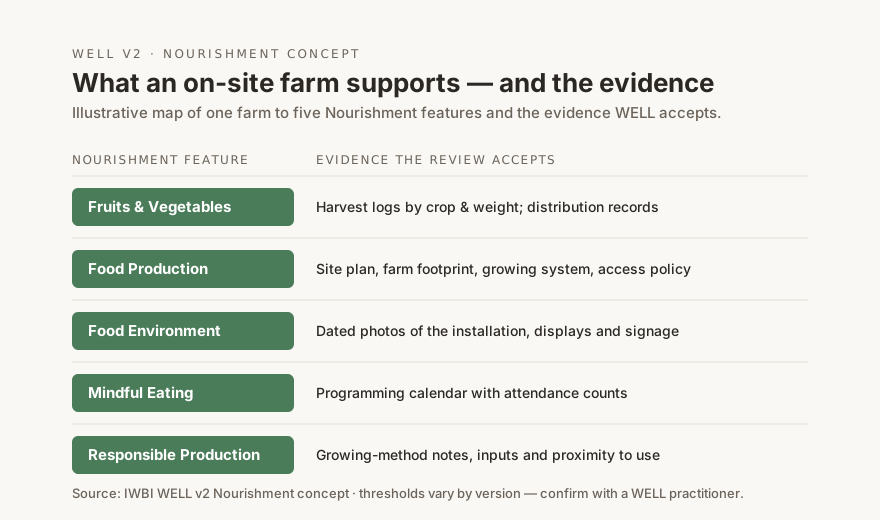
An on-site urban farm most directly supports the WELL v2 nourishment feature set across Fruits and Vegetables, Food Production, Food Environment and Mindful Eating, because each of those rewards exactly what a farm delivers: fresh produce, an on-premises growing program, a healthy-food amenity, and a setting that promotes a better food culture. Rather than spreading thin influence across the whole concept, a farm concentrates credible evidence into a handful of features — which is what makes it a defensible contribution at review rather than a vague wellness gesture. The table below maps the contribution to the documentation you can actually file.
| WELL Nourishment feature | How an on-site farm contributes | Evidence to document |
|---|---|---|
| Fruits and Vegetables | Supplies fresh, on-site-grown fruits and vegetables to occupants, raising the availability and visibility of produce | Harvest logs by crop and weight, distribution records (café, tenant pickup, events) |
| Food Production | Provides a dedicated, occupant-accessible growing space — the feature's core intent — on roof or grounds | Site plan with farm footprint (m²/ft²), growing-system type, crop list, access policy |
| Food Environment | Creates a visible healthy-food presence that nudges choices toward fresh produce within the building | Photos of the installation and produce displays, signage, location relative to dining areas |
| Mindful Eating | Hosts harvest sessions, workshops and tastings that build a healthier food culture and connection to food | Programming calendar, attendance counts, workshop descriptions and feedback |
| Responsible Food Production | Demonstrates local, low-food-mile, often organic-method production on the property itself | Growing-method notes, inputs used, proximity-to-consumption description |
Two cautions keep this credible. First, WELL does not award points for "having a garden" as a line item — points flow through the specific features above only when you meet each feature's stated requirements and supply the evidence. Second, the exact points and thresholds depend on the WELL v2 version and feature parts in force at your registration, so the farm's contribution should always be confirmed against the current feature language with your WELL practitioner. Treat the farm as a strong, multi-feature evidence source within Nourishment — not an automatic certification.
How does fresh-produce access count as documented evidence?
Fresh-produce access counts as WELL evidence when it is captured as dated, quantified records rather than described in general terms, because WELL certification reviews are documentation-led and credit artifacts that are verifiable. A claim that occupants "have access to fresh food" is not reviewable; a harvest log showing kilograms of produce by crop and date, paired with a distribution record and an access map, is. The single most common reason a genuinely healthy program underperforms at review is thin documentation — so the evidence trail should be built as the growing season runs, not reconstructed at submission.
A professional operator should generate most of this as a byproduct of running the farm well. Across Microhabitat's installations in North America and Europe, the routine harvest logs, programming records and date-stamped photography produced through normal operation are the same artifacts a WELL Nourishment submission draws on — which is why scoping the farm with certification in mind from day one (covered below) removes most of the documentation burden. Use this checklist as the operating standard for a farm tied to the WELL v2 nourishment feature category.
Farm-to-WELL Nourishment evidence checklist
- Footprint & system: site plan showing farm area in m²/ft², location, and the growing-system type.
- Access definition: a stated policy for how occupants access produce (café supply, tenant pickup, harvest events) and where the farm sits relative to dining areas.
- Harvest record: yields logged by crop and weight across the season, with dates.
- Distribution record: where the produce went — internal café, tenant distribution, donation — with quantities.
- Programming calendar: dated schedule of harvest days, workshops and tastings, with attendance counts.
- Food culture & signage: descriptions and photos of how the farm is communicated to occupants (signage, displays, education).
- Visual evidence: date-stamped photography of the installation, produce and events across the season.
- Operating partner: the service agreement and maintenance logs from your farm provider, corroborating that the program ran as described.
Can you combine Nourishment with Mind and Community features?
Yes — an on-site farm contributes evidence beyond Nourishment, supporting the WELL Mind and Community concepts at the same time, which is what makes it efficient for a certification budget. The Mind concept rewards features that support mental health and connection to nature, and a farm's greenery, hands-on growing and outdoor amenity feed directly into that intent. WELL's restorative and nature-contact features overlap heavily with the principles of biophilic design in the workplace, so a single installation can document both a food-environment improvement and a nature-connection benefit. The Community concept, in turn, rewards engagement, education and access; the workshops, harvest events and tenant programming a farm runs generate attendance and feedback records that map onto those features.
This cross-concept reach is the practical argument for an on-site farm in a WELL pursuit: one program produces evidence the review can apply across Nourishment, Mind and Community rather than serving a single feature. The same logic extends beyond WELL into other rating systems — the green-space and site-ecology contributions a farm makes are also recognized under the LEED v5 sites credit for urban farms, so a property pursuing both WELL and LEED can scope one installation to feed both submissions and accumulate building certification credits across schemes. Understanding how on-site urban farms work operationally is the first step to mapping a single program onto multiple concepts and frameworks.
How do you plan an on-site farm for WELL certification?
Plan an on-site farm for WELL certification by designing for evidence from the outset — defining the access model, programming and documentation cadence that map cleanly onto the Nourishment features you intend to pursue, and confirming each against the current feature language with your WELL practitioner. The farms that contribute best to certification are not the largest; they are the ones whose produce, access and programming are captured, dated and aligned to the standard. The scoping table below frames the conversation with your sustainability lead, facilities team and finance.
| Element | What to define up front | Why it matters for WELL Nourishment |
|---|---|---|
| Size & location | Vegetated area and siting on roof or grounds, relative to dining areas | Sets the Food Production footprint and Food Environment visibility |
| Access model | How occupants receive produce (café, pickup, events) | Establishes the fresh-produce access the review credits |
| Programming plan | Number and type of harvest sessions and workshops per year | Drives Mindful Eating and Community engagement evidence |
| Operating partner | Who installs, maintains, harvests and reports | Ensures continuous, review-ready documentation |
| Reporting cadence | How harvest, distribution and attendance data are logged | Makes the Nourishment contribution defensible at submission |
Build the documentation requirements into the brief, choose an operator that delivers harvest and programming records as a contractual deliverable, and the WELL Nourishment contribution becomes a byproduct of running the farm well rather than a scramble before review. For the authoritative feature definitions, preconditions and current requirements, consult the International WELL Building Institute's Nourishment concept directly before finalizing your certification approach, and confirm the applicable feature parts with your WELL practitioner.
For property teams, on-site farms make the case for rooftop farms on office towers.
Ready to scope an on-site farm built to support the WELL v2 nourishment feature set? Book an ESG consultation with Microhabitat to design a farm aligned to your certification goals.
Already have green space on site? See which of the 17 certification reports your building qualifies for — eight questions, no account needed.