BOMA BEST & Urban Farms: Scoring Guide
How urban farms contribute to your BOMA BEST certification score: which questionnaire categories on-site agriculture supports, and how to document it.
On this page
Quick answer: An on-site urban farm supports BOMA BEST certification primarily through its site, biodiversity, and stakeholder-engagement categories. By adding managed green space and tenant programming, a building generates documented evidence for several BOMA BEST questionnaire items, raising its overall score and helping it reach a higher certification level.
Part of our guide: Green Certification: Turning Properties into Green Assets.
A rooftop or grounds farm rarely earns a building its BOMA BEST certification on its own. But it is one of the few capital-light interventions that touches multiple scoring categories at once — environmental management, site stewardship, and tenant engagement — while producing the kind of operating records assessors want to see. For property managers already pursuing ESG-aligned urban farming, understanding exactly where a farm maps onto the questionnaire turns a "nice amenity" into measurable certification points. This guide breaks down what BOMA BEST measures, the categories a farm contributes to, and how to document it so the contribution actually counts.
What does BOMA BEST certification measure?
BOMA BEST certification measures the environmental performance and management practices of existing commercial buildings through a structured online questionnaire, administered by BOMA Canada. According to BOMA Canada, the program is the largest environmental assessment and certification program for existing buildings in Canada, with thousands of certified properties spanning office, retail, light industrial, and multi-unit residential asset classes.
Rather than scoring a building purely on energy modelling, BOMA BEST evaluates both performance (measured outcomes like energy and water intensity) and management (the policies, plans, and procedures a building has in place). The current Sustainable Buildings version organizes its questions into key areas covering energy, water, air, comfort, health and wellness, custodial, waste, and site — alongside an overarching environmental management framework. Buildings earn points across these areas, and the total determines a certification level: Certified, Bronze, Silver, Gold, or Platinum. Because it weighs documented management practices, not just utility bills, BOMA BEST rewards initiatives — like a managed on-site farm — that demonstrate active environmental stewardship and occupant engagement.
Which BOMA BEST categories does an urban farm contribute to?
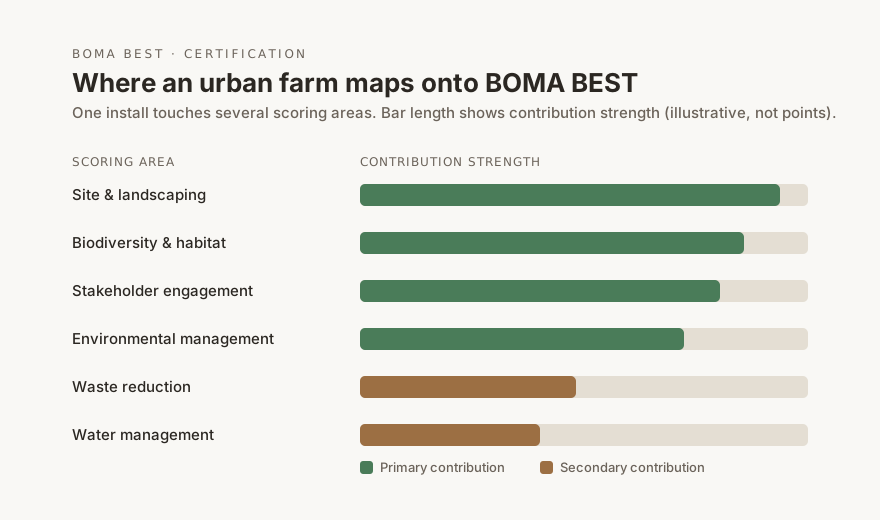
An urban farm contributes most directly to the site, environmental management, and stakeholder/occupant engagement dimensions of BOMA BEST, with secondary contributions to waste and water management. It does not generate energy-efficiency points, so it should be positioned as a complement to — not a substitute for — building-systems upgrades.
The value of a farm is that a single installation creates evidence across several questionnaire areas at once. A rooftop or ground-level growing space is, simultaneously, a landscaping and site-management feature, a biodiversity and habitat asset, an organic-waste diversion endpoint (via on-site composting), and a tenant-programming amenity. The table below maps the typical contributions. Treat it as a planning aid; confirm the exact wording and point values against your building's current questionnaire, since BOMA Canada periodically revises the assessment.
| BOMA BEST area | How an on-site urban farm contributes | Evidence to capture |
|---|---|---|
| Site & landscaping | Replaces conventional or low-value surfaces with productive, low-input managed green space; supports native and pollinator planting | Site plan, planting list, square footage, maintenance schedule |
| Biodiversity & habitat | Adds pollinator forage and habitat; introduces plant diversity on otherwise sealed surfaces | Species list, pollinator features, photos across seasons |
| Environmental management | Demonstrates an active, documented sustainability initiative with measurable goals | Management plan, seasonal objectives, harvest logs |
| Waste reduction | Diverts organic waste through on-site composting used as growing medium | Composting records, volumes diverted, waste-audit notes |
| Water management | Can incorporate rainwater capture or efficient irrigation for the growing area | Irrigation specs, water-source description, usage logs |
| Stakeholder engagement | Provides tenant workshops, volunteer harvest days, and produce donations | Event calendar, attendance, communications, donation receipts |
For a fuller picture of how on-site urban farms work day to day — installation, growing seasons, and the maintenance model behind these records — see our overview.
How does farm activity map to specific questionnaire items?
Farm activity maps to questionnaire items by converting ongoing operations into the documented policies, plans, and measured outcomes that BOMA BEST assessors score. The principle is that BOMA BEST frequently awards points for having a plan and tracking it, not merely for a one-time installation — so the recurring activity a farm generates is what aligns with the questions.
In practical terms, four operating streams line up with the questionnaire:
- Site and grounds management. A farm's planting plan, species list, and seasonal maintenance schedule answer site-stewardship and landscaping questions about how outdoor and amenity space is managed and what proportion supports vegetation or habitat.
- Organic-waste diversion. On-site composting that feeds the farm's growing medium provides evidence for waste-management and diversion questions — particularly where the building can report organic volumes kept out of the landfill.
- Tenant and community engagement. Workshops, volunteer harvest days, and produce donations supply attendance records and communications that answer occupant-engagement and community-involvement items.
- Environmental policy and reporting. A documented farm management plan with seasonal objectives and harvest data slots into the environmental-management framework, demonstrating continuous improvement rather than a static feature.
This is the same logic that lets a farm contribute to other frameworks — it earns points where a credit rewards documented site, biodiversity, and engagement activity. The mechanics differ by scheme: under the LEED v5 sites credit the emphasis is on open space and ecological quality, while GRESB sustainability reporting rewards portfolio-level data coverage and stakeholder programs. The common thread is documentation discipline.
How do you document an urban farm's contributions for certification?
You document an urban farm's contributions by maintaining a dated evidence pack that pairs each claim with a verifiable record, assembled across the growing season rather than reconstructed at audit time. BOMA BEST submissions are verified, so unsupported claims do not score — the difference between points earned and points lost is almost always the quality of documentation.
Build the evidence pack around this checklist:
- Site documentation — a site or roof plan showing the farm footprint, total growing area in square metres or feet, and the planting list (including native and pollinator species).
- Management plan — a written plan stating the farm's environmental objectives, maintenance responsibilities, and seasonal schedule.
- Harvest and activity logs — dated records of harvests, yields where tracked, and growing cycles that show the space is actively operated.
- Waste diversion records — composting volumes and a description of how organic material is captured and reused on site.
- Water records — irrigation method, water source, and any rainwater-capture details.
- Engagement records — a calendar of tenant workshops and volunteer days, attendance figures, internal communications, and produce-donation receipts.
- Photographic evidence — seasonal photos demonstrating the farm is established, planted, and in use across the year.
A managed-farm operator typically maintains these records as a standard part of service delivery, which removes most of the documentation burden from the property team — a meaningful advantage when an assessment deadline approaches. Across Microhabitat's installations in North America and Europe, this operating-records discipline is built into how each farm is run, precisely because the data has value well beyond a single certification cycle.
How do you maximize your BOMA BEST score with an urban farm?
You maximize your BOMA BEST score by treating the farm as an integrated environmental program — not a standalone amenity — and by deliberately capturing evidence for every category it touches. The single biggest lever is intentionality: a farm planned with the questionnaire in mind earns more recognized points than the same farm planned only as a perk.
Four practices compound the contribution:
- Map to the questionnaire before you install. Identify the specific site, waste, water, and engagement questions the farm can support, then design records to answer them from day one.
- Use on-site composting to close the waste loop. Routing organic waste into the farm's growing medium turns a single feature into evidence for both site and waste-diversion questions.
- Program for tenants on a schedule. Recurring workshops and harvest days generate the attendance and communications records that engagement questions reward, while also lifting tenant satisfaction.
- Pair the farm with systems improvements. Because the farm does not earn energy points, combine it with efficiency upgrades so site and engagement gains stack on top of performance gains.
Done well, an on-site farm becomes one of the most cost-effective ways to strengthen the site, biodiversity, and stakeholder dimensions of your BOMA BEST certification — while producing a story tenants and investors can see, not just read in a report. BOMA BEST is one entry in our wider green building certifications hub, which maps how a single farm supports several schemes at once.
For property teams, on-site farms are a practical lever for urban farming in commercial real estate.
Ready to turn an on-site farm into documented BOMA BEST points? Book an ESG consultation with Microhabitat to map a farm to your building's questionnaire and certification goals.
Already have green space on site? See which of the 17 certification reports your building qualifies for — eight questions, no account needed.