CSRD Biodiversity Reporting for Real Estate
A practical guide to CSRD biodiversity reporting for real estate: what ESRS E4 actually requires, and how on-site nature features support your disclosures.
On this page
Quick answer: CSRD biodiversity reporting requires real estate companies to disclose their impacts and dependencies on nature under ESRS E4. On-site urban farms provide concrete, measurable biodiversity actions — added habitat, green space and species support — that give property owners reportable evidence and a credible improvement narrative for their disclosures.
For property managers and sustainability officers, CSRD biodiversity reporting is one of the few disclosure areas where a physical, on-the-ground intervention translates directly into reportable evidence — not just a policy statement. The Corporate Sustainability Reporting Directive moves biodiversity from a "nice to mention" line in a brochure to a regulated disclosure with defined datapoints, and real estate sits squarely in scope because buildings occupy, seal and fragment land. This guide explains what ESRS E4 actually asks for, where reporting gets hard for property owners, and how an on-site farm turns a soft sustainability ambition into auditable data. For the wider strategy, see our pillar guide to ESG-aligned urban farming.
What does CSRD and ESRS E4 require real estate to disclose?
CSRD requires in-scope companies to report biodiversity through ESRS E4, the European Sustainability Reporting Standard covering biodiversity and ecosystems, whenever the topic is material under double materiality. The Corporate Sustainability Reporting Directive is the EU law that, in the European Commission's own words, requires companies above a certain size to disclose "the impact of their activities on people and the environment" as well as the risks those issues create for the business. ESRS E4 is the specific standard that operationalizes biodiversity within that regime.
The standard is organized around a set of disclosure requirements rather than a single metric. At a high level, ESRS E4 asks an undertaking to describe its biodiversity transition plan (E4-1) — including how it responds to the Kunming-Montreal Global Biodiversity Framework — its policies (E4-2), its actions and the resources allocated to them (E4-3), its targets (E4-4), and the metrics describing its impacts on the state of species and the condition of ecosystems (E4-5). Underpinning all of it is the materiality assessment set out in ESRS 2 (IRO-1), where a company identifies its impacts, dependencies, risks and opportunities on nature. The takeaway for property owners is structural: ESRS E4 rewards documented action and quantified evidence, not intentions — exactly the kind of artifact a physical on-asset program can generate.
Who must report under CSRD, and when?
CSRD applies to large companies and listed companies that meet the EU's size thresholds, with the obligation phasing in over several years and biodiversity (ESRS E4) reported wherever it is assessed as material. Many large real estate owners, REITs, asset managers and corporate occupiers fall in scope directly; others are pulled in indirectly, because in-scope clients, lenders and investors increasingly request the same nature data down their value chain. Even property teams that are not first-wave reporters are being asked for biodiversity evidence today.
Two points matter for planning. First, the regulatory timetable and thresholds have been subject to revision at the EU level — so the authoritative source for who reports when is the European Commission's CSRD page and your own auditor, not a blog. Second, materiality is the real trigger for E4: a company in scope of CSRD only produces the full ESRS E4 disclosures if biodiversity is material to it under the double-materiality test. For most real estate portfolios — which physically alter land and depend on ecosystem services like water and pollination — biodiversity is difficult to dismiss as immaterial, which is why a credible action and evidence base is worth building now rather than at the filing deadline.
Where does biodiversity reporting get hard for property owners?
Biodiversity reporting gets hard for property owners because nature is local, hard to quantify, and rarely measured in the building's existing data systems — unlike energy, which is metered. A real estate company can pull kilowatt-hours from a utility bill, but it usually has no equivalent feed for habitat area, species presence or ecosystem condition on its sites. That gap creates three recurring problems at disclosure time.
- No baseline. ESRS E4 expects you to describe impacts on the state of species and the condition of ecosystems. Without a starting measurement, there is nothing to report against and no way to show progress.
- Thin, retrospective evidence. Teams often try to reconstruct biodiversity actions at filing time, producing vague claims ("we support green space") that are neither dated, quantified, nor auditable — and assurance providers increasingly probe exactly this.
- Actions that don't map to datapoints. A landscaping contract or a one-off tree planting is real, but if it isn't captured as a quantified, located, ongoing program, it is hard to slot into the E4 actions and metrics structure.
The deeper issue is that biodiversity disclosure spans frameworks. The same underlying nature data feeds CSRD's ESRS E4 and the voluntary TNFD nature disclosure framework that many property owners use to structure their risk and opportunity assessment — so fragmented, undocumented actions cost you twice. The property teams that struggle least are the ones running a defined, measurable nature intervention they control end to end.
How do on-site nature features support CSRD biodiversity reporting disclosures?
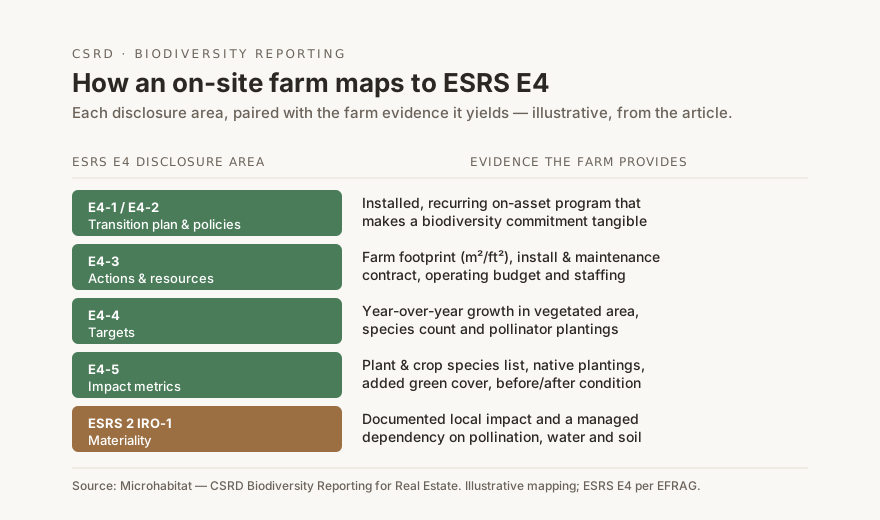
On-site nature features support CSRD biodiversity reporting by converting an abstract obligation into a concrete, located, measurable program — which is precisely the form ESRS E4 evidence needs to take. An operating urban farm on a roof or ground-level site is an implemented action by definition: it occupies a defined footprint, introduces plant and pollinator habitat onto otherwise sealed or inert surface, runs on a documented schedule, and produces data as a byproduct of normal operation. That maps cleanly onto the E4 disclosure requirements, as the table below shows.
| ESRS E4 disclosure area | What it asks for | Evidence an on-site urban farm provides |
|---|---|---|
| E4-1 Transition plan / E4-2 Policies | How the company responds to biodiversity loss; stated policies | A biodiversity-positive commitment made tangible by an installed, recurring on-asset program |
| E4-3 Actions & resources | Specific actions taken and resources allocated | Farm footprint (m²/ft²), install and maintenance contract, annual operating budget and staffing |
| E4-4 Targets | Measurable biodiversity targets | Year-over-year expansion of vegetated area, species count, pollinator plantings and habitat features |
| E4-5 Impact metrics (state of species / ecosystem condition) | Quantified impacts on species and ecosystems | Crop and plant species list, native/pollinator plantings, added green coverage, before/after site condition |
| ESRS 2 IRO-1 (materiality) | Impacts, dependencies, risks and opportunities | A documented positive local impact and a managed dependency on pollination, water and soil health |
A few honest caveats keep this credible. A single urban farm does not, by itself, discharge a portfolio's entire ESRS E4 obligation, and CSRD does not award "credit for a garden" as a line item — the value flows through the disclosure requirements above when you supply quantified, dated evidence. Understanding how on-site urban farms work operationally is what lets you scope the program so its outputs line up with the datapoints you actually have to report. Treat the farm as a high-evidence, controllable contributor to several E4 requirements at once — not a compliance silver bullet.
How do you turn farm data into reportable evidence?
Turn farm data into reportable evidence by capturing it continuously and quantitatively throughout the year, not by reconstructing it at submission — ESRS E4 credits artifacts that are dated, located, and measurable. The single most common reason a genuine biodiversity action underperforms in a disclosure is thin documentation, so build the paper trail as the season runs. Use this checklist as the operating standard for an on-site farm tied to CSRD biodiversity reporting.
Farm-to-ESRS-E4 documentation checklist
- Footprint & design: site plan showing the vegetated area in m²/ft², location on the asset, and growing-system type — your E4-3 action baseline.
- Biodiversity record: crop and plant species list, native and pollinator plantings, and habitat features installed — core E4-5 species/condition evidence.
- Baseline & change: date-stamped before/after documentation of the surface (sealed roof vs. vegetated), so improvement is provable across reporting years.
- Targets log: the planned year-over-year expansion in coverage, species or habitat features that supports your E4-4 targets.
- Resources record: install contract, maintenance schedule, annual operating budget and staffing — the "resources allocated" half of E4-3.
- Dependencies note: how the farm relies on and supports pollination, water and soil health, feeding the ESRS 2 IRO-1 materiality narrative.
- Operating partner evidence: the service agreement and maintenance logs from your farm provider, which corroborate that the program ran as described.
A professional operator should hand you most of this as a deliverable rather than a favor. Across Microhabitat's installations in North America and Europe, the species lists, footprint records, photo documentation and maintenance logs generated through routine operation are the same artifacts that feed a sustainability disclosure — which is why scoping the farm with reporting in mind from day one saves significant effort at filing time. This evidence also compounds beyond E4: the same located nature data supports adjacent frameworks, including Scope 3 nature-based solutions narratives where shortened produce supply chains and added vegetation contribute to value-chain impact reporting — part of the wider green building certifications picture an in-scope owner is managing.
How do you build a credible biodiversity narrative?
Build a credible biodiversity narrative by reporting documented progression on specific datapoints — more vegetated area, more species, fuller records — rather than asserting an unquantified "commitment to nature." CSRD assurance and informed readers both reward a believable, evidence-backed trajectory over a single dramatic claim, and they penalize anything that reads as greenwash. An on-site farm suits this well precisely because its outputs accumulate: year one establishes the baseline (footprint, species, the inaugural plantings), and subsequent years tell a story of change — expanded coverage, added pollinator habitat, growing species counts — which is exactly the directional, quantified progress ESRS E4 is built to capture.
Keep three principles front of mind. Quantify, don't adjective: "added 400 m² of pollinator-supporting vegetated area with 30+ plant species" is reportable; "we love nature" is not. Don't overclaim scope: describe the farm as a material, on-asset biodiversity action, not as proof of a nature-positive portfolio. Cite the standard, not a vibe: ground your disclosure in the actual ESRS E4 requirements as published by EFRAG, and confirm scope and timing against the European Commission. Done this way, the farm becomes a byproduct of running the building well that happens to produce first-class disclosure evidence — and a defensible, audit-ready biodiversity story instead of a liability.
For property teams, on-site farms are a practical lever for urban farming in commercial real estate.
Ready to turn an on-site farm into documented ESRS E4 evidence? Book an ESG consultation with Microhabitat to scope a biodiversity program built for your CSRD disclosure.
Already have green space on site? See which of the 17 certification reports your building qualifies for — eight questions, no account needed.