TNFD Nature Disclosure for Property Owners
What property owners need to know about TNFD nature disclosure: the LEAP approach explained, what to report, and how on-site nature features support it.
On this page
Quick answer: TNFD nature disclosure asks organizations to assess and report their nature-related dependencies, impacts, risks and opportunities using the LEAP approach. For property owners, on-site urban farms create tangible nature-positive actions and location-specific data that strengthen the "opportunities" and impact-management sides of a TNFD disclosure.
For property managers and sustainability officers, TNFD nature disclosure is the framework that extends the climate-reporting logic of TCFD to the wider question of nature — and real estate sits squarely in scope because buildings occupy, seal and depend on land. The Taskforce on Nature-related Financial Disclosures gives the market a structured way to report how a business relies on and affects ecosystems, and an on-site farm is one of the few interventions that produces concrete, located evidence for that report rather than another policy statement. This guide explains what TNFD is, walks through the LEAP approach in plain terms, and shows where a physical nature program credibly fits. For the wider strategy this sits inside, see our pillar guide to ESG-aligned urban farming.
What is TNFD, and why should property owners care?
TNFD is the Taskforce on Nature-related Financial Disclosures, a global framework that helps organizations assess and report their nature-related dependencies, impacts, risks and opportunities — and property owners should care because buildings both depend on and affect the ecosystems around them. Launched to do for nature what the TCFD did for climate, the TNFD published its final recommendations in September 2023, structured around the same four pillars the market already knows from climate reporting: Governance, Strategy, Risk and Impact Management, and Metrics and Targets. The TNFD recommendations are designed to slot into mainstream corporate reporting rather than sit beside it as a separate exercise.
The reason this lands on real estate desks is structural. Property portfolios physically alter land — sealing surfaces, fragmenting habitat — and depend on ecosystem services such as water, pollination and a stable climate. That makes nature a material topic for most owners, not an abstract one. Investors, lenders and in-scope corporate tenants are increasingly asking for the same nature data down their value chains, which means even teams that are not formally reporting under TNFD are being asked to evidence their nature impacts today. Building a credible, documented nature action now is far easier than reconstructing one at a reporting deadline.
What is the LEAP approach in plain terms?
The LEAP approach is TNFD's recommended four-phase process for a nature assessment — Locate, Evaluate, Assess, Prepare — that takes an organization from "where do we interface with nature?" to a disclosure-ready set of risks, opportunities and metrics. It is the practical engine behind the framework: the four pillars say what to disclose, while LEAP is how you generate the underlying analysis. The phases run in sequence, each building on the last.
- Locate your interface with nature: identify which assets and activities sit in or near ecologically sensitive areas and which ecosystems they touch.
- Evaluate your dependencies and impacts: determine how the business relies on nature (water, pollination, soil) and how it affects it (land use, habitat change).
- Assess the risks and opportunities that flow from those dependencies and impacts, including how material they are to the business.
- Prepare to respond and report: set actions, targets and metrics, and disclose against the four TNFD pillars.
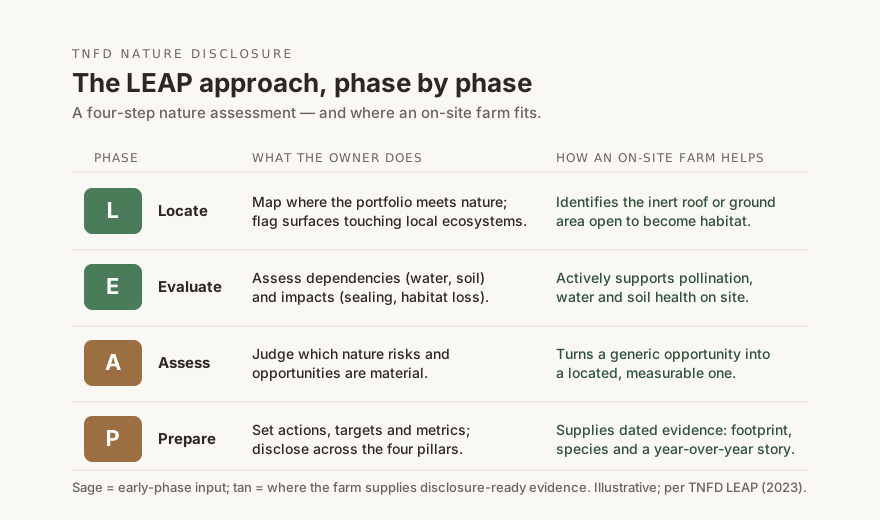
For a property owner, LEAP is less daunting than it first looks because much of the input is site-specific and physical. The table below maps each LEAP phase to a concrete action at the building level — and to the role an on-site farm can play — which is also the featured-snippet-ready summary of the process.
| LEAP phase | What the property owner does | How an on-site farm supports it |
|---|---|---|
| Locate | Map the portfolio's interface with nature; flag assets in or near sensitive areas and identify the surfaces (sealed roofs, grounds) that touch local ecosystems | Identifies the otherwise-inert roof or ground area available to be converted into managed habitat |
| Evaluate | Assess dependencies (water, pollination, soil, climate) and impacts (land sealing, habitat loss) at the asset level | Demonstrates a managed dependency on, and active support of, pollination, water and soil health on site |
| Assess | Judge which nature-related risks and opportunities are material to the asset and portfolio | Converts a generic "opportunity to improve nature" into a specific, located, measurable one |
| Prepare | Set actions, targets and metrics; disclose across Governance, Strategy, Risk & Impact, Metrics & Targets | Supplies dated evidence — footprint, species, habitat features — and a year-over-year improvement narrative |
What are the nature-related impacts and opportunities for buildings?
Buildings carry both nature-related impacts — chiefly land use, surface sealing and habitat fragmentation — and dependencies on ecosystem services like water management, pollination and climate regulation, and TNFD asks owners to report both sides honestly. On the impact side, a commercial property typically replaces living surface with impervious roof and hardstanding, which removes habitat, increases runoff and contributes to the urban heat-island effect. On the dependency side, the same asset relies on functioning ecosystems — for stormwater absorption, for the broader food and water systems its occupants use, and for a stable local climate — so degradation of nature is a genuine, if often unpriced, business risk.
The opportunity side is where property teams have the most agency, and it is the side a physical program speaks to directly. Adding managed vegetated area turns a net-negative surface into one that supports pollinators, provides green amenity, and creates the kind of nature-positive evidence TNFD's "opportunities" and impact-management disclosures reward. Crucially, the data this generates is reusable across frameworks: the same dependency-and-impact picture that anchors a TNFD disclosure also feeds CSRD biodiversity reporting under ESRS E4, so one well-scoped nature action services several obligations at once rather than being a single-use compliance cost.
How do on-site farms support TNFD nature disclosure?
On-site farms support TNFD nature disclosure by converting an abstract nature-related opportunity into a concrete, located, measurable program — exactly the form of evidence the LEAP "Assess" and "Prepare" phases need. An operating urban farm is a nature-positive action by definition: it occupies a defined footprint, introduces plant and pollinator habitat onto sealed or inert surface, runs on a documented maintenance schedule, and produces ecological data as a byproduct of normal operation. That gives a property team something rare in nature reporting — a managed intervention it controls end to end, with outputs that map directly onto the disclosure pillars.
The contribution is strongest, and most defensible, on three pillars in particular. Under Strategy and Risk & Impact Management, the farm is a documented response to identified nature impacts — a real action, not an intention. Under Metrics and Targets, it yields the species lists, footprint figures, habitat features and year-over-year change that quantified targets require. And it materially strengthens the opportunities narrative, because a nature-positive action that occupants can see and participate in is more credible than a desktop commitment. Understanding how on-site urban farms work operationally is what lets you scope the program so its outputs line up with the LEAP analysis you actually have to produce.
Two honest caveats keep this credible. First, a single farm does not, by itself, discharge a portfolio's entire TNFD assessment — the framework is portfolio-wide, and LEAP still requires you to locate and evaluate every material interface with nature. Second, TNFD does not award "credit for a garden"; the value flows through the recommendations when you supply quantified, dated evidence. Treat the farm as a high-evidence, controllable contributor to several disclosure requirements — not a substitute for the assessment itself.
How does TNFD differ from TCFD, and is it mandatory?
TNFD extends the structure of TCFD from climate to the broader topic of nature — using the same four pillars (Governance, Strategy, Risk & Impact Management, Metrics & Targets) — but it is materially harder because nature is local, multi-dimensional and far less metered than carbon, and it is currently voluntary in most jurisdictions rather than mandated. Where TCFD reporters track a relatively standard unit (tonnes of CO₂e), TNFD reporters must handle dependencies and impacts that vary by location and ecosystem, which is why the LEAP "Locate" phase has no real equivalent in climate reporting. The two frameworks are deliberately aligned so that a company already reporting under TCFD can extend its governance and disclosure machinery to nature rather than rebuild it.
On the mandatory question, the honest answer is "voluntary today, but converging with regulation." The TNFD recommendations are a voluntary, market-led framework, and adoption is something organizations opt into and publicly state. In parallel, mandatory regimes are moving in the same direction — the EU's CSRD already requires biodiversity disclosure under ESRS E4 for in-scope companies, and many owners use TNFD to structure the underlying assessment that feeds those mandatory reports. The practical implication for property teams is to treat TNFD as the organizing framework for nature data now, because the same evidence increasingly satisfies both voluntary disclosure and tightening regulation. For the authoritative position on scope, structure and updates, consult the TNFD directly rather than relying on summaries.
How do property owners get started with TNFD-aligned reporting?
Property owners get started with TNFD-aligned reporting by running a first-pass LEAP assessment at the portfolio level, then deploying and documenting concrete nature actions where the analysis shows material impact or opportunity — capturing evidence continuously rather than reconstructing it at filing. The most common reason a genuine nature action underperforms in a disclosure is thin documentation, so build the record as the program runs. A practical sequence looks like this:
- Run a first-pass LEAP screen. Locate which assets touch sensitive or relevant ecosystems and evaluate the headline dependencies and impacts — you do not need perfect data to identify where nature is material.
- Prioritize material assets. Focus action and reporting effort on the sites and activities where impacts and opportunities are greatest, rather than spreading thin.
- Deploy a concrete nature action. Install a measurable, located intervention — an on-site farm or managed habitat — on a material asset, designed from day one to produce reportable evidence.
- Capture LEAP-ready evidence continuously. Log the footprint (m²/ft²), species and pollinator plantings, habitat features, dated before/after photography, and the maintenance and dependency records throughout the season.
- Set targets and disclose against the four pillars. Translate the action into year-over-year targets and metrics, and report it under Governance, Strategy, Risk & Impact Management, and Metrics & Targets.
A professional operator should hand you most of the underlying records as a deliverable rather than a favor. Across Microhabitat's installations in North America and Europe, the species lists, footprint records, photo documentation and maintenance logs generated through routine operation are the same artifacts a nature disclosure needs — which is why scoping the farm with reporting in mind from the start saves significant effort later. That evidence also compounds across frameworks: the same located nature data supports Scope 3 nature-based solutions narratives and CSRD biodiversity disclosures, so a single well-documented program earns its keep several times over — and feeds the voluntary green building certifications many owners pursue in parallel.
For property teams, on-site farms are a practical lever for urban farming in commercial real estate.
Ready to turn an on-site farm into documented TNFD evidence? Book an ESG consultation with Microhabitat to scope a nature program built for your LEAP assessment and disclosure.
Already have green space on site? See which of the 17 certification reports your building qualifies for — eight questions, no account needed.