How to Become an Urban Farmer
The core skills, the education that helps, and the first practical steps to start growing food and build a career in 2026.
On this page
Quick answer: To become an urban farmer, learn the core growing skills through volunteering or an internship, build hands-on experience across a full growing season, then prove your reliability with a small project or portfolio before applying for paid roles. Formal education helps but is rarely required — demonstrated growing ability and consistency matter most.
If you want to grow food in the city and turn it into a career, learning how to become an urban farmer is far more achievable than most people assume — and 2026 is a strong year to start. The barrier to entry is low, the work is concrete and hands-on, and demand is rising as corporate property owners, real-estate firms, and municipalities install productive farms on rooftops and unused ground space. You do not need a four-year degree or a rural background. You need to actually grow things, show up reliably through a season, and build enough proof to get hired. This guide breaks the path into five practical steps, answers the questions people ask most, and shows you exactly where the paid roles are. If you are brand new to the field, it helps to first understand what urban farming involves before deciding which step matters most for you.
Step 1: How do I learn the core urban farming skills?
You learn the core urban farming skills by getting your hands in the soil and practicing the full crop cycle — seeding, transplanting, watering, pest identification, and harvest timing — on real plants, not just in theory. The fastest way to start is to grow something now: a container garden on a balcony, a community-garden plot, or a few raised beds. The goal is to be able to say "I have grown X, start to finish" with confidence in an interview.
Urban farming sits at the intersection of horticulture and a service business, so the skill set is broader than backyard gardening. Beyond the plants themselves, employers value comfort with drip irrigation, hand tools, basic record-keeping, and — increasingly — the apps and sensors used to log crop and yield data. Because many urban farms operate on client rooftops and corporate grounds, communication and professionalism matter as much as green thumbs. The table below is a practical checklist of what to learn first.
Core urban farming skills checklist:
| Skill area | What to learn | Why it matters |
|---|---|---|
| Crop fundamentals | Seeding, transplanting, watering, harvest timing for leafy greens, herbs, tomatoes | The non-negotiable base of every growing role |
| Plant health | Identifying pests, disease, and nutrient stress early | Catching problems early protects an entire season's yield |
| Irrigation & tools | Drip systems, hand tools, basic timers and setup | Most sites run on irrigation; tool fluency speeds you up |
| Soil & substrate | Soil health, compost, container and rooftop growing media | Rooftop and container growing differs from in-ground farming |
| Record-keeping | Logging planting dates, yields, and observations | Managed farms run on data; clean records stand out |
| Communication | Talking to tenants, building managers, and the public | Work happens on client properties, not isolated fields |
You do not need every skill on day one. Start with crop fundamentals and plant health — those are what get you hired — and add the rest on the job. Free and low-cost learning is everywhere: extension programs, gardening nonprofits, YouTube, and local farms that welcome volunteers.
Step 2: Should I volunteer or do an urban farming internship?
Yes — volunteering or doing an internship is the single most effective way to gain real urban farming experience, because it puts you on a working farm where you learn the crops, the rhythm, and the standards employers expect. Hiring managers in this field consistently value demonstrable hands-on experience over credentials, and a season of farm work — paid or unpaid — is the clearest signal that you can handle the physical, weather-exposed reality of the job.
A structured internship is especially valuable because it gives you mentorship, a defined learning arc, and a reference. Many urban farms, food-systems nonprofits, and controlled-environment operators run seasonal programs designed to take beginners and teach them the trade. If a formal program is an option for you, our guide to landing an urban agriculture internship walks through where to find them and how to apply. If a full internship is not realistic, a recurring volunteer shift at a community farm achieves much of the same thing: consistent reps, a network, and proof of reliability.
Aim to experience a full growing season if you can. One season — spring planting through fall harvest — teaches you the arc of the work in a way that a few scattered weekends cannot. Showing up on time, every shift, through heat and rain, is exactly the reliability that farm employers screen for, and a season demonstrates it better than any certificate.
Step 3: Do you need a degree to be an urban farmer?
No, you do not need a degree to be an urban farmer — most entry-level urban farming roles hire on practical growing ability, reliability, and physical capacity rather than formal credentials. A degree becomes genuinely useful only as you move into specialized or senior positions such as agronomy, food-systems planning, or operations management, where a background in horticulture, environmental science, or business adds real leverage.
This is one of the most attractive features of the field for career-changers and students: the fastest route to becoming hireable is not a four-year program — it is demonstrable, hands-on experience. That said, short, affordable education can accelerate your path and help you stand out. A horticulture certificate, a permaculture design course, a food-safety credential, or coursework in soil science signals seriousness and gives you vocabulary employers recognize. The right framing is that credentials accelerate a career in urban farming but rarely gate the first job.
Public resources make this easier than ever. The USDA's Beginning Farmers and Ranchers hub lays out a clear six-step process for starting a farm operation and connects new growers with state-level Beginning Farmer Coordinators, funding programs, and educational webinars. The USDA defines a "beginning farmer" as anyone who has operated a farm for less than ten years — a deliberately wide door. Pair that with a local extension program or a community college horticulture course, and you can build credible, recognized skills for very little money.
Step 4: How to become an urban farmer with credibility — building a portfolio
The next part of how to become an urban farmer is building credibility, and you do that by completing one small, finish-able project and documenting it — turning "I want to farm" into "here is what I have grown." Credibility in this field is concrete: it is photos of a season's harvest, a tidy growing log, a reference from a farm you volunteered at, and the vocabulary to talk about crops, pests, and irrigation like someone who has done the work.
Start a deliberate project you can point to. Grow out a full bed of leafy greens or herbs from seed to harvest, keep a simple log of planting dates and yields, and photograph the progress. If you completed an internship or a recurring volunteer role, ask your supervisor for a short reference. Stack one credential on top — a food-safety certificate or a horticulture short course — and you have a profile that reads as serious to any hiring manager. The combination matters more than any single piece.
Decide, too, which path you are building toward, because it shapes your portfolio:
- Employment path — you want a paid role on someone else's farm. Emphasize reliability, transferable work history (landscaping, construction, hospitality, and logistics all count), and your hands-on growing reps. Target the skills the urban farming jobs market actually screens for.
- Independent path — you want to grow on your own plot, sell at a market, or start a micro-operation. Emphasize business basics, a viable site, and a crop plan. The USDA beginning-farmer resources above are built for exactly this route, including funding and planning tools.
Most people start on the employment path — it pays you to learn, removes the risk of running your own operation, and builds the network that makes an independent venture viable later.
Step 5: How do I find paid urban farming work or launch my project?
You find paid urban farming work by applying to seasonal and technician roles in late winter and early spring, when urban farms staff up for the growing season — and by applying directly to the companies that install and maintain commercial farms. These operators expect to train motivated beginners, so the door is genuinely open even if this is your first season. Follow these final steps:
- Apply early and seasonally. Watch the careers pages of urban farming companies and submit applications in late winter, before spring hiring closes. Seasonal grower and technician roles are the intended entry points.
- Apply directly to urban farming operators. Companies that install and run farms on commercial rooftops and corporate grounds — like Microhabitat — hire seasonal crews and technicians across multiple cities each year. Apply to them first; they are built to onboard newcomers.
- Lead with reliability and attitude. In interviews, emphasize that you show up, you can handle physical outdoor work, and you genuinely care about food and sustainability. Polished farming credentials matter less than coachability.
- Translate adjacent experience. Landscaping, construction, hospitality, warehousing, and logistics all transfer — they prove physical stamina, customer interaction, and dependability.
- Or launch small. If you are pursuing the independent path, use the USDA Urban Agriculture initiative — which funds urban growers and runs dedicated offices and grant programs — to plan a modest first plot before scaling.
How much do urban farmers earn?
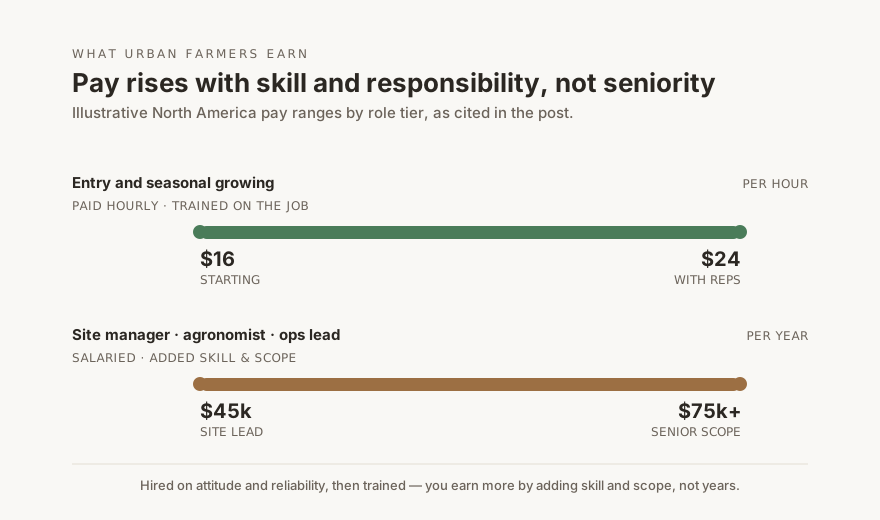
Urban farmers in North America typically earn roughly $16 to $24 per hour in entry and seasonal growing roles, while salaried site managers, agronomists, and operations leads commonly earn $45,000 to $75,000+ per year, depending on city, experience, and scope. Pay tracks how technical a role is, how much responsibility it carries, and the local labor market — so the way to earn more is to add skill and take on more responsibility, not simply to log more years.
Across Microhabitat's installations in North America and Europe, a large share of growing and technician staff began their first season with little or no professional farming background. They were hired on attitude, reliability, and a demonstrated love of the work, then trained on the specifics — exactly the pattern this guide describes. That is what makes urban farming such an accessible career: it is one of the few fields where a curious, reliable beginner can get paid to learn the trade and then climb on skill rather than seniority.
If you bring genuine care for the plants, the discipline to show up through a full season, and a willingness to learn, the sector has room for you — and it is hiring.
Ready to grow your career in urban farming? View open positions → with Microhabitat and start your first season on a real commercial farm.