Urban Farming Jobs in 2026: Career Guide
A 2026 career guide to urban farming jobs: the main roles, what they pay, the skills employers want, and how to break into this growing green industry.
On this page
Quick answer: Urban farming jobs range from hands-on growers and farm technicians to agronomists, operations managers, and program coordinators. The field is growing as cities and employers invest in on-site food production, and most entry roles value practical growing skill and reliability over formal credentials — making it an accessible, fast-growing green career path in 2026.
If you want to work with your hands, grow real food, and build a career in the green economy, urban farming jobs are one of the most accessible entry points available in 2026. The work is concrete and seasonal, the barrier to entry is lower than most people assume, and the sector is expanding as commercial property owners, municipalities, and food companies install productive farms on rooftops and unused ground space. This guide walks through the real roles, what they pay, the skills employers actually screen for, and a practical path to getting hired — even if you have never farmed before. If you are new to the field, it helps to first understand what urban farming involves before deciding which role fits you.
What jobs are in urban farming?
Urban farming jobs span five broad categories: hands-on growing roles (urban farmers and farm technicians), technical and agronomic roles (agronomists and growing specialists), operations and logistics roles (site managers and route coordinators), program and client-facing roles (community and workshop coordinators), and design or build roles (installation crews and horticultural designers). Most people enter through a growing or technician role and move outward from there.
The defining feature of urban farming as an employer is that it blends agriculture with a service business. A company like Microhabitat does not just grow food — it installs and maintains farms on client properties, runs educational programming for tenants, and reports on outcomes. That service layer creates roles that traditional rural farms rarely have: client-facing coordinators, multi-site operations managers, and seasonal crews who travel between installations across a city. It also means the work happens where people live and work, on commercial rooftops and corporate grounds, rather than in isolated fields. The breadth of these positions overlaps closely with the wider world of urban agriculture jobs, which includes adjacent employers in community farming, food-systems nonprofits, and controlled-environment agriculture.
Crucially, urban farming is not a single job — it is a ladder. A first-season technician who learns the crops, the irrigation, and the client relationships is exactly the person who becomes a site lead the following year, and an operations coordinator the year after that.
How much do urban farmers make?
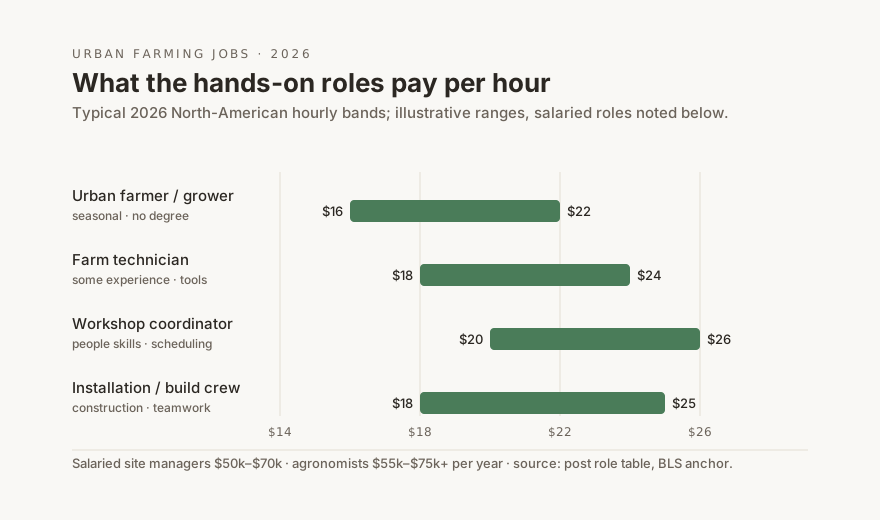
Urban farmers in North America typically earn between roughly $16 and $24 per hour in entry and seasonal growing roles, with salaried site managers, agronomists, and operations leads commonly earning $45,000 to $75,000+ per year, depending on city, experience, and scope of responsibility. According to the U.S. Bureau of Labor Statistics, agricultural workers earned a median wage of $37,140 per year (about $17.86 per hour) as of its most recent Occupational Outlook data, which is a reasonable anchor for the hands-on end of the urban farming pay range.
Pay in this field tracks three things: how technical the role is, how much responsibility it carries (one site versus many, individual versus team management), and the local labor market of the city you work in. The table below maps the main urban farming jobs to typical pay bands and the requirements employers look for. Treat the figures as realistic 2026 ranges for North American urban and rooftop farming — actual offers vary by employer and region.
| Role | What you do | Typical pay (North America) | Common requirements |
|---|---|---|---|
| Urban farmer / grower (seasonal) | Plant, tend, harvest, and maintain crops across one or more sites | ~$16–$22 / hr | Reliability, physical fitness, willingness to learn; no degree required |
| Farm technician | Operate irrigation, monitor crop health, log data, support multiple installations | ~$18–$24 / hr | Some growing experience or training; comfort with tools and basic tech |
| Workshop / community coordinator | Run tenant workshops, harvest events, and educational programming | ~$20–$26 / hr or $42k–$55k | People skills, communication, scheduling; horticulture knowledge a plus |
| Site / operations manager | Manage crews, schedules, and quality across a portfolio of farms | ~$50k–$70k / yr | 2–4+ yrs experience, leadership, logistics; valid driver's license |
| Agronomist / growing specialist | Set crop plans, troubleshoot pests and soil, optimize yield | ~$55k–$75k+ / yr | Agronomy/horticulture degree or equivalent field expertise |
| Installation / build crew | Construct beds, set up substrate and irrigation at new sites | ~$18–$25 / hr | Hands-on construction skill, physical fitness, teamwork |
Do you need a degree to be an urban farmer?
No, you do not need a degree to be an urban farmer — most entry-level urban farming jobs hire on practical growing ability, reliability, and physical capacity rather than formal credentials. A degree becomes genuinely useful only as you move into specialized or senior roles: agronomy, food-systems planning, or operations management, where a background in horticulture, environmental science, or business adds real leverage.
This is one of the most attractive features of the field for career-changers and students. The fastest way to become hireable is not a four-year program — it is demonstrable, hands-on experience. Employers want to see that you have actually grown things, shown up consistently through a season, and can handle the physical and weather-exposed reality of the work. That experience can come from a community garden plot, a backyard, a volunteer shift, an internship, or a single seasonal contract.
That said, education and certification do help in specific situations. A horticulture certificate, a permaculture design course, a food-safety credential, or coursework in soil science and agronomy can move you up the pay table faster and open doors to technical roles. The right framing is that credentials accelerate a career in urban farming but rarely gate the first job. For a detailed roadmap on building those skills from scratch, see our step-by-step guide on how to become an urban farmer.
Skills and qualifications employers actually screen for:
- Reliability and stamina — showing up on time, every shift, through heat, rain, and a full growing season. This is the single most-cited requirement.
- Core growing knowledge — seeding, transplanting, watering, pest identification, and harvest timing for common urban crops (leafy greens, herbs, tomatoes).
- Comfort with tools and simple tech — drip irrigation, hand tools, and increasingly, apps or sensors for logging crop and yield data.
- Communication and professionalism — many urban farms operate on client properties, so staff interact with tenants, building managers, and the public.
- A valid driver's license — frequently required for multi-site and operations roles where staff travel between installations.
- Food-safety awareness — basic handling and hygiene knowledge, especially where produce is distributed or donated.
How do I get hired in urban farming with no experience?
You get hired in urban farming with no experience by building demonstrable growing skill outside of work, then applying to seasonal and entry roles where employers expect to train. The most reliable path follows a clear sequence of steps that turn zero formal experience into a hireable profile within a single season.
- Grow something now. Start a container garden, claim a community-garden plot, or volunteer at a local farm. The goal is to be able to say "I have grown X" with confidence in an interview.
- Get one piece of paper. A short, affordable horticulture or permaculture course, or a food-safety certificate, signals seriousness and gives you vocabulary employers recognize.
- Target seasonal and technician roles. These are the intended entry points. Apply in late winter and early spring, when urban farms staff up for the growing season.
- Apply directly to urban farming companies. Operators that install and maintain commercial farms — like Microhabitat — hire seasonal crews and technicians across multiple markets each year. Watch their careers pages and apply early.
- Lean on adjacent experience. Landscaping, construction, hospitality, and logistics all transfer: physical work, customer interaction, and reliability are exactly what farm employers value.
- Show up coachable. In interviews, emphasize willingness to learn, comfort with physical outdoor work, and a genuine interest in food and sustainability over polished farming credentials.
Across Microhabitat's installations in North America and Europe, a large share of growing and technician staff began their first season with little or no professional farming background — they were hired on attitude, reliability, and a demonstrated love of the work, then trained on the specifics. That pattern is the rule in this industry, not the exception, which is what makes it such an open door.
Where are urban farming jobs growing fastest?
Urban farming jobs are growing fastest in dense metropolitan areas where commercial real estate, corporate sustainability commitments, and municipal food policy intersect — major cities across North America and Europe with large stocks of flat commercial rooftops and active green-building programs. The U.S. Department of Agriculture has expanded its support for city-based growing through its Urban Agriculture initiative, including dedicated offices, grants, and committees, a signal that the institutional infrastructure behind these jobs is still being built out.
Demand is driven less by agriculture for its own sake and more by what an on-site farm does for a building: it supports ESG and sustainability reporting, helps attract and retain tenants, supplies fresh produce, and creates visible community programming. As more corporate and real-estate owners adopt these goals, they need people to design, install, run, and report on the farms — which is precisely where the hiring happens. Companies that operate across many cities, such as Microhabitat with farms throughout North America and parts of Europe, hire seasonally and year-round as their portfolio of sites grows.
For job-seekers, the practical implication is simple: the more commercial rooftops and corporate campuses a city has, the more urban farming jobs it tends to generate. Position yourself in or near those markets, build your growing skills, and apply early in the season.
Explore the roles: urban agriculture jobs, agronomy jobs in Canada, green jobs in real estate, internships, seasonal roles, and how to become an urban farmer.
Ready to grow your career in urban farming? View open positions → with Microhabitat and start your first season on a real commercial farm.