Urban Agriculture Jobs: Roles & Salaries
Urban agriculture jobs explained: the main roles, the typical salaries, and a clear step-by-step path to getting hired in the growing urban farming sector.
On this page
Quick answer: Urban agriculture jobs include farm operators, growers, agronomists, educators, and sustainability coordinators working within city food systems. Salaries vary by role and region, and demand is rising as municipalities and corporations expand urban food programs — with clear entry points for people coming from horticulture, hospitality, logistics, or environmental fields.
If you want to grow food for a living without leaving the city, urban agriculture jobs are one of the most accessible doors into the wider green economy. The work spans rooftops, vacant lots, greenhouses, and the grounds of office and residential buildings, and it blends hands-on growing with logistics, education, and data. This guide breaks down what the work actually involves, the main roles and what they typically pay, and a concrete step-by-step path to getting hired. If you already know you're ready, you can View open positions → at Microhabitat, but read on first to find the role that fits you.
What do urban agriculture jobs involve?
Urban agriculture jobs involve producing food inside or near cities — planting, tending, harvesting, and distributing crops grown on rooftops, in greenhouses, on building grounds, and in repurposed urban spaces. Unlike rural farming, the work is shaped by tight footprints, proximity to the people who eat the food, and a strong public-facing element: tenant workshops, community harvests, and visible sustainability programming.
Day to day, the job is a mix of agronomy and operations. A grower might seed trays in the morning, troubleshoot an irrigation line at midday, and run a lunchtime harvest event for office tenants in the afternoon. Because urban farms sit on or beside the buildings they serve, attention to safety, cleanliness, and presentation matters as much as yield. Many roles also carry a teaching dimension — explaining to residents, employees, or students how the food in front of them was grown. To understand the installation and growing model behind these roles, it helps to first see what urban farming involves at the building level. If you want a parallel view of the same field framed around hiring, our companion guide to urban farming jobs covers the landscape from an employer's perspective.
What are the main urban agriculture roles and responsibilities?
The main urban agriculture roles are growers and farm technicians, urban farm operators or managers, agronomists and crop specialists, education and community coordinators, and sustainability or program coordinators on the corporate side. Each sits at a different point on the spectrum from hands-in-soil fieldwork to planning, data, and stakeholder management.
Here is what each role typically owns:
- Urban farmer / grower (entry to mid-level). The hands-on core of the field — seeding, transplanting, watering, pest scouting, harvesting, and basic record-keeping. This is the most common entry point and values reliability and care over credentials.
- Farm technician / lead grower. A grower with added responsibility for a site's day-to-day operations: managing planting schedules, maintaining systems, and often training seasonal staff.
- Urban farm operator / farm manager. Owns one or several sites end to end — crop planning, budgets, client relationships, safety, and team coordination. Combines agronomy with project management.
- Agronomist / crop specialist. Focuses on soil health, plant nutrition, integrated pest management, and yield optimization across sites. Usually requires formal training; see our overview of agronomy jobs in Canada for the credentialed track.
- Education & community coordinator. Designs and runs workshops, volunteer harvest days, and school or tenant programming — the public face that makes urban farms a visible amenity.
- Sustainability / program coordinator (corporate or municipal). Sits inside a property company, employer, or city department and manages the farm program as part of a broader ESG or food-systems strategy.
Across Microhabitat's installations in North America and Europe, these roles map onto real teams: field growers running building farms, coordinators leading tenant engagement, and operations staff planning seasons across a portfolio of sites. The same titles recur across the sector, which makes the path between employers relatively legible.
How much do urban agriculture jobs pay?
Urban agriculture jobs pay across a wide range, with entry-level grower roles generally clustering near the broader agricultural-worker wage and management roles paying meaningfully more. In the United States, the Bureau of Labor Statistics tracks the two closest occupations: agricultural workers, which covers hands-on growing and harvesting roles, and farmers, ranchers, and other agricultural managers, which covers the operator and manager tier — and the median for the management category sits well above the field-worker category. Urban roles often pay at or above these baselines because they sit in higher-cost cities and frequently bundle public-facing and program responsibilities.
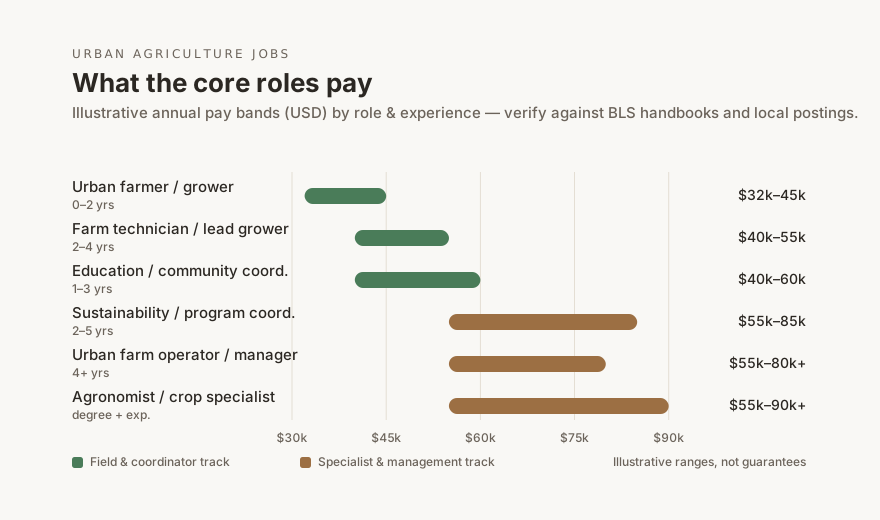
The table below gives indicative pay bands for the core roles. Treat these as planning ranges, not guarantees: actual pay depends heavily on city, cost of living, employer type (startup farm, established operator, corporate, or municipal), season length, and whether the role is full-time year-round or seasonal. Always check the linked BLS handbooks for the current official U.S. medians and verify local postings for your market.
| Role | Typical experience | Indicative pay band (USD, annual) | Core responsibilities |
|---|---|---|---|
| Urban farmer / grower | 0–2 years | ~$32,000 – $45,000 | Seeding, watering, harvesting, pest scouting, record-keeping |
| Farm technician / lead grower | 2–4 years | ~$40,000 – $55,000 | Planting schedules, systems upkeep, training seasonal staff |
| Urban farm operator / manager | 4+ years | ~$55,000 – $80,000+ | Crop planning, budgets, client relationships, team and site leadership |
| Agronomist / crop specialist | Degree + experience | ~$55,000 – $90,000+ | Soil and plant health, IPM, yield optimization across sites |
| Education / community coordinator | 1–3 years | ~$40,000 – $60,000 | Workshops, volunteer days, school and tenant programming |
| Sustainability / program coordinator | 2–5 years | ~$55,000 – $85,000 | Managing the farm program within an ESG or food-systems strategy |
Seasonal and part-time urban agriculture jobs are common and are often paid hourly; they are a realistic and widely used on-ramp into a full-time role rather than a dead end. Many growers start on a single season's contract, prove themselves, and convert to a permanent position the following year.
How do you get hired in urban agriculture? A step-by-step path
You get hired in urban agriculture by building a small base of practical growing experience, learning the core agronomy concepts, and applying to operators, corporate farm programs, and municipal food initiatives — most entry roles weigh demonstrated reliability and hands-on skill over formal degrees. Follow these steps:
- Get real growing reps. Volunteer at a community garden, take a seasonal farm role, or grow intensively at home. Employers want evidence you can keep plants alive and show up consistently. Even one full season of hands-on work changes how your application reads.
- Learn the fundamentals. Build working knowledge of seeding, transplanting, irrigation, soil health, and integrated pest management. Free and low-cost resources, extension courses, and the USDA's urban grower resources are a strong, credible starting point.
- Translate your background. Career-changers have an edge here. Hospitality teaches food safety and pace; logistics teaches scheduling and inventory; environmental or science backgrounds teach data and systems thinking. Name these transferable skills explicitly on your resume.
- Build a simple portfolio. Photos of crops you've grown, a harvest log, a workshop you ran, or a small yield record all serve as proof. For urban roles, evidence that you can engage the public is a genuine differentiator.
- Target the right employers. Apply to established urban farm operators, property and corporate sustainability programs that run on-site farms, municipal food and parks departments, and educational farms. Tailor each application to whether the role is field-heavy or program-heavy.
- Start seasonal, then convert. Treat a seasonal or part-time contract as the front door. Reliability over one season is the most common route to a year-round offer and a step up the ladder.
If you'd rather skip straight to live roles, you can View open positions → and apply with the experience you have today — many teams hire growers who are still early in their journey.
Is urban agriculture in demand, and what's the outlook?
Urban agriculture is in growing demand, driven by city food-security goals, corporate ESG and wellness programs, and rising public interest in local, traceable food. While the largest U.S. agricultural occupations are projected to stay roughly flat or grow modestly through the early 2030s according to the Bureau of Labor Statistics, the urban slice of the field is expanding faster than the headline numbers suggest, because new programs are being created where none existed before — on rooftops, building grounds, and underused city land.
Three forces are pushing the trend. First, employers and property owners increasingly install on-site farms as visible amenities tied to sustainability reporting and tenant wellbeing, creating grower and coordinator roles attached to real estate. Second, municipalities are funding urban food initiatives and dedicating land and grant support, with national backing reflected in the USDA's urban grower resources and its Office of Urban Agriculture and Innovative Production. Third, the work is hard to offshore and is rooted in the cities where demand lives — the food is grown beside the people who eat it.
For job-seekers, that combination is encouraging: the field rewards practical skill, offers a clear ladder from grower to operator, and welcomes people arriving from adjacent industries. Sustainable agriculture jobs and food-systems roles are no longer a niche — they are a durable, accessible part of the urban green economy.
Ready to grow your career in city food systems? View open positions → at Microhabitat and apply with the hands-on experience you have today.