Employee Stress Reduction Programs: What Evidence Supports
Employee stress reduction programs graded by the evidence: what WHO guidelines and meta-analyses support, how big the effects are, and where nature fits.
Quick answer: The employee stress reduction programs with the best evidence change the work itself and train managers, then add skills training and easy ways to recover during the day. Of the measures the World Health Organization grades for workers in general, only manager training gets a strong recommendation; stress-management training based on mindfulness or cognitive behavioural approaches gets a conditional one. Time in nature lowers a stress hormone in field research, which makes it a useful recovery layer, not a replacement for fixing workload. Such a program works best as one part of a nature-based workplace wellness program.
Many employee stress reduction programs are chosen on enthusiasm: a meditation app, a lunch-and-learn, a wellness week. Six months later, leadership asks what changed, and an honest answer can be hard to give. This guide sorts the common options by the strength of the evidence behind them. It draws on the WHO guidelines on mental health at work, a meta-analysis of workplace stress management trials and a field study of time spent in nature, and it is plain about effect sizes and limits. The goal is a program you can defend in a budget meeting and that employees can actually feel. It is part of our complete guide to nature-based workplace wellness.
On this page: What they are · Evidence by program type · Largest effects · Nature and stress · Building a program · Measuring results
Employee stress programs
Three places a stress program can act
Each layer does a different job. A program that holds up uses all three.
Change the work
Acts on the sources of stress
- Manager training for mental healthStrong · moderate certainty
- Changes to psychosocial risks, with employees involvedConditional · very low certainty
Build skills
Acts on how people handle pressure
- Stress-management training (mindfulness or cognitive behavioural)Conditional · low certainty
- Mental health literacy and awareness trainingConditional · very low certainty
Recover during the day
Acts on recovery between demands
- Leisure-based physical activity, such as walking or yogaConditional · very low certainty
- Time outdoors in green spaceNot graded by WHO
What are employee stress reduction programs?
Employee stress reduction programs are workplace efforts to lower work-related stress, and each one acts in one of three places: the work itself, the skills people use under pressure, or the recovery they get during the day.
- Change the work. Workload, schedules, role clarity, how much say people have, and how managers respond when someone is struggling. This layer acts on the sources of stress.
- Build skills. Training in stress management techniques, often based on mindfulness or cognitive behavioural approaches, plus training that helps people recognise mental health problems and ask for help.
- Recover during the day. Physical activity, real breaks and time outdoors. This layer helps people come down from pressure before it builds up.
The layers are not rivals. A skills course cannot remove an unmanageable workload, and a lighter workload does not teach anyone to handle a hard week. Skills and recovery programs are easier to buy off the shelf, so they tend to fill wellness budgets, while changes to the work are harder to package and easier to leave out. A program that holds up uses all three, weighted by the evidence below.
How strong is the evidence for each type of program?
The evidence is strongest for manager training, low for stress-management skills training, and very low for changes to the work, awareness training and physical activity, according to the grades in the WHO guidelines on mental health at work (2022).
WHO rates each recommendation in two ways. Strength says how firmly it backs a measure: strong (the measure “should be delivered”) or conditional (it “may be considered”). Certainty says how confident reviewers can be in the research behind it. A low certainty rating does not mean a program fails. It means the studies are too few, too small or too mixed to be sure how large the benefit is.
| Program | WHO recommendation | Certainty of evidence | What the recommendation targets |
|---|---|---|---|
| Manager training for mental health | Strong | Moderate | Managers' knowledge, attitudes and behaviours; workers' help-seeking |
| Stress-management skills training, such as mindfulness or cognitive behavioural approaches | Conditional | Low | Positive mental health, emotional distress, work effectiveness |
| Organizational changes that address psychosocial risks, including participatory approaches | Conditional | Very low | Emotional distress, work-related outcomes |
| Mental health literacy and awareness training | Conditional | Very low | Knowledge and attitudes about mental health at work |
| Leisure-based physical activity, such as walking, yoga or strength training | Conditional | Very low | Mental health, work ability |
| Screening programmes during employment | No recommendation for or against | Not applicable | WHO found it unclear whether benefits outweigh harms |
Two details matter when you read that table. Manager training earns the strongest grade, but what it improves is how managers understand and respond to mental health, and whether workers seek help. That is an indirect route to lower stress, not a direct measure of it. And changes to the work sit at very low certainty because the evidence is thin, not because they have been shown not to work. WHO still says they may be considered, and they are the only layer that acts on the causes.
Time in nature does not appear in the table, because the WHO guidelines do not grade it. The evidence for it comes from elsewhere, and it is covered below.
Which stress management programs show the largest effects?
In a meta-analysis of workplace stress management trials, programs based on cognitive behavioural techniques produced the largest effects, and all program types together showed a medium to large average effect.
Richardson and Rothstein pooled 36 experimental studies covering 55 interventions and 2,847 participants, and the average program ran 7.4 weeks. Across all studies, the overall effect size was 0.526 (Cohen's d), which the authors describe as a significant medium to large effect. Cognitive behavioural programs, which teach people to spot and rework stressful thinking and to build coping skills, consistently produced larger effects than other types. Relaxation programs were the most common.
The same review carries limits worth repeating to anyone who promises a quick win:
- More components diluted the effect. When cognitive behavioural programs added extra treatment components, their effect got smaller. A focused, well-run course beats a crowded menu.
- Outcomes were mostly psychological. Effects were measured mainly on psychological variables, not on physiological or organizational measures such as absence or turnover.
- Organizational interventions were scarce. Few trials tested changes to the work itself, which is part of why the evidence for that layer is thin.
- Trial results are a ceiling. Trials measure people who enrolled and took part. A voluntary program with low uptake will deliver less across a whole workforce.
- The review predates app-based programs. Its findings describe structured courses, so do not assume a self-guided app performs the same.
The practical reading: if you fund one skills program, choose a structured course built on the cognitive behavioural or mindfulness methods WHO names, run it in work time, and keep it focused.
Does time in nature reduce employee stress?
Time in nature lowers stress in the short term: in a field study of city residents, 20 to 30 minutes in a place that felt like nature was the most efficient dose for lowering the stress hormone cortisol, although the study was small and had no separate control group.
Hunter, Gillespie and Chen followed 36 urban dwellers for eight weeks. Each was asked to take a “nature pill” at least three times a week: 10 minutes or more outdoors, anywhere that gave a sense of contact with nature. They gave saliva samples before and after. Cortisol fell 21.3% per hour beyond its normal daily decline of 11.7% per hour. The benefit per minute was greatest between 20 and 30 minutes, and it kept building after that, at a slower rate.
Read it with its limits in view. The sample was small, 92% female and self-selected, so participants may have been more likely to stick with the routine than most people, which the authors note could bias the results. Each person served as their own baseline rather than being compared with a separate group. And the study followed daily life in general, not a workplace program. It is good evidence that a short, regular nature break is worth making easy. It is not evidence that nature alone fixes workplace stress.
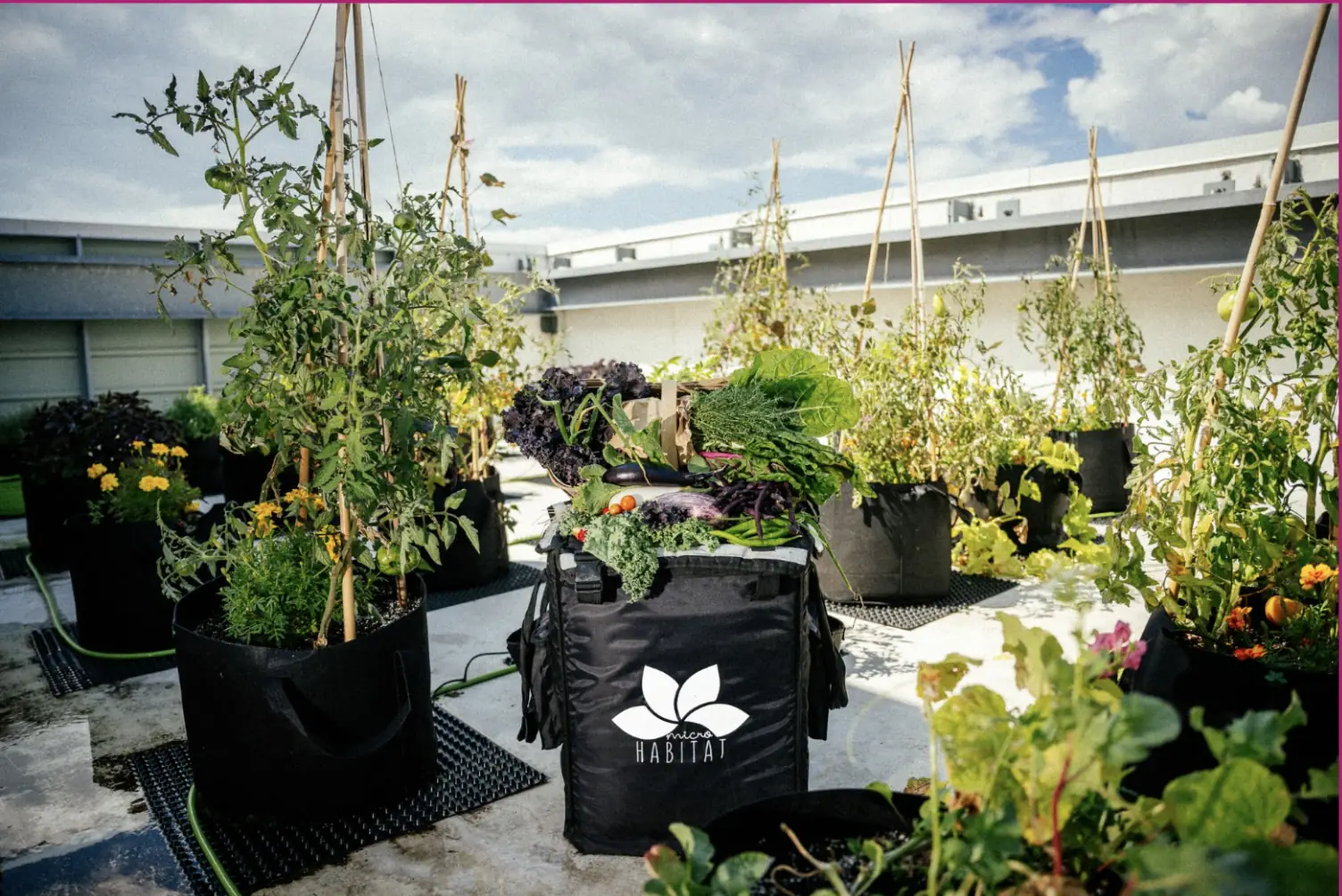
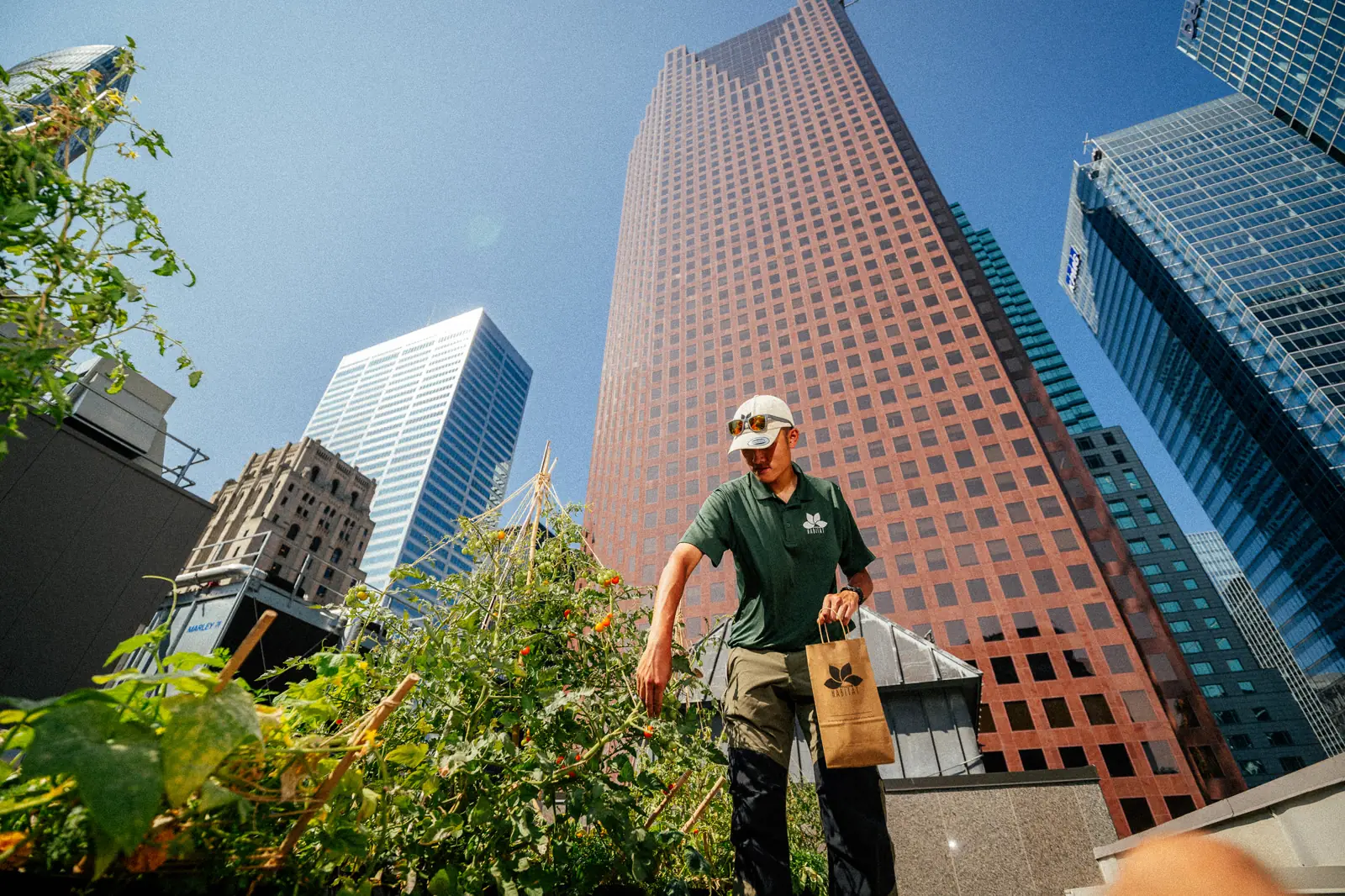
For a workplace, the lesson is access. A 20-minute outdoor break only happens if green space is close enough to reach during the day. That is where on-site nature earns its place: a rooftop farm or terrace garden puts the break a floor away, and harvests and workshops give colleagues a reason to step outside together. A walk in that space also fits WHO's physical activity recommendation, which lists walking. For how a company runs one without taking on the growing work, see the office garden program guide.
How do you build an employee stress reduction program that works?
Build it in the order of the evidence: start with the sources of stress and with managers, add one skills course people have time to attend, and make recovery easy with activity and nearby nature.
- Find the sources. Ask teams what drives their stress (workload, schedules, unclear roles, communication) and involve them in the fixes. WHO specifically names participatory approaches.
- Train managers. It is the highest-graded measure, and managers are where workload, recognition and support are decided day to day.
- Offer one focused skills course. Choose mindfulness or cognitive behavioural methods, schedule it in work time, and resist adding extras that dilute it.
- Make recovery easy. Protect real breaks, create chances to walk, do yoga or exercise, and put green space within reach for a 20 to 30 minute pause.
- Skip blanket screening. WHO made no recommendation for or against screening programmes during employment, because the balance of benefits and harms is unclear.
- Plan the measurement before launch. Decide what you will track and collect a baseline first.
On-site nature belongs in the recovery layer and supports the other two. It gives teams a shared, low-pressure place to meet, and it turns a break into something people look forward to. MicroHabitat runs 250+ urban farms across 20+ cities in North America and Europe as a managed service, so the growing work stays with a professional urban farmer instead of landing on the people the program is meant to help.
How should you measure whether a stress program is working?
Measure who takes part, how stress changes on a validated scale and how a few work outcomes move over time, and compare against a team or period without the program wherever you can.
- Reach. Track who enrols and who keeps attending. A program used only by people who were already coping well can look successful and change little.
- Stress. Use a validated questionnaire, such as the Perceived Stress Scale, at baseline and again after the program. Keep responses anonymous.
- Work outcomes. Absence, turnover and engagement move slowly and for many reasons. Track them over a year, and treat them as supporting evidence, not proof.
- Comparison. Roll out in stages across sites or teams, so the later groups act as a comparison for the earlier ones.
- Honest reporting. Report what did not move as well as what did. It is what makes the next budget request credible.
Most trials in the meta-analysis above measured psychological outcomes rather than absence or turnover, so your own work-outcome data fills a real gap. Collect it with the same care as the stress scores.
Dig deeper: the nature-based workplace wellness guide, corporate wellness program ideas that go beyond the app, how an office garden program runs, biophilic design in the workplace and nature in the workplace.
Want recovery to be part of your stress program, a floor away from your team? See how corporate programs work, then contact us to scope one for your workplace.