Corporate Sustainability Employee Engagement in Practice
Corporate sustainability employee engagement made practical: programs that turn ESG targets into daily participation, and how to measure and report it.
Quick answer: Corporate sustainability employee engagement is how many of your people take part in reaching the company's ESG targets, not just how many know those targets exist. It grows when sustainability is part of the normal workweek, through recurring formats such as team training, a green team or an on-site farm with weekly harvests, and when you count participation rung by rung and report it where investors and assessors already look.
Most companies now have ESG targets. Far fewer have a plan for the people expected to help reach them. Corporate sustainability employee engagement closes that gap: it turns a target set in the boardroom into something employees do, see and talk about during an ordinary week. For wellness and sustainability leads, it is also where the two agendas meet, which is why this topic sits inside our guide to nature-based workplace wellness.
On this page:
- What is corporate sustainability employee engagement?
- Why do ESG targets stall at the employee level?
- What does the research say about sustainability and employee engagement?
- Which programs turn ESG targets into daily participation?
- How do you measure employee participation in sustainability?
- How do you report employee participation in ESG disclosures?
- How do you launch a sustainability engagement program in one season?
What is corporate sustainability employee engagement?
Corporate sustainability employee engagement is the degree to which employees take an active part in the company's environmental and social goals through their own work, rather than simply knowing those goals exist.
Three ideas often get blended here, and it helps to keep them apart. Awareness is knowing the company has a net-zero, waste or biodiversity target. Engagement, in the general HR sense, is how committed and energized people feel about their work. Participation is the observable part: people doing something, repeatedly, that moves a target forward. This guide focuses on participation, because it is the part you can design, count and report.
It is also not the same thing as a wellness program, although the two overlap. A wellness program asks what the workplace does for employees. Sustainability engagement asks what employees do with the company for something larger than their own role. The strongest programs answer both questions at once. A lunchtime harvest on the roof is a break from the screen, and it is also a visible contribution to a biodiversity or community goal.
Why do ESG targets stall at the employee level?
ESG targets stall at the employee level because they are written in units most people never touch, such as tonnes of CO2e or portfolio-wide percentages, and they arrive with no clear role for anyone outside the sustainability team.
Four patterns show up again and again:
- Abstract units. An emissions target measured across the whole company gives an analyst or a marketing coordinator nothing to do on a Tuesday afternoon.
- No owner below leadership. Targets have an executive sponsor and a reporting lead. Between them and everyone else there is often no program, only a newsletter.
- One-off events. Earth Day activities and annual volunteer days are well meant, but they happen once, sit outside normal work and leave nothing to come back to.
- Nothing to see. Energy savings in a plant room or a clause in a supplier contract are real progress, but nobody walking through the office can see them.
Each of these has a practical fix, and the fixes point the same way: make sustainability part of the week, give it a place people can see, and count who takes part.
What does the research say about sustainability and employee engagement?
Research links social responsibility work, including sustainability, to higher employee engagement, and a large study found that the link weakens when the work sits outside people's jobs.
A large study on the question is Ante Glavas's analysis of data from 15,184 employees at a large US professional service firm, published in Frontiers in Psychology in 2016. It found that authenticity, meaning being able to bring your whole self to work, significantly mediated the relationship between corporate social responsibility and employee engagement. Perceived organizational support, the direct benefits employees receive, did not. And when responsibility work was extra-role, such as volunteering that sits outside job design, the relationship with engagement weakened. The paper's practical conclusion is that this work should be embedded in everyday practice as much as possible.
Survey data shows how much purpose matters to employees. Deloitte's 2025 Gen Z and Millennial Survey, based on 23,482 respondents in 44 countries, found that 89% of Gen Zs and 92% of millennials consider a sense of purpose important to their job satisfaction and well-being.
Two honest limits apply. The Glavas study covers one firm, so it shows a relationship, not a guarantee for every company. And purpose means different things to different people, so no single sustainability program will answer it for everyone. Together, though, the evidence gives a clear brief: build participation into the workday and make it visible.
Which programs turn ESG targets into daily participation?
The programs that turn ESG targets into daily participation are the ones that recur during normal working hours, connect to a named target and produce a result people can see.
The table compares common formats against those tests. Frequency matters most, because it decides whether taking part becomes a habit or stays an event.
| Program | ESG target it supports | How often people take part | What you can count |
|---|---|---|---|
| ESG training by team | All targets, starting with the ones each team affects | Once, then yearly refreshers | Share of employees trained |
| Green team | Waste, energy and commuting goals | Monthly meetings | Members, actions completed |
| Energy or waste challenge | Operational emissions, waste diversion | A few weeks per campaign | Teams enrolled, change in the building's own data |
| Annual volunteer day | Community goals | Once a year | Participants, hours volunteered |
| On-site urban farm | Biodiversity, community, well-being | Weekly during the growing season | Visits, repeat participants, pounds harvested |
| Donation harvest for a food bank | Community and food security goals | Several times a season | Participants, pounds donated |
Most companies run several of these. The useful question is which one carries the weekly rhythm. Training and green teams add structure, but reach many people once or a few people often. Volunteer days reach many people once, and the Glavas finding is a reminder that work kept outside the job connects less strongly to engagement.
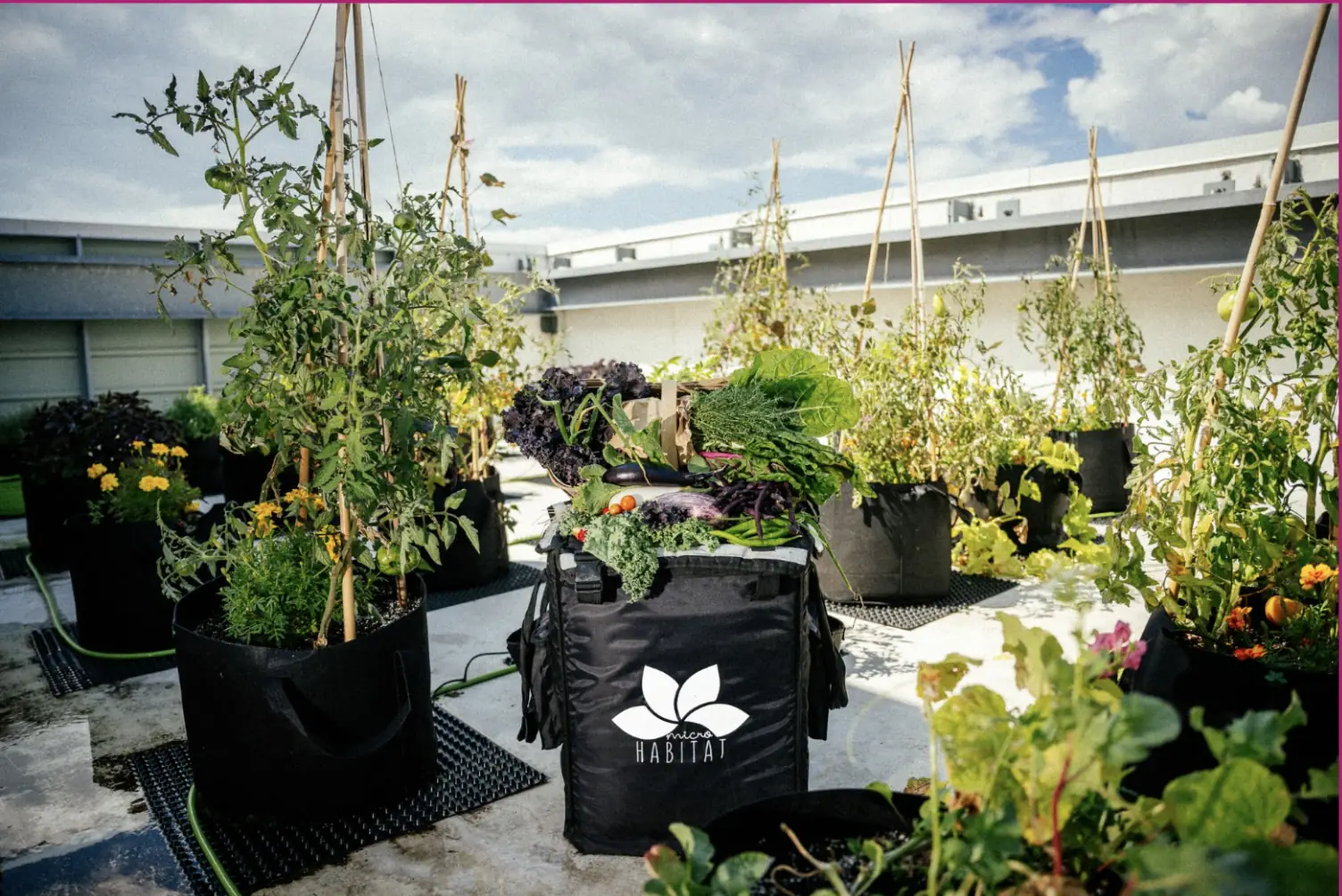
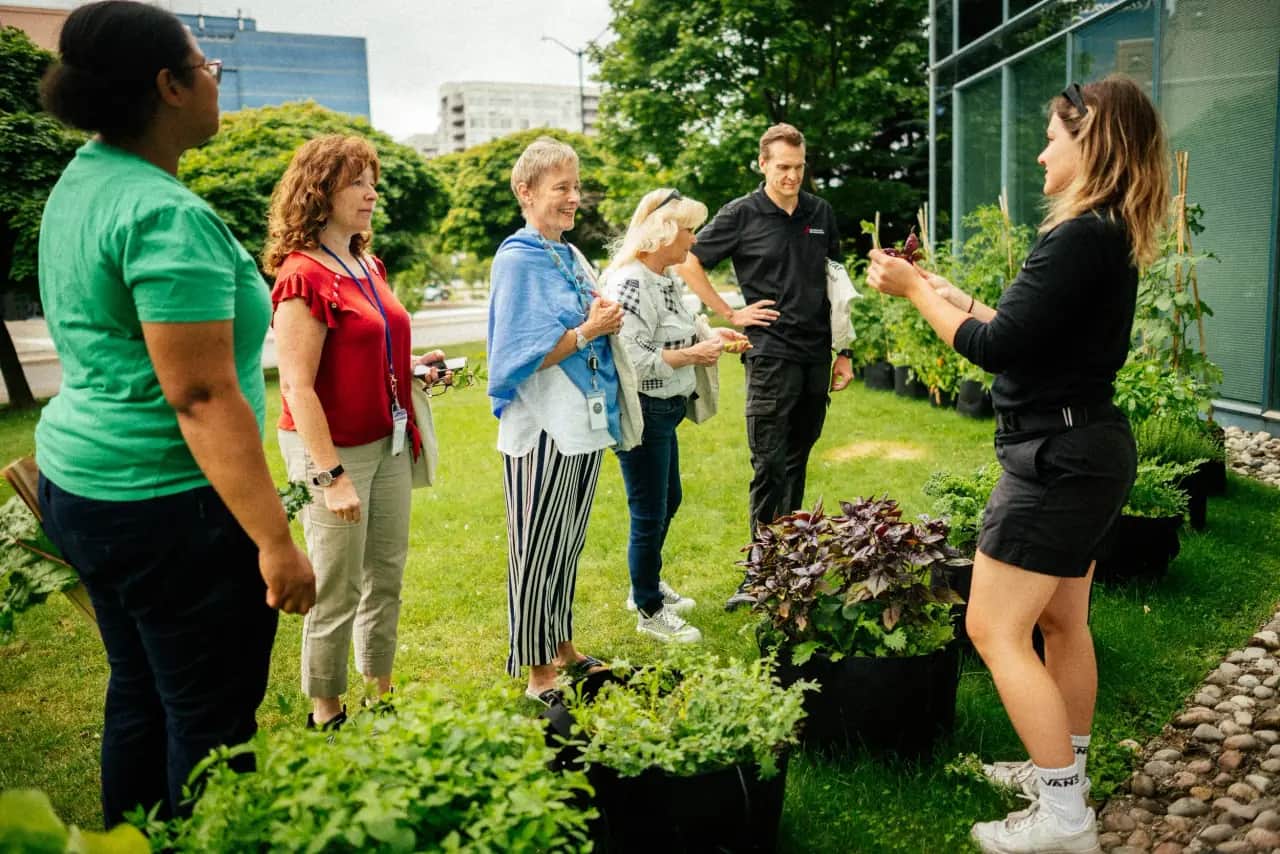
An on-site farm is one of the few formats that is weekly, visible and tied to more than one target at once. A professional urban farmer tends it every week, so employees can join a harvest over lunch without owning any of the work. The farm adds living, planted habitat to a roof or terrace, which gives a biodiversity goal something physical to point to; our guide to nature-positive buildings covers how that is measured. And the harvest can go to people who need it: MicroHabitat partners with 35+ local food banks, so a harvest can become a donation. Formats such as planting days and donation harvests are covered step by step in team building with purpose.
How do you measure employee participation in sustainability?
Measure participation as a ladder: count how many people know the target, how many learned their part, how many took part once, how many came back, and how many help lead, and report each rung separately.
From ESG target to participation
Five rungs of employee participation
Move people up one rung at a time, and count each rung on its own line.
Leading
Rung 5 of 5
What people do
Helps run or improve the program
Example
A green team member or a farm champion for a floor
What to count
Named champions and ideas adopted
Contributing
Rung 4 of 5
What people do
Comes back and produces a result
Example
Weekly harvests, or a donation harvest for a food bank
What to count
Repeat participants, pounds harvested and donated
Taking part
Rung 3 of 5
What people do
Joins an activity at least once
Example
A planting day or a lunchtime farm visit
What to count
Share who took part at least once
Learning
Rung 2 of 5
What people do
Understands their own part in it
Example
ESG training run team by team
What to count
Share of employees trained
Aware
Rung 1 of 5
What people do
Knows the target and why it matters
Example
The target explained at a town hall and on the intranet
What to count
Share of employees reached
Counting rungs separately stops one large event from hiding a thin program. A town hall reaches everyone in an afternoon; a farm season that brings people back every week is a more durable result and deserves its own line.
- Use a clear denominator. Report shares of all employees, or of employees at the site where the program runs. A count of participants means little without it.
- Set a baseline before launch. Record where each rung stands in the first month, so end-of-season results show change rather than a snapshot.
- Count outputs, not just attendance. Pounds harvested, pounds donated, beds planted and training completions are facts that a colleague or a food bank can confirm.
- Add one short pulse survey. Two questions at the end of an activity, a rating and one open question, capture how it felt without adding survey fatigue.
Be careful with attribution. One season of activities will rarely move a company-wide engagement score by itself, and a report that claims it did will not survive an auditor. Report what you measured, who took part and what they produced, and let the trend build over several seasons.
How do you report employee participation in ESG disclosures?
Report employee participation where investors and assessors already look: in your annual sustainability report and, for real estate companies, in the employee indicators of the GRESB assessment.
The GRESB 2025 Real Estate Reference Guide shows how specific this has become. Indicator SE1 asks for the percentage of employees who received ESG-specific training during the reporting year, and whether that training covered environmental, social or governance issues. SE2.1 asks whether an employee satisfaction survey was run within the last three years, with the percentage of employees covered and the response rate. SE2.2 asks whether there is a program to improve satisfaction based on what that survey found. The learning rung of a participation ladder gives you the SE1 figure directly, and recording survey coverage, response rates and what you changed afterwards is what SE2.1 and SE2.2 ask for. For how an on-site farm supports other parts of the same assessment, see how urban farming improves your GRESB score.
In a sustainability report, pair each number with a story. State the target, the program, the rungs and the outputs, then show one real moment, such as a donation that reached a local food bank. Keep dated photos, sign-up lists and harvest logs as you go, so the report is assembled rather than reconstructed. For the wider ESG picture, see our ESG-aligned urban farming guide.
How do you launch a sustainability engagement program in one season?
Launch in one season by choosing one target, one weekly format and one seasonal moment, then naming owners and recording a baseline before the first activity.
- Pick one target employees can affect. On-site biodiversity, food donations or waste are easier to connect to daily life than a company-wide emissions figure.
- Choose a weekly format and a seasonal moment. For example, lunchtime harvests every week and a planting day to open the season.
- Name the owners. One sponsor in leadership, one program lead, and a champion on each floor or team.
- Record the baseline. Measure each rung of the ladder in the first month.
- Report at the end of the season. Share the rungs, the outputs and one story internally first, then carry them into the sustainability report.
You do not need to hire for the weekly part. MicroHabitat runs 250+ urban farms across North America and Europe as a managed service, so your team can focus on inviting people in and counting who comes back.
Dig deeper: the complete guide to nature-based workplace wellness, team building with purpose, nature-positive buildings and biodiversity net gain, corporate wellness program ideas beyond the app, and our ESG-aligned urban farming guide.
Ready to give your ESG targets a place where employees take part every week? See urban farming for corporations or contact us to plan a program for your office.