Office Garden Program: Run One Without Owning the Work
How an office garden program works: indoor or outdoor, who does the weekly work, what the company provides, cost per employee and a one-season launch.
Quick answer: An office garden program is a food garden at your workplace — on a roof, a terrace or indoors — that a specialist runs for you as a managed service. An urban farmer handles planting, weekly maintenance and harvests, and leads the employee activities. The company provides access, a water source and a few decisions, then tells employees about it. With the space confirmed early, an outdoor program can go from signature to first harvest within one growing season.
Corporate wellness teams are asked for programs employees actually use — not another app login or a poster in the kitchen. An office garden program is something people can see, taste and take part in during the workday. The obstacle is rarely interest. It is ownership: who waters it in August, who harvests, and what happens when the person who championed it changes jobs. This guide covers how a corporate garden program works when a professional does the growing, what stays with your company, the cost per employee, and a one-season launch. A garden program is one part of nature-based workplace wellness.
On this page: What it is · Indoor vs outdoor · Who does the work · What the company does · Cost per employee · Launching in one season
Office garden program
What MicroHabitat does, and what your company does
Who does what once the program is running.
MicroHabitat
The growing work
- Design and installation
- Weekly maintenance and harvests
- Harvest delivery
- Employee activities led by the urban farmer
- Farm page updates and communication tools
- End-of-season impact report
- Winterization and next-season planning
Your company
Access, decisions and people
- Secure access to the roof, terrace or indoor space
- A water source close to the farm
- Deciding where the harvest goes
- Deciding whether employees can visit the farm and harvest
- Deciding how the urban farmer engages employees during weekly visits
- Telling employees about the program
- Hosting the activities: a room, a date, an invitation
What is an office garden program?
An office garden program is a productive garden at a workplace, run as an ongoing service, whose harvests and activities are shared with employees. The garden is the visible part: planters of vegetables, herbs and edible flowers on a roof or terrace, or an indoor growing unit in a lobby or cafeteria. The program is everything around it — the weekly care, the harvests delivered to staff, the workshops, and the updates that keep people following along through the season.
It is different from office plants and from a volunteer community garden. Plants are decor. A volunteer garden depends on staff time and goodwill, which can run out by midsummer. A managed corporate garden program keeps the energy of a community garden and removes the chores. We compare the two models in urban farm vs community garden.
The case for it rests on two lines of evidence. The first is about green workplaces: in three field experiments in large commercial offices in the Netherlands and the UK, researchers found that adding plants improved perceived air quality, concentration and workplace satisfaction, as well as productivity. The second is about gardening itself: a meta-analysis of 22 case studies published in Preventive Medicine Reports associated gardening with reductions in depression, anxiety and body mass index, and with increases in life satisfaction, quality of life and sense of community. An office garden program offers both — greenery where people work, and a chance to take part in growing food. See also the benefits of biophilic design in offices and nature in the workplace.
Indoor or outdoor: which office garden fits your building?
Choose outdoor if you have a sunny roof or terrace and want a hands-on seasonal program; choose indoor if you have no suitable outdoor space or want the garden producing all year.
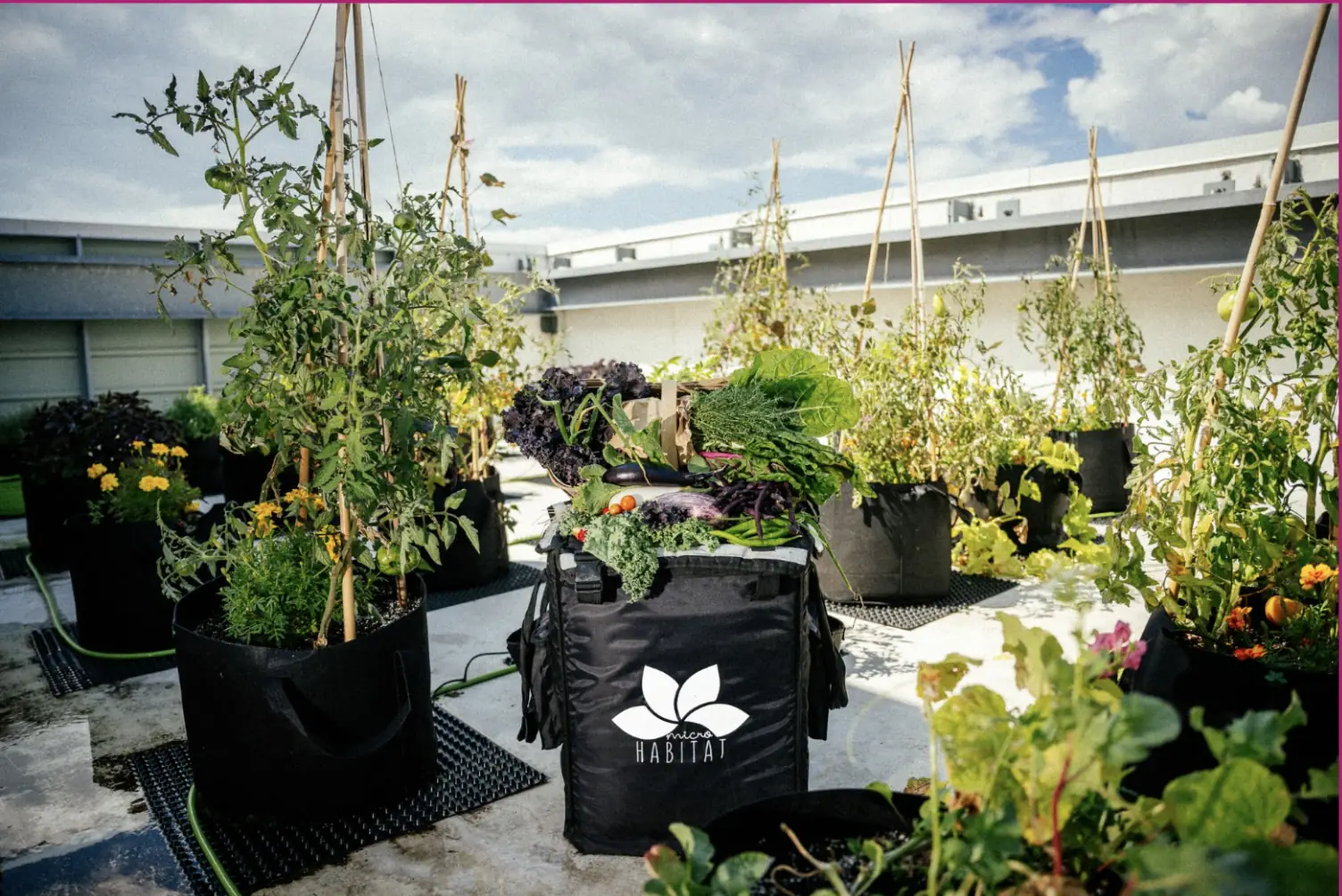
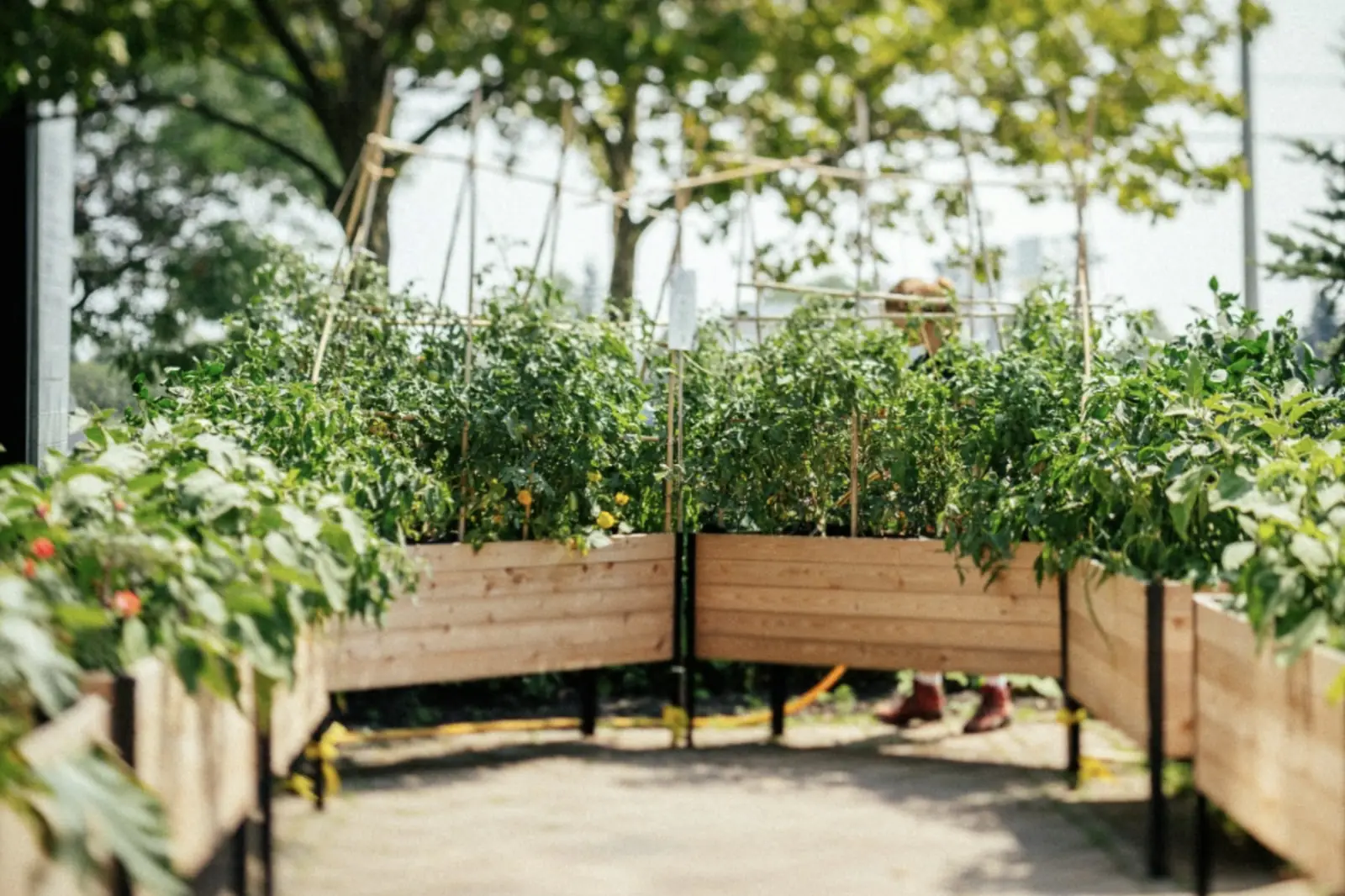
An outdoor farm is a set of planters on a roof, terrace or ground-level space. It grows a broad mix of vegetables, herbs and flowers through the growing season, 100% chemical-free, and it is the version employees can walk through — and harvest from, if you allow it. It needs sun and safe access: MicroHabitat asks for six hours or more of daily sunlight, secure roof access, a guardrail or a minimum safety distance from the edge, and an outdoor water tap.
An indoor farm is a self-contained growing unit, about 1.98 m tall, 1.37 m wide and 0.61 m deep, that produces about 3 lbs of fresh lettuce and herbs every two weeks. It needs no natural light and no plumbing connection, only a standard electrical outlet and a water source nearby, so it can sit in a lobby, cafeteria or break room and keep producing through winter. The two combine well: the rooftop carries the summer, and the indoor unit the rest of the year.
| Outdoor farm | Indoor farm | |
|---|---|---|
| Where it goes | Roof, terrace or ground-level space | Lobby, cafeteria, break room or other indoor space |
| What it grows | Vegetables, herbs and edible flowers | Lettuces and leafy greens |
| When it produces | Through the outdoor growing season | Year-round |
| Light | Six hours or more of daily sunlight | No natural light needed |
| Water and power | Outdoor water tap | A nearby water source and a standard outlet; no plumbing connection |
| Access and safety | Secure roof access; guardrail or minimum safety distance | Secure access to the unit |
| Best for | A visible, hands-on summer program | Year-round presence, or buildings without outdoor space |
Who does the work in a corporate garden program?
In a managed program, an urban farmer from the provider does all of the growing work, and your staff do none of it.
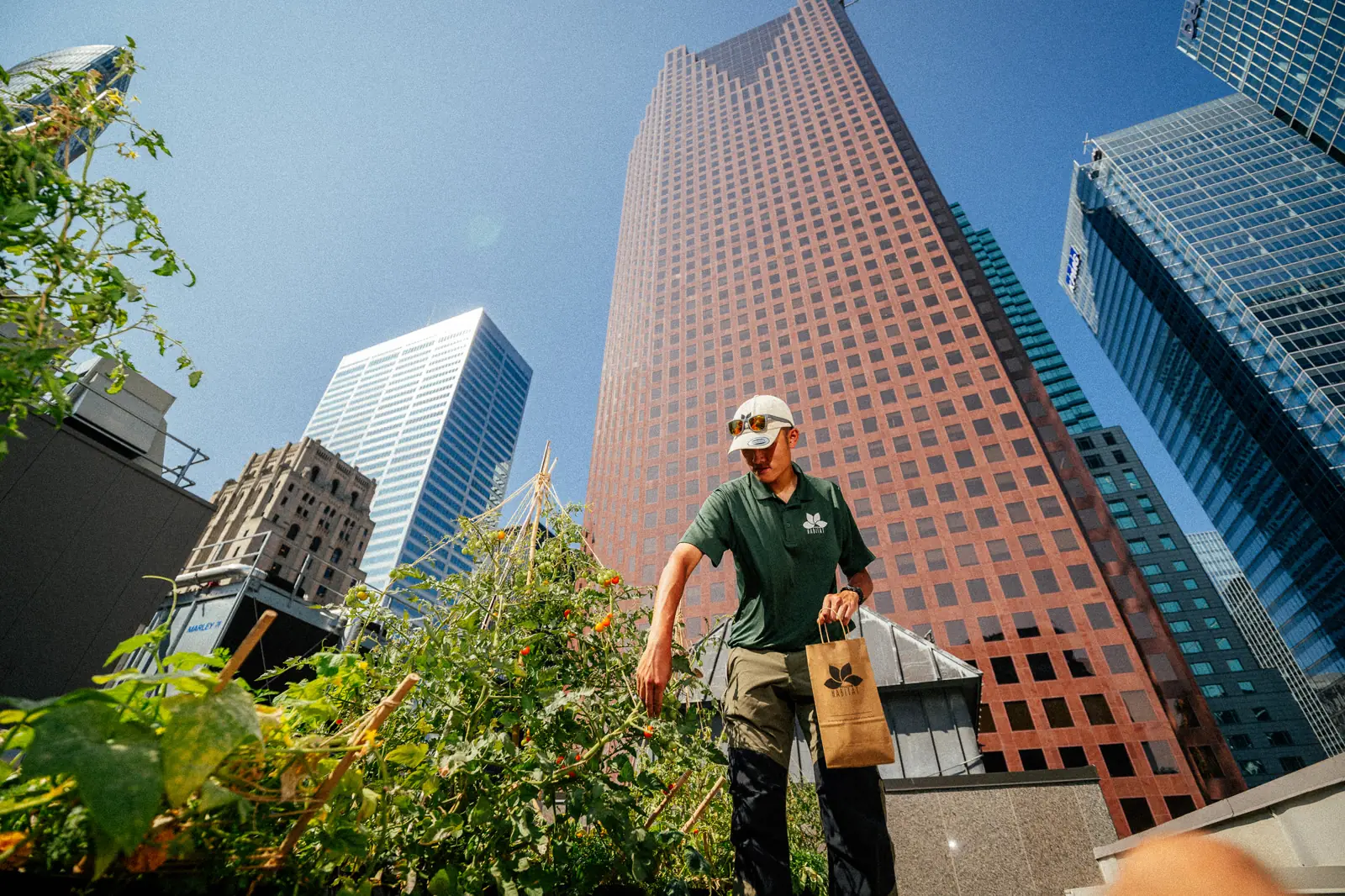
MicroHabitat designs and installs the farm, then an urban farmer visits every week to maintain it and harvest. The harvest goes to employees, is delivered internally, or is donated to a local organization such as a food bank, depending on what you choose. The farmer also leads the employee activities — two to four per year, depending on the package, typically one-hour sessions held in person for up to 30 people or virtually for up to 100, from garden visits to workshops on growing at home. You can browse the formats on our educational activities page.
Between visits, each farm has its own page on MyUrbanFarm with weekly updates, so anyone in the building can follow the season. At the end of the season comes an impact report covering figures such as pounds harvested and meals donated, which wellness and ESG teams can reuse in their own reporting. Then the farm is winterized, and planning for the next season — seed sourcing, planting plans, purchasing — starts as early as November. That is why the service is annual even though the harvest is seasonal.
This is the routine a do-it-yourself garden has to cover on its own: watering in a heat wave, pests, crop rotation, and a harvest that ripens while half the team is on vacation. MicroHabitat runs 250+ urban farms across North America and Europe, and that routine is the product.
What does the company need to provide?
The company provides the space, water and access, makes three decisions, and owns the communication with employees.
Before launch, three things are yours:
- Access. Secure access to the roof, terrace or indoor space for the weekly visit, with a guardrail or safe distance from the edge on a roof.
- Water. An outdoor tap for a rooftop farm, or a water source near the indoor unit.
- Three decisions. Where the harvest goes (employees, internal delivery, a donation to a local organization, or a mix); whether employees can visit the farm and harvest; and how the farmer engages staff during weekly visits. These shape the signage and the activity plan.
During the season, your job is to make the program visible:
- Announce it in several places. Intranet, newsletter, lobby screens and events reach more people than a single email.
- Keep a simple communication calendar. For example, a short monthly update on what the farm is producing.
- Host the activities. Book the room or rooftop slot, send the invitation, and plan them for in-office days — see return-to-office incentives that work.
- Create a recurring tradition. A monthly kiosk where employees meet the farmer and bring questions about their own plants keeps interest going all season.
- Reuse the impact report. Put the season's figures into wellness, CSR and ESG communications.
For buildings pursuing WELL certification, there is a reporting angle. In WELL v1, the food production feature asks for gardening space of at least 0.1 m² (1 ft²) per occupant, with no more than 70 m² (754 ft²) required, plus planting medium, a watering system, lighting for indoor spaces, plants and gardening tools. WELL v2 has its own Food Production feature, and we cover how an on-site farm fits it in WELL v2 Nourishment and on-site farms.
What does an office garden program cost per employee?
Divide the program's annual cost by the number of employees who can use it: the size and type of garden set the total, and the per-person figure falls as headcount rises.
Start with the total. Size depends on your building: see the outdoor farm requirements, or ask us to assess your site. Our rooftop garden cost guide puts setup at roughly $3,000–$15,000 for a small installation under about 300 sq ft and $15,000–$50,000 for a medium one of about 300–1,500 sq ft, with maintenance as a separate recurring line. Treat those as planning ranges, not quotes. A managed service changes how you pay rather than what the garden needs: design, installation, weekly care, harvests, activities and reporting become one annual figure.
Then turn it into a per-employee figure:
- Count the people who can use it. Use the headcount in the building or on the campus, not the company total.
- Separate year one from renewal years. Setup falls in the first year, so later years cost less per person.
- Run the arithmetic on the ranges. Across 300 employees, the build works out to $10–$50 per person for a small installation and $50–$167 for a medium one. Across 1,000 employees, it is $3–$15 and $15–$50.
- Compare like with like. Set the figure beside what you already spend per person on wellness perks and events, and count what the garden replaces — an activity budget, a volunteering day, content for internal communications.
For the return side, see rooftop garden ROI for corporates.
How do you launch an office garden program in one season?
Confirm the space and make your decisions in winter or early spring, plan communications before installation, and install about four weeks before the first harvest.
- Confirm the space (winter to early spring). Check sunlight, roof access, edge safety and a water tap — or, for indoor, a spot with an outlet and water nearby. A site assessment and an in-person visit confirm what fits.
- Make the three decisions. Harvest destination, employee access and engagement style shape the signage and the activity plan, so settle them before installation.
- Plan communications. Draft the launch announcement and a season calendar, and pick activity dates. Activities are offered between April and October, depending on the format.
- Install. The farm goes in about four weeks before the first harvest.
- Run the season. Weekly maintenance and harvests, harvest delivery, activities, and weekly updates on the farm page.
- Close and renew. Winterization, an end-of-season meeting and the impact report — then planning for the next season starts as early as November.
A late decision about the space or the harvest can push the start past the planting window. An indoor farm avoids that, because it grows year-round.
Dig deeper: the guide to nature-based workplace wellness, corporate wellness program ideas, return-to-office incentives that work, the benefits of biophilic design in offices and nature in the workplace.
Planning a garden program for your office? See how urban farming works for corporations, or contact us — tell us about your space and your team, and we'll scope a program and a launch date for your building.