Rooftop Garden ROI for Corporates
Rooftop garden ROI corporate buildings guide: a 5-year financial model of the costs vs value drivers, and how to justify the investment to stakeholders.
On this page
Quick answer: Rooftop garden ROI for corporate buildings is best modeled over five years, weighing setup and annual maintenance against the value drivers — tenant amenity and retention, ESG and certification benefits, brand value, and space utilization. For most corporate properties, evaluating rooftop garden ROI corporate buildings comes down to these combined benefits rather than produce yield alone.
If you are evaluating a rooftop garden ROI for corporate buildings, the mistake to avoid is judging it like a vegetable patch — counting pounds of produce against the install cost. That math almost never works, and it is not the math that matters. A corporate rooftop farm is an amenity-and-positioning asset, and it earns its return across a five-year horizon through tenant retention, sustainability and certification value, brand differentiation, and better use of otherwise dead roof space. Below is the financial model that makes the case defensible: the cost side laid out honestly, the value drivers quantified the way a CFO would want them, and a step-by-step way to build the business case for your own stakeholders.
What should you know about rooftop garden ROI corporate buildings?
Think about rooftop garden ROI for corporate buildings as an amenity-and-positioning investment, not a produce business — the return shows up in tenant economics, sustainability value, and brand, not in the harvest. Commercial real estate is valued on net operating income and the cap rate applied to it, so the right question is not "how much food does it grow?" but "how does it move rent, occupancy, retention, and the asset's appeal to tenants and investors?" Framed that way, a rooftop farm sits in the same category as a fitness center, a rooftop lounge, or a high-end lobby renovation: a cost that earns its keep by changing how the building leases and performs.
This reframing matters because produce yield alone almost never carries the spreadsheet. The food is real and tenants love it, but its dollar value is small next to a single avoided tenant turnover or a sustainability credential that helps win an anchor lease. Before you model the return, it helps to understand how urban farms work as a managed amenity on commercial properties — because the operating model is what makes the value drivers below actually materialize, rather than leaving you with a neglected roof installation that delivers neither produce nor positioning.
What does the 5-year financial model look like (costs vs value)?
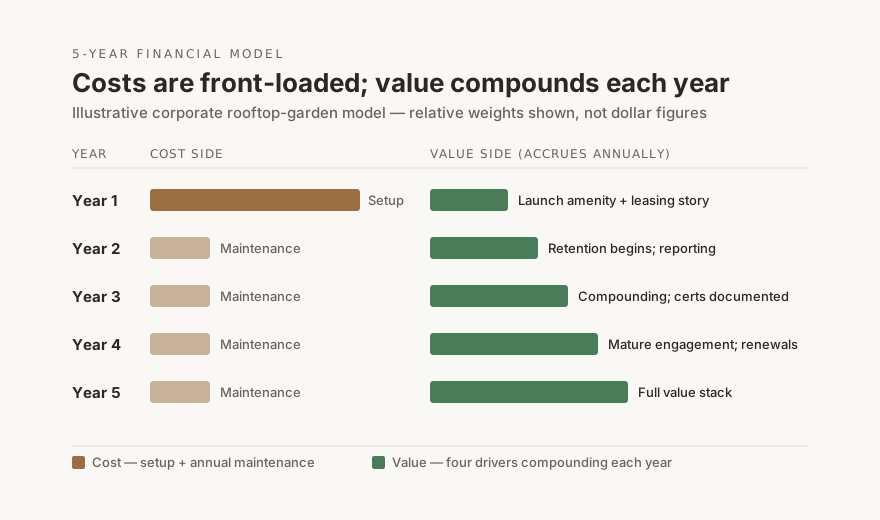
The 5-year financial model weighs two cost lines — one-time setup and recurring annual maintenance — against four value drivers that accrue every year: tenant amenity and retention, ESG and certification benefits, brand and marketing value, and space utilization. The model works over five years because the costs are front-loaded (a large setup spend in year one) while the value compounds: each year of programming deepens tenant engagement, supports another reporting cycle, and reinforces the building's positioning. A one-year snapshot makes any amenity look expensive; a five-year view is where the return becomes visible.
The table below is the core model. The cost figures are illustrative planning ranges — your real numbers depend on roof size, system type, access, and structure, which we break down in detail in our guide to how much does a rooftop garden cost. The value column is deliberately qualitative where a credible dollar figure would have to be invented; the point is to show where the return comes from and force each driver to be estimated against your own building's economics.
| Year | Cost side | Value side (accrues annually) |
|---|---|---|
| Year 1 | One-time setup: design, structural review, growing systems, substrate, plants, irrigation, install labor — the largest single outlay | Launch amenity + leasing story; first programming season; initial ESG/marketing artifacts |
| Year 2 | Annual managed maintenance (a fraction of setup cost) | Retention effect begins; first full reporting cycle; brand content library grows |
| Year 3 | Annual managed maintenance | Compounding retention; certification credits documented; comp-set differentiation |
| Year 4 | Annual managed maintenance | Mature tenant engagement; renewal conversations anchored by the amenity |
| Year 5 | Annual managed maintenance | Full five-year value stack: avoided churn + positioning + brand + utilized space |
| 5-yr total | Setup (yr 1) + 4× annual maintenance | Cumulative value across all four drivers vs. cumulative cost = ROI |
Read across the rows and the structure is clear: costs are heaviest in year one and flat thereafter, while value builds each season. The ROI question becomes whether the cumulative five-year value — driven mostly by avoided tenant turnover and sustainability positioning — exceeds setup plus four years of maintenance. For most corporate properties with meaningful lease values, even a modest retention effect closes that gap on its own.
How do you quantify the value drivers?
You quantify the value drivers by converting each one into a number tied to your building's actual economics — lease value, churn rate, cap rate, and certification goals — rather than assuming a flat premium. Each driver maps to a metric your finance and leasing teams already track, which is what makes the business case credible instead of aspirational. The matrix below pairs every value driver with how the farm produces it and the figure to estimate.
| Value driver | How the rooftop farm produces it | What to quantify |
|---|---|---|
| Tenant amenity & retention | A programmed, experiential amenity (harvests, workshops, fresh produce) tenants engage with repeatedly | Avoided turnover: one retained tenant saves months of lost rent + re-leasing, broker, and TI costs |
| ESG & certification | A documented, occupant-accessible green amenity feeding sustainability frameworks and credits | Certification points earned; reporting inputs; eligibility for ESG-screened tenants and capital |
| Brand & marketing | Photogenic, story-rich differentiator for leasing tours, content, and corporate reputation | Marketing value of owned content; differentiation in the comp set; PR and recruitment lift |
| Space utilization | Activation of otherwise unused, non-revenue roof area into a usable amenity | Value of converting dead square footage into programmable amenity space |
| Operational co-benefits | An engineered growing system that contributes to roof performance | Energy and stormwater effects (see EPA figure below) as a secondary, not headline, line |
The single largest driver for most buildings is retention, because vacancy is so expensive: every month a commercial space sits empty is lost rent plus the substantial cost of re-leasing it. That is why a farm that helps retain even one tenant can outweigh its entire annual cost — the same logic behind whether do urban farms increase property value, where the effect runs through rents and occupancy rather than a direct appraisal bump.
The operational co-benefits are real but should sit below the headline drivers, sized honestly. The U.S. EPA reports that, on a yard-by-yard basis, green roofs achieve annual energy savings of $0.15–$0.57 for cooling and $0.18 for heating, and can reduce cooling loads by up to 70 percent. Those savings help, but they rarely justify the investment alone — they are a supporting line, not the centerpiece. Across Microhabitat's installations on commercial and institutional properties in North America and Europe, the consistent pattern is that property teams value the tenant engagement and sustainability positioning far more than the utility savings or the produce.
How do you build the business case for stakeholders?
Build the business case for stakeholders by leading with the avoided-cost and positioning numbers, sizing each value driver against your own building's economics, and presenting the five-year model rather than a one-year cost. Different stakeholders care about different lines — finance wants the NOI and cap-rate math, leasing wants the tour-and-renewal story, sustainability wants the reporting and certification value — so a winning case translates the same farm into each audience's language. Work through these steps to assemble it:
- Establish the baseline. Pull current occupancy, average achieved rent per square foot, annual tenant churn, and the all-in cost of re-leasing a vacated space (downtime, broker fees, tenant improvements). This is the denominator everything else is measured against.
- Quantify the retention case. Estimate how a distinctive, programmed amenity might reduce churn, then convert even a modest reduction into annual dollars of avoided turnover cost. This is usually the largest single line.
- Add the sustainability value. Identify the specific frameworks and credits the farm supports, and the tenants or capital that screen for them. GRESB's Real Estate Assessment benchmarks managers on management and performance factors — a documented green amenity is exactly the kind of evidence that strengthens that reporting, which we cover further in our breakdown of GRESB sustainability reporting.
- Price the brand and space value. Account for the marketing and differentiation value of owned content and a feature few competitors offer, plus the value of activating dead roof area into usable amenity space.
- Run the five-year model and apply your cap rate. Total cumulative value against setup plus four years of maintenance, then capitalize the recurring NOI improvement at your building's cap rate to express the return as an estimated change in asset value.
Presented this way, the rooftop garden stops looking like a soft green expense and starts looking like what it is: an amenity investment you can model, defend, and measure like any other capital decision. For the questions stakeholders most often raise next — on cost, logistics, and outcomes — our urban farming FAQ is the fastest reference.
How do you get a tailored ROI estimate for your building?
Get a tailored ROI estimate by sharing the specifics that drive both cost and value — roof size and access, your lease economics and churn rate, and your sustainability goals — so the model reflects your building rather than an industry average. A generic five-year framework gets you oriented; a real estimate requires plugging in your numbers, because the same farm produces very different returns on a high-rent, high-churn office tower versus a stable, fully-leased asset. The fastest path is to scope the project against your actual property and objectives rather than a range.
That means measuring usable rooftop area, documenting access and structure, defining whether the goal is amenity, sustainability, brand, or a mix, and deciding between a one-time build and a fully managed service that bundles design, installation, and maintenance into a predictable annual cost. With those inputs, a specialist can model setup, annual maintenance, and the value drivers specific to your building — and return an ROI estimate you can actually put in front of finance.
Run the full 5-year ROI model for your building, and see how it fits urban farming for corporations.
Want a five-year ROI model built for your specific building? Contact us for a quote — share your roof size, lease economics, and sustainability goals, and we'll scope a rooftop farm and walk you through its projected return.