Rooftop Garden Cost: 2026 Pricing Guide
How much does a rooftop garden cost in 2026? A clear pricing guide covering setup, size, system type, maintenance, and the factors that drive total cost.
On this page
Quick answer: How much does a rooftop garden cost depends mainly on size, system type, and whether it is managed for you. Small installations start in the low thousands, while larger productive rooftop farms run higher, with ongoing maintenance a separate line item. A managed service bundles design, setup, and upkeep into a predictable annual cost rather than one large upfront build.
If you are pricing a rooftop garden in 2026, the honest answer is that there is no single sticker price — but there is a clear set of cost drivers you can reason about. How much does a rooftop garden cost comes down to a handful of variables: the square footage you are covering, whether you want decorative planters or a productive food-growing farm, the structural and access conditions of your roof, and the model you choose to build and run it. This guide breaks each of those down with concrete ranges, separates one-time setup from recurring maintenance, and shows where a managed service changes the math. If you want the wider context first, here is how urban farms work on commercial properties.
How much does a rooftop garden cost in 2026?
A rooftop garden in 2026 typically costs anywhere from a few thousand dollars for a small planter-based installation to tens of thousands for a large, productive rooftop farm — with most commercial projects falling somewhere in between, before ongoing maintenance. The single biggest variable is scale: a 200-square-foot herb-and-flower setup and a 5,000-square-foot food-producing farm are different products at different price points, even on the same building.
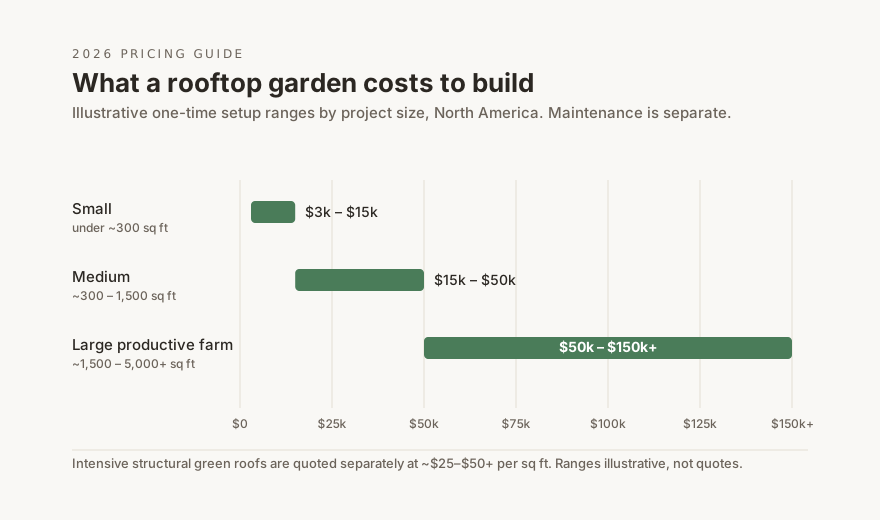
It helps to anchor the conversation in cost-per-square-foot, because that is how most landscape and green-roof professionals quote. Lightweight container and raised-bed gardens sit at the lower end. Full extensive and intensive green roofs — engineered growing systems with drainage layers, waterproofing, and deeper substrate — sit considerably higher, and they overlap with the structural work that the American Society of Landscape Architects documents across green-roof projects. The table below maps typical project sizes to realistic 2026 cost ranges for North American installations. Treat these as planning ranges, not quotes: your actual figure depends on the factors in the next section.
| Project size | What it usually looks like | Typical setup cost range (2026) |
|---|---|---|
| Small (under ~300 sq ft) | Planters, raised beds, herbs and greens, a seating nook | ~$3,000 – $15,000 |
| Medium (~300 – 1,500 sq ft) | Mixed beds and planters, drip irrigation, modest food production | ~$15,000 – $50,000 |
| Large productive farm (~1,500 – 5,000+ sq ft) | Engineered growing system, high-yield food production, programming space | ~$50,000 – $150,000+ |
| Intensive green roof (deep substrate, structural) | Garden-grade landscape, trees/shrubs, requires structural capacity | $25 – $50+ per sq ft |
These ranges are deliberately wide because rooftop gardens are not commodities. Two buildings of identical footprint can differ by a factor of three once you account for roof access, structural reinforcement, and whether you are growing food or simply greening the space. The next section explains exactly which factors move the number.
What factors affect rooftop garden cost?
The factors that affect rooftop garden cost are, in rough order of impact: size, system type, roof structure and access, irrigation and water source, plant selection, and whether the project is decorative or productive. Together these explain why two seemingly similar rooftops can carry very different price tags.
- Size and coverage. The dominant driver. More square footage means more substrate, more plants, more irrigation line, and more labor. Costs do not scale perfectly linearly — there are fixed mobilization costs — but bigger is reliably more expensive.
- System type. Lightweight planters and raised beds are the most affordable. Modular tray systems sit in the middle. Built-in-place extensive and intensive green roofs — with engineered drainage, root barriers, and deeper growing medium — cost the most because they are part landscape, part construction.
- Structural capacity. A saturated growing system is heavy. If your roof needs a structural assessment or reinforcement to carry the load, that engineering and construction can become a significant line item independent of the garden itself.
- Access and logistics. Getting soil, beds, and equipment onto a roof — by stair, elevator, or crane — materially changes labor cost. A roof with easy freight-elevator access is cheaper to build on than one requiring a crane lift.
- Irrigation and water. A nearby water tap and drainage point keep costs down; running new lines or adding automated drip irrigation and timers adds to them. Automation costs more upfront but reduces labor later.
- Plants and purpose. Hardy ornamentals and sedums are inexpensive and low-maintenance. A productive vegetable farm needs richer substrate, more diverse crops, and more hands-on care — which raises both setup and maintenance.
There is also a climate-and-resilience dimension that is easy to overlook. Engineered green roofs deliver measurable building benefits — the U.S. EPA notes that, on a yard-by-yard basis, green roofs achieve annual energy savings of $0.15–$0.57 for cooling and $0.18 for heating. Those operational savings do not lower your build cost, but they are part of why higher-spec systems can pay back over time — a thread we pick up in the ROI discussion below.
What is the difference between setup cost and ongoing maintenance?
Setup cost is the one-time spend to design and build the garden; ongoing maintenance is the recurring cost to keep it healthy, productive, and safe season after season. Confusing the two is the most common pricing mistake — a rooftop garden is not a one-time purchase, it is an asset that needs continuous care, and the maintenance line item is where many self-managed projects quietly overrun.
Setup (one-time) typically covers design and structural review, growing systems (planters, beds, or built-in green-roof layers), substrate and soil, plants and seed, irrigation installation, and the labor to assemble it all on the roof. This is the number most people mean when they ask about price.
Maintenance (recurring) covers planting and harvesting cycles, watering and irrigation upkeep, fertilization and pest management, seasonal turnover, debris and drainage clearing, and the labor to do it consistently. For a productive food-growing rooftop, maintenance is not optional — crops need regular attention, and an unmaintained farm degrades fast. As a planning rule of thumb, annual maintenance for a productive rooftop garden commonly runs a meaningful fraction of the initial setup cost each year, scaling with size and how intensively the space is farmed.
This is precisely why the produce yield alone rarely justifies a rooftop garden on a spreadsheet — the value shows up across tenant amenity, sustainability reporting, and brand. We dig into that calculation in our guide to rooftop garden ROI for corporate buildings, and into the broader question of whether urban farms are profitable once all the value drivers are counted.
Is it cheaper to build a rooftop garden yourself or hire a managed service?
Building a rooftop garden yourself can look cheaper on the initial setup line, but a managed service is usually more predictable and often lower total cost once you account for maintenance, expertise, and risk over several years. The DIY-versus-managed decision is less about the build-day price and more about who carries the ongoing burden of keeping a living system alive on a roof.
A do-it-yourself or general-contractor build gives you maximum control and can minimize upfront spend, especially for a simple planter garden. The trade-offs appear later: you own the agronomy (what to plant, when, how to manage pests), the irrigation troubleshooting, the seasonal labor, the liability of working at height, and the risk that an under-maintained roof garden fails or even damages the roof membrane. For a small ornamental setup, that can be perfectly manageable. For a productive farm, it rarely is.
A managed service — the model Microhabitat operates — bundles design, installation, planting, maintenance, and often tenant programming into a single, predictable annual arrangement. Across Microhabitat's installations in North America and Europe, the recurring pattern is that property teams value the predictability and the offloaded operational risk as much as the produce: one accountable partner, one annual cost, and a farm that is professionally maintained rather than left to a busy facilities team. The right choice depends on scale and intent: DIY suits small, simple, decorative gardens; a managed service suits productive farms and any property owner who wants the outcome without owning the operation. For more on the model and common questions, see our urban farming FAQ.
How do you get an accurate rooftop garden quote?
You get an accurate rooftop garden quote by sharing the specifics that drive cost — roof size, access, structural information, your goals, and your maintenance preference — so a provider can scope the project rather than guess. A generic price range gets you in the ballpark; an accurate quote requires a real look at your roof and your objectives. The faster path follows a clear sequence:
- Measure your usable rooftop area. Even a rough square-footage figure lets a provider place you on the cost curve and rule options in or out.
- Document access and structure. Note how equipment reaches the roof (elevator, stairs, crane) and share any structural or load information you have. These two factors swing the price more than almost anything else.
- Define the goal. Decorative greening, a productive food farm, tenant amenity, sustainability and certification support — or a mix. The purpose dictates the system, the plants, and the maintenance plan.
- Decide build-only versus fully managed. State whether you want a one-time installation or an ongoing managed service. This determines whether you are comparing a single setup cost or an annual all-in figure.
- Request a tailored proposal. Share the above with a specialist who can walk the roof, confirm feasibility, and return a real number rather than a range.
With those five inputs, a credible provider can give you a quote you can actually budget against — setup, maintenance, and timeline included.
Dig deeper: are urban farms profitable, do they raise property value, the corporate ROI model, and the best rooftop plants — or get a custom estimate.
Want a real number for your building, not a range? Contact us for a quote — share your roof size and goals, and we'll scope a rooftop garden tailored to your property.