Are Urban Farms Profitable? ROI Data
Are urban farms profitable? Real ROI data from commercial projects, the revenue and value drivers, and what makes the difference between profit and loss.
On this page
Quick answer: Are urban farms profitable? Yes — but for most commercial buildings the return comes less from produce sales and more from tenant amenity value, ESG and sustainability benefits, branding, and better space utilization. Counted alongside direct yield, a well-run managed installation delivers a measurable return. The key is accounting for total value, not produce revenue alone.
If you are weighing an on-site farm for an office, a retail center, or a mixed-use property, you have probably hit conflicting answers. Stand-alone urban-farming startups make headlines for going bankrupt; corporate rooftop programs get praised as marketing wins. Both stories are true, because they measure profit on completely different ledgers. This guide gives you the honest, numbers-forward version: where the money actually comes from, what published ROI data shows, what separates a profitable installation from a money pit, and how to model the return for your specific building.
Are urban farms profitable? The honest answer
Urban farms are profitable when you count total value, and usually unprofitable when you count produce sales alone. That single distinction explains nearly every contradictory headline you will read. A farm run as a stand-alone food business has to clear commercial rent, labor, and distribution on the strength of vegetable revenue — a brutally thin-margin game. A farm run as a building amenity is measured the way landlords measure any amenity: against tenant attraction, retention, brand value, and sustainability outcomes.
The research backs this up. Published studies of urban-farm economics consistently find that very few sites are financially self-sufficient on produce sales alone, and that the ones that work almost always layer in additional revenue or value streams — education, events, grants, or institutional support. The USDA's own urban agriculture program frames the same reality: urban farms deliver food, but also community, education, and environmental benefits that conventional accounting misses. For a commercial property owner, those "missed" benefits are not soft extras. They are the core of the business case.
So the honest answer is not a flat yes or no. It is conditional: profitable as an amenity and ESG asset, rarely profitable as a produce-only enterprise. The rest of this article shows you how to land on the profitable side of that line.
Where does the value of an urban farm actually come from?
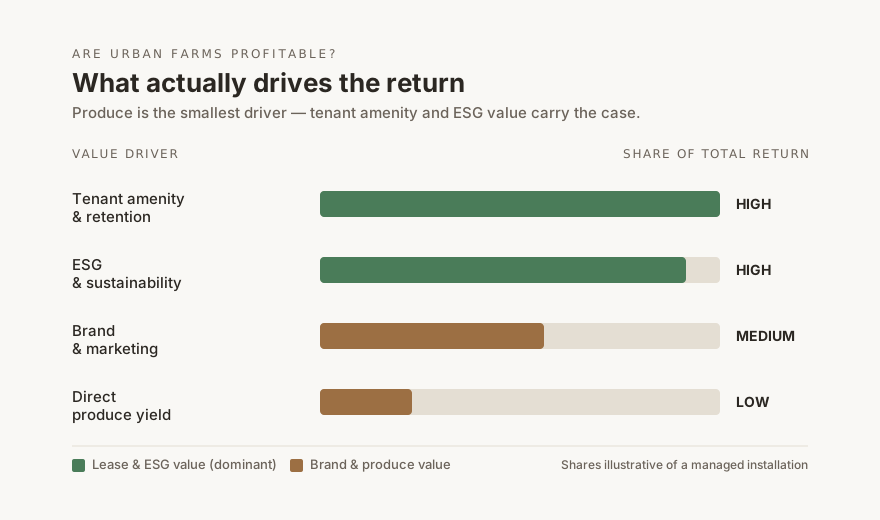
The value of a commercial urban farm comes from four stacked drivers, with produce typically the smallest of them. For a building owner, treating the farm as a single produce line is the most common modeling mistake — it undercounts the return by a wide margin. The table below breaks down the value drivers and roughly how much each tends to contribute to the total return on a corporate installation.
| Value driver | What it delivers | Typical share of total return |
|---|---|---|
| Tenant amenity & retention | Differentiated space, events, perceived wellbeing; supports leasing and renewals | High |
| ESG & sustainability | Biodiversity, stormwater, scope-aligned reporting, certification points (LEED, BOMA BEST, WELL) | High |
| Brand & marketing | Press, social content, tours, recruitment appeal, tenant goodwill | Medium |
| Direct produce yield | Harvests for cafeterias, tenant giveaways, donations, on-site events | Low |
Tenant amenity is usually the largest driver because it plugs into the single biggest number in commercial real estate: lease economics. An amenity that helps win a tenant or renew a lease can be worth more than a decade of vegetable sales in a single signature. ESG value compounds that, because the same farm that hosts a lunchtime event also generates biodiversity and stormwater benefits and contributes to certification credits that increasingly influence financing and valuation. Branding and produce sit lower on the stack, but they are real — produce harvested on-site is the proof that makes the marketing and ESG stories credible rather than greenwashed.
This is also why our deeper look at whether urban farms increase property value matters to the profit question: the asset-value lift is part of the return, not a side effect. If you want the operational picture behind these drivers — how a managed farm is designed, planted, and run across a season — start with how urban farms work.
What is the ROI of a rooftop farm or commercial urban farm?
The ROI of a commercial urban farm depends almost entirely on whether you count amenity and ESG value, and on whether the farm is professionally managed. Produce-only ROI is usually weak; total-value ROI on a well-run managed installation is positive and measurable. Published research on urban-farm economics consistently shows the same pattern: thin or negative margins on food sales alone, and viable economics once additional value streams are included.
Independent studies reinforce this. Research collected by the USDA National Agricultural Library on the economics of urban agriculture documents that profitability hinges on diversified revenue and on keeping infrastructure and labor costs in check — exactly the variables a building owner can control by treating the farm as a managed amenity rather than a side venture. Academic work on rooftop agriculture similarly finds that the strongest returns come from integrating the farm into the building's operations, branding, and tenant programming rather than running it as an isolated food operation.
Across Microhabitat's installations on commercial and institutional properties in North America and Europe, the projects that perform best follow that integrated model: the farm is run by trained urban farmers, the harvest feeds tenant events and donations, and the data feeds straight into the building's sustainability and wellness reporting. We keep specific client ROI figures with the clients they belong to, but the consistent finding is that the amenity, ESG, and brand value materially exceed the produce value — which is precisely why the total-value lens is the right one. For a building-by-building breakdown of how that math is built, see our analysis of rooftop garden ROI for corporate buildings.
What separates profitable urban farms from money pits?
Profitable urban farms differ from money pits in five controllable variables, and almost every failed project gets at least one of them wrong. The headline-grabbing bankruptcies were rarely caused by bad gardening — they were caused by business-model and cost-structure mistakes that a building owner can avoid by design. Use this checklist to pressure-test any proposal before you commit.
- Counted value vs. produce alone. Profitable projects budget for amenity, ESG, and brand value from day one; money pits expect vegetables to pay the rent.
- Managed vs. neglected. Profitable farms are run by trained operators; money pits rely on unpaid volunteers or staff with no horticulture time, and the space degrades.
- Right-sized infrastructure. Profitable farms match the growing system to the roof or grounds; money pits overspend on complex, high-energy build-outs that never recoup.
- Integrated vs. isolated. Profitable farms tie into leasing, events, cafeteria, and reporting; money pits sit in a corner disconnected from anything that creates value.
- Realistic timeline. Profitable owners model a multi-year return that includes intangible value; money pits expect produce-sales payback in year one and abandon the project when it doesn't appear.
The pattern is clear: the failures cluster around treating an urban farm like a commodity food business on expensive urban land, while the successes treat it like a building amenity that also happens to grow food. The difference is strategy and management, not luck or climate.
How do you model the return of an urban farm for your building?
You model an urban farm's return by listing every value stream it touches, not just produce, then comparing the total against the all-in annual cost of a managed installation. The most common error is a spreadsheet with one revenue line — harvest value — versus a full cost stack. That comparison will always look bad, and it is the wrong comparison. Build the model in this order.
- List the value streams. Tenant amenity and retention, ESG and certification contribution, brand and marketing reach, recruitment appeal, and produce yield. Assign each a value, even a conservative one.
- Anchor amenity value to your leases. Estimate how the farm supports attraction and retention, then express that against your actual rent and renewal economics — usually the largest number in the model.
- Quantify the ESG contribution. Map the farm to your reporting and certification goals (LEED, BOMA BEST, WELL) and to biodiversity and stormwater outcomes you would otherwise pay to achieve.
- Add the all-in cost. Use a managed-service quote covering design, installation, trained labor, seasonal operation, and reporting — not just materials.
- Compare over a realistic horizon. Look at the total-value return across several seasons, not produce payback in year one.
Done this way, the model usually flips from "marginal" to "clearly worthwhile," because the dominant value drivers finally appear on the page. If you want help sourcing the inputs — typical costs, certification credits, and the questions worth asking a provider — our urban farming FAQ collects the practical answers prospects ask most often before committing.
The bottom line: urban farms are profitable for commercial buildings when they are managed well and measured honestly. Treat the farm as an amenity and ESG asset, account for the full stack of value it creates, and the return is real and quantifiable.
To put numbers to your own building, see the full rooftop garden cost breakdown and calculate your farm's ROI.
Ready to see the numbers for your property? Contact us for a quote and we'll build the total-value model for your building, roof, or grounds.