Do Urban Farms Raise Property Value?
Data on green space, rents, occupancy and appeal: how rooftop farms shift the value of commercial buildings.
On this page
Quick answer: Do urban farms increase property value? The evidence on green space and amenities indicates yes — indirectly. Urban farms support building value by improving tenant attraction and retention, enabling sustainability and amenity positioning, and differentiating an asset in competitive markets. The effect runs through rents, occupancy, and asset appeal rather than a direct line-item valuation bump.
If you own or manage a commercial building and you are weighing an on-site farm, the question you actually care about is financial: does the green space pay for itself in the value of the asset? The honest, numbers-forward answer is that urban farms move property value the same way the best amenities do — by changing how a building leases, who wants to be in it, and how long they stay. Below, we lay out the mechanisms, the third-party data on green space and value, and a practical way to estimate the impact for your own building, without inflating the case beyond what the evidence supports.
Do urban farms increase property value? What the data shows
Urban farms increase property value indirectly, by strengthening the rent, occupancy, and positioning levers that drive a commercial building's valuation rather than adding a fixed dollar amount to an appraisal. No appraiser assigns a standalone "farm premium" to a building. What the evidence does show is that green space and well-run amenities are consistently associated with higher property values, and an on-site farm is a particularly visible, programmable form of green amenity.
The clearest third-party signal comes from green-space research in real estate economics. A USDA Forest Service national meta-analysis of tree cover and property values (Kovacs, West, Nowak & Haight, 2022) pooled 21 hedonic property-value studies and 157 observations and found that tree cover is positively capitalized into home prices — with the effect roughly four times larger in neighborhoods above 25% tree cover than in those with almost none. Earlier USDA Forest Service work found that street trees in front of a house added, on average, about $8,870 to its sale price and reduced time on market. These figures are residential, not commercial, but they establish a durable principle: buyers and tenants pay measurably more for proximity to greenery. An on-site farm brings that greenery into a commercial property as an active, year-round amenity.
What are the mechanisms by which urban farms affect property value?
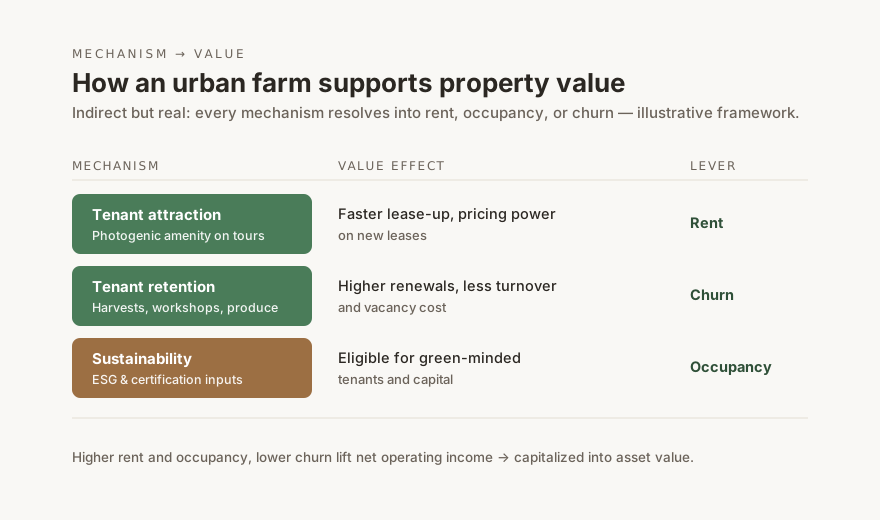
Urban farms affect property value through three mechanisms — tenant attraction and retention, amenity and sustainability positioning, and competitive differentiation — all of which feed the rents and occupancy that determine a building's worth. Commercial real estate is valued largely on net operating income and the capitalization rate applied to it, so anything that lifts achievable rent, raises occupancy, or lowers tenant churn flows directly into value. A farm is not magic; it is a lever on those exact inputs.
The table below maps each mechanism to the value effect it produces and the metric an owner can actually track.
| Mechanism | How the farm drives it | Value effect | Metric to track |
|---|---|---|---|
| Tenant attraction | Distinctive, photogenic amenity that strengthens leasing tours and marketing | Faster lease-up, pricing power on new leases | Days on market, achieved rent vs. asking |
| Tenant retention | Programming (harvests, workshops, fresh produce) that deepens occupant connection | Higher renewal rates, lower vacancy and turnover cost | Renewal rate, tenant churn |
| Sustainability positioning | Documented green amenity supporting ESG, wellness, and certification narratives | Eligibility for green-minded tenants and capital | Certification credits, ESG reporting inputs |
| Differentiation | A feature few competing buildings offer in the same submarket | Reduced substitutability, defended rents | Comp-set premium, leasing win rate |
| Occupant wellbeing | Hands-on nature engagement linked to satisfaction and amenity use | Stronger tenant satisfaction scores | Occupant surveys, amenity usage |
Read down the "value effect" column and the pattern is clear: every mechanism resolves into either higher rent, higher occupancy, or lower churn. That is precisely how an amenity becomes value rather than just cost — and it is the same logic behind the rooftop garden ROI for corporate buildings that owners use to justify the investment.
How do urban farms drive tenant attraction and retention?
Urban farms drive tenant attraction and retention by giving a building a differentiated, experiential amenity that tenants engage with repeatedly, which is exactly what reduces churn and defends rents. Retention is the highest-leverage of the three mechanisms, because vacancy is expensive: every month a commercial space sits empty is lost rent plus re-leasing costs, broker fees, and tenant-improvement allowances. Amenities that make occupants want to stay quietly protect a building's income stream, and income is what gets capitalized into value.
A farm earns its retention impact through programming, not just appearance. Unlike a static green roof or a lobby planter, an operating farm produces a recurring stream of reasons to engage — seasonal harvests, on-site workshops, fresh produce for tenants, and visible change through the growing year. Across Microhabitat's installations on commercial and institutional properties in North America and Europe, the consistent observation is that occupants return to a space they can tend, harvest, and watch change, and that sustained engagement is what separates a living amenity from a one-time design feature. For the leasing team, that translates into a concrete story to tell on every tour and at every renewal conversation. To see what that amenity actually involves operationally, our overview of how urban farms work walks through the managed-service model behind it.
Do sustainable buildings and green amenities command higher rents and asset appeal?
Sustainable buildings and well-amenitized green spaces generally command stronger leasing demand and asset appeal, which supports — though does not single-handedly guarantee — higher rents and values. Across commercial real estate, sustainability credentials and distinctive amenities have moved from optional to expected for a large segment of corporate tenants with their own ESG commitments. A building that can document a genuine green amenity is eligible for demand that a comparable conventional building is not, and that demand is what underwrites pricing power.
An on-site farm contributes to this positioning in two ways. First, it is a tangible, occupant-accessible sustainability feature that produces real artifacts — programming, produce, and engagement data — for ESG and wellness reporting, rather than an abstract claim. Second, it supports the kind of asset narrative that helps a building stand out to both tenants and investors who screen for environmental performance. The underlying economic value of urban greenery is well documented: the USDA Forest Service's Value of Urban Forests research has found returns on the order of $1.89 in benefits for every $1 invested in urban forest management in case studies such as Modesto, California. A commercial farm channels a version of that documented green-amenity value into a single, leasable building.
How do you estimate the value impact of an urban farm for your building?
Estimate an urban farm's value impact by modeling its effect on rent, occupancy, and retention for your specific building — not by assuming a flat valuation premium. Because the value runs through net operating income, even small, defensible improvements in the right inputs can outweigh the program's cost. Work through these numbered steps to build a grounded estimate rather than a guess:
- Establish your baseline. Pull current occupancy, the average achieved rent per square foot, your annual tenant churn rate, and the all-in cost of re-leasing a vacated space (downtime, broker fees, improvements).
- Model a retention gain. Estimate how a distinctive, programmed amenity might reduce churn — even a modest reduction in turnover avoids substantial re-leasing cost and lost rent. Convert that to annual dollars saved.
- Model a rent or lease-up effect. Consider whether the amenity supports a small pricing premium on new and renewing leases, or faster lease-up of vacant space, and quantify the conservative case.
- Add the positioning value. Account for the harder-to-price benefits — ESG and certification inputs, tenant satisfaction, marketing differentiation — qualitatively alongside the hard numbers.
- Apply your cap rate. Capitalize the recurring NOI improvement (rent gains plus avoided churn cost) at your building's cap rate to translate annual income impact into an estimated change in asset value.
- Compare to program cost. Weigh that value estimate against the farm's installation and managed-service cost to see the net effect on the asset.
This is the same framework that determines whether any amenity pencils, and it keeps the case honest. If you want to pressure-test the operating economics underneath it, our analysis of whether urban farms are profitable examines the cost-and-return side directly, and our urban farming FAQ answers the common follow-up questions on cost, logistics, and outcomes.
The bottom line on urban farms and property value
Urban farms support property value by improving the rents, occupancy, and asset appeal that drive a commercial building's worth — an indirect but real effect, consistent with the documented relationship between green space and value. The case is strongest when the farm is run as a managed, programmed amenity that tenants actually use, and when its impact is tracked through the right metrics rather than assumed. Treated that way, an on-site farm is not a cost center with a vague green halo; it is an amenity investment you can model, defend, and measure like any other.
To put numbers to your own building, see the full rooftop garden cost breakdown and calculate your farm's ROI.
Ready to model the impact for your building? Contact us for a quote and we will scope an on-site farm and walk through its expected effect on tenant retention, leasing, and asset value with you.