
Green BuildingsESG
De Botanische Bento is een vastgoednoodzaak
Biofiel ontwerp op de werkplek gaat verder dan esthetiek. Ontdek hoe MicroHabitats Botanische Bento ESG-scores, huurdersretentie en vastgoedwaarde verhoogt.
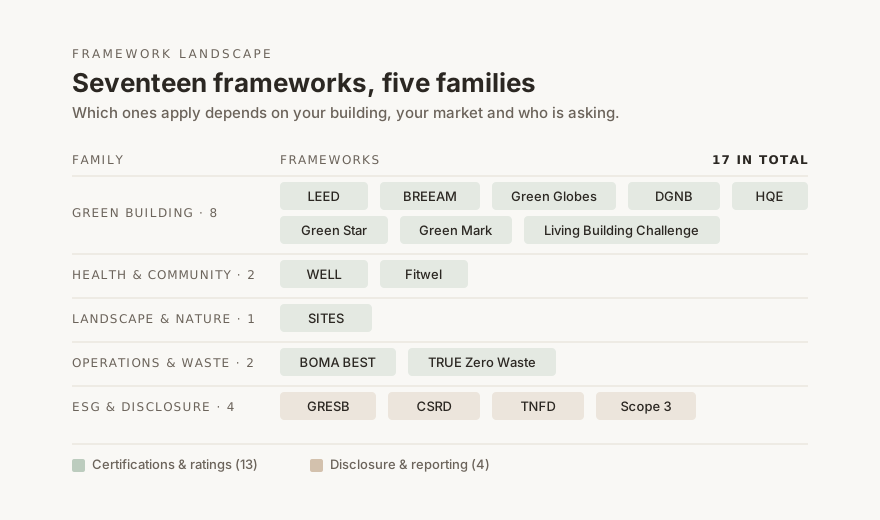
LEED, WELL, BREEAM, GRESB, BOMA BEST, Fitwel, DGNB, HQE, Green Star, CSRD, TNFD and more — what each one is for, where it applies, and how to tell which belong on your building's shortlist.
Quick answer: Seventeen frameworks sort into five families — green building (LEED, BREEAM, Living Building Challenge, Green Globes, DGNB, HQE, Green Star, Green Mark), health & community (WELL, Fitwel), landscape & nature (SITES), operations & waste (BOMA BEST, TRUE Zero Waste), and ESG & disclosure (GRESB, CSRD, TNFD, Scope 3). Which apply to you is driven by four things: where the building is, what type of asset it is, whether it is new or in operation, and what is pushing you — regulation, investors, or tenants.
The honest problem with certification is not that the standards are bad. It is that there are seventeen credible ones, they overlap, several are regional, and the acronyms give you no clue which are relevant. Teams routinely pursue the certification they have heard of rather than the one that fits, and discover the mismatch late.
This is a map. It will not make the choice for you — the four variables below do that — but it will stop you shortlisting a standard that was never going to apply.
Green building systems assess the building’s environmental performance — energy, water, materials, site, ecology. This is the category most people mean by “certification,” and it is the biggest: eight of the seventeen. The Living Building Challenge sits here too, as the most demanding of them.
Health & community systems assess the building’s effect on the people inside it — air, light, nourishment, movement. They run alongside a green building system rather than replacing it, which surprises people.
Landscape & nature is SITES, alone in its family: it grades the site and its landscape rather than the building on it, which is why it is the one standard where a farm is close to the whole subject rather than one credit in it.
Operations & waste covers how a building is actually run, once it is running: BOMA BEST on operational performance, TRUE on waste and circularity. This is the family people forget exists, and it is the one an existing building is usually most ready for.
ESG & disclosure frameworks are a different animal entirely. They do not certify a building or award a plaque — they set what you must report, often at fund or portfolio level, and increasingly by law rather than by choice.
| System | Group | Assessed by | Where it is strongest | Applies to |
|---|---|---|---|---|
| LEED | Green building | USGBC / GBCI | North America, global | New build + in operation |
| BREEAM | Green building | BRE | UK, Europe, growing US | New build + in operation |
| Green Globes | Green building | GBI | US, Canada | New build + in operation |
| DGNB | Green building | DGNB | Germany, Europe | New build + in operation |
| HQE | Green building | Cerway | France, francophone | New build + in operation |
| Green Star | Green building | GBCA | Australia, NZ | New build + in operation |
| Green Mark | Green building | BCA | Singapore, SE Asia | New build + in operation |
| Living Building Challenge | Green building | ILFI | Global, most demanding | Mostly new build |
| WELL | Health & community | IWBI | Global | Buildings + interiors |
| Fitwel | Health & community | Center for Active Design | North America, global | Buildings + interiors |
| SITES | Landscape & nature | GBCI | Global | Landscape / site |
| TRUE Zero Waste | Operations & waste | GBCI | Global | Waste / circularity |
| BOMA BEST | Operations & waste | BOMA Canada | Canada | In operation |
| GRESB | ESG & disclosure | GRESB | Global, investor-facing | Funds / portfolios |
| CSRD (ESRS) | ESG & disclosure | Regulatory (EU) | EU | Corporate entity |
| TNFD | ESG & disclosure | TNFD | Global | Corporate / portfolio |
| Scope 3 | ESG & disclosure | GHG Protocol | Global | Corporate value chain |
Four variables, and they do almost all the work.
Geography. Several systems are effectively regional. BOMA BEST is Canadian. HQE is French. DGNB is German. Green Star is Australian and New Zealand. Green Mark is Singaporean. Pursuing DGNB on a Toronto office is not wrong so much as pointless — nobody in that market is asking for it. LEED and WELL travel globally; BREEAM travels across Europe and is gaining ground in the US.
Asset type. Office, retail, mixed-use, institutional and educational assets are graded differently, and some credits simply do not exist for some typologies.
Project stage. This is the one that catches people. New construction, major renovation, and existing-building-in-operation are graded against different editions of the same standard. LEED v4.1 BD+C is not LEED O+M. Being assessed against the wrong edition is a common and completely avoidable failure — and it is why “we are doing LEED” is not yet a decision.
What is driving it. Regulation points you at disclosure frameworks — if CSRD catches your entity, that is not a preference. Investor pressure points at GRESB, because that is what funds are benchmarked on. Tenant demand points at WELL and Fitwel, because those are the ones tenants can feel. Voluntary leadership opens the field.
Worth stating plainly, because conflating these wastes quarters.
A certification is a building-level achievement, awarded by an authority, that you pursue. A disclosure framework is an obligation at entity or portfolio level that you satisfy. GRESB benchmarks funds, not single buildings — which is why “we should get GRESB certified” is a category error. CSRD applies to a company. TNFD reports on nature-related dependencies across a business.
Most portfolios end up needing both: certifications on assets, disclosure at the top. They are complementary, not alternative.
Across the green building and health systems, a rooftop or urban farm is a directly qualifying compliance path — not a nice-to-have that a reviewer might reward:
| System | Credit |
|---|---|
| LEED | SSc5 Heat Island Reduction |
| WELL | N12 Food Production |
| Fitwel | OS1 Garden |
| BOMA BEST | Green roof ≥30% coverage |
| BREEAM | LE04 ecology |
| GRESB | TC4 Community |
And on the disclosure side, on-site nature features feed CSRD’s ESRS E4 biodiversity disclosures and TNFD’s nature-related reporting directly. One physical intervention, evidence in several frameworks at once — which is the actual argument for it.
You could work the four variables against the table above by hand. Or answer eight questions — country, asset type, project stage, green space on site, portfolio size, what is driving it — and get the shortlist returned, best fit marked first, with a plain-language reason for every one. Already certified? Add the year and you will see how your validity is tracking as versions move on.
No account needed to look.
See what your building unlocks →
Going deeper on a single framework: GRESB · LEED v5 · WELL v2 · BOMA BEST · CSRD · TNFD · Scope 3. The pillar guide to ESG-aligned urban farming ties them together.
Biofiel ontwerp op de werkplek gaat verder dan esthetiek. Ontdek hoe MicroHabitats Botanische Bento ESG-scores, huurdersretentie en vastgoedwaarde verhoogt.

MicroHabitat introduceert de Botanische Bento — een precisie-ontworpen modulair ecosysteem dat statische daken transformeert tot de meest productieve activa.

Vancouvers Rain City-gids zet de blauwdruk voor stedelijke veerkracht. Zo transformeert MicroHabitat beleidsdoelen in productieve, levende daken.
Volgende stap
Sluit u aan bij meer dan 250 panden die al groeien met MicroHabitat. Ons team regelt alles, van ontwerp tot oogst.