On this page
Quick answer: The contract and local law decide who answers for what on a rooftop farm. A common starting point: the owner covers the roof, its access and the building; the provider covers its own work and staff; activities get supervision agreed in advance. Have your broker and lawyer confirm the split and the insurance this winter, before signing for spring 2027.
Part of our guide: Outdoor Farm.
Rooftop garden insurance is easy to postpone until a lease review or a lender’s questionnaire brings it up. By then the farm is installed, the activity calendar is set and nobody remembers who agreed to what. In climates with a winter shutdown, the outdoor season has ended and the next installation window is spring 2027, so the coming months are the natural time to settle contracts, coverage and rooftop farm liability.
This article is a checklist of questions for your broker and your lawyer, not insurance or legal advice. Rules, customary limits and policy wording differ by country, province and state, and only the professionals who read your documents can say what your building needs.
Who is responsible for what on a rooftop farm?
Your contract and the law where the building stands decide who is responsible for what, so before you meet your broker and lawyer, sort each risk by who controls it. The owner or property manager controls the roof, the access route and the building’s rules. The provider controls how its urban farmers work, what equipment they bring and how they run the activities they lead. Tenants and visitors control very little, so their safety has to be planned by the other two.
The table below is a common starting point for that conversation, not a rule. Treat every row as a question to check with your broker and lawyer.
| Risk | Often responsible | What to ask for |
|---|---|---|
| Roof structure and load | Owner, advised by a structural engineer | An engineer’s review before the layout is final |
| Roof membrane and drains | Owner, within the terms of any roofing warranty | Placement rules, protective mats and a condition record |
| Access route, roof edges and guardrails | Owner or property manager | Written access rules and a plan of open and closed areas |
| Injury to the provider’s staff | Provider, as their employer | Proof of workers’ compensation or the local equivalent |
| Damage or injury caused by the provider’s work | Provider | A certificate of liability insurance, with limits your broker approves |
| Tenants and visitors at activities | Shared by the building host and the provider | A named supervisor, a maximum group size and an incident procedure |
Weather decisions and seasonal checks also need an owner. Our autumn review of rooftop farm responsibilities covers that split.
What insurance should a rooftop farm provider carry?
Expect a rooftop farm provider to carry liability insurance for damage or injury its work could cause to others, and coverage for its own employees if they are hurt on the job. In North America the first is often called commercial general liability and the second workers’ compensation, but the names and the systems change from place to place. Ask whether the policy describes the work the provider will actually do on your roof, workshops included.
Proof of workers’ coverage depends on where you are. In the United States, the U.S. Department of Labor directs people injured while working for private companies to their state workers’ compensation board, so the right document varies by state. In Ontario, the WSIB issues clearances showing that a business is registered and up to date with its premiums and reporting, each valid for up to 90 days. Your lawyer can tell you which system applies to your contract.
Which types and limits to require is for your broker to decide, informed by your lease, your lender and the building’s own insurance. As one example, MicroHabitat’s programs include liability coverage, which its FAQ describes; ask any provider for the same information in writing. More questions to put to a provider are in our guide to choosing an urban farm provider.
What does a certificate of insurance actually prove?
A certificate of insurance proves that a policy existed on the day the certificate was issued, and not much more. The Connecticut Insurance Department puts it plainly: a certificate is a snapshot of coverage, it confers no rights on the certificate holder, the holder is owed no notice if the policy is cancelled, and a certificate cannot amend, expand or alter the policy it describes. Other jurisdictions word this differently, so ask your broker how it works where your building stands. Treat the certificate as a pointer to the policy, not as the policy.
When a certificate arrives, check these points with your broker:
- The named insured is the same legal entity that signs your contract.
- The policy period covers the whole season, including installation and removal.
- The coverage types and limits match what you asked for.
- The described operations include urban farming, installation and activities with participants.
- A new certificate arrives at every renewal, instead of last year’s copy staying on file.
Should the building owner be named as an additional insured?
Whether the owner should be named as an additional insured is a question for your broker, who will weigh it against your lease and your own insurance. In North America, an owner may ask to be added to the provider’s liability policy this way, so that the policy also protects the owner on the terms it sets out. The Connecticut bulletin notes that a certificate holder only gains that status through an endorsement, or by being named an insured in the policy itself, and that there may be a cost.
If you go this way, ask for the endorsement itself, not only a certificate that mentions it, because its wording sets what is covered. List the entities to include, such as the ownership entity and the property management company, and agree how names will be updated if the building changes hands or managers. Outside North America, the practice and the vocabulary can differ: ask your broker how the owner’s interests can be protected, and your lawyer how the contract should share liability.
How do you keep tenants, visitors and staff safe on the roof?
Safety on a rooftop farm rests on three written agreements: who may go onto the roof, how activities are supervised and how incidents are reported. Thresholds for working near a roof edge differ by country. In the United States, OSHA requires fall protection at four feet in general industry and six feet in construction, and counts falls among the most common causes of serious work-related injuries and deaths.
For a rooftop farm, agree the following before the first site visit:
- Access: who holds keys or badges, whether urban farmers sign in, which route they take with tools and soil, and which parts of the roof stay closed.
- Edges: how far growing areas and activities stay from roof edges, and which local rule sets that distance.
- Activities: a named host from the building, a named lead from the provider, a maximum group size and registration in advance.
- Conduct: participants stay inside marked areas, and nobody remains on the roof without a host.
- Emergencies: who calls for help, where the first-aid kit is kept and how the roof is cleared.
- Incidents: what counts as one, who is told and how quickly, and where the record is kept.
Records matter as much as rules. MicroHabitat’s urban farmers, for example, record every site visit in MyUrbanFarm, and those records feed the End of Season Report. Whoever your provider is, agree how an incident, a near miss or damage to the roof reaches the property team, who reports it and how quickly, so patterns show up before they turn into claims.
How is the roof protected, and what happens when the farm leaves?
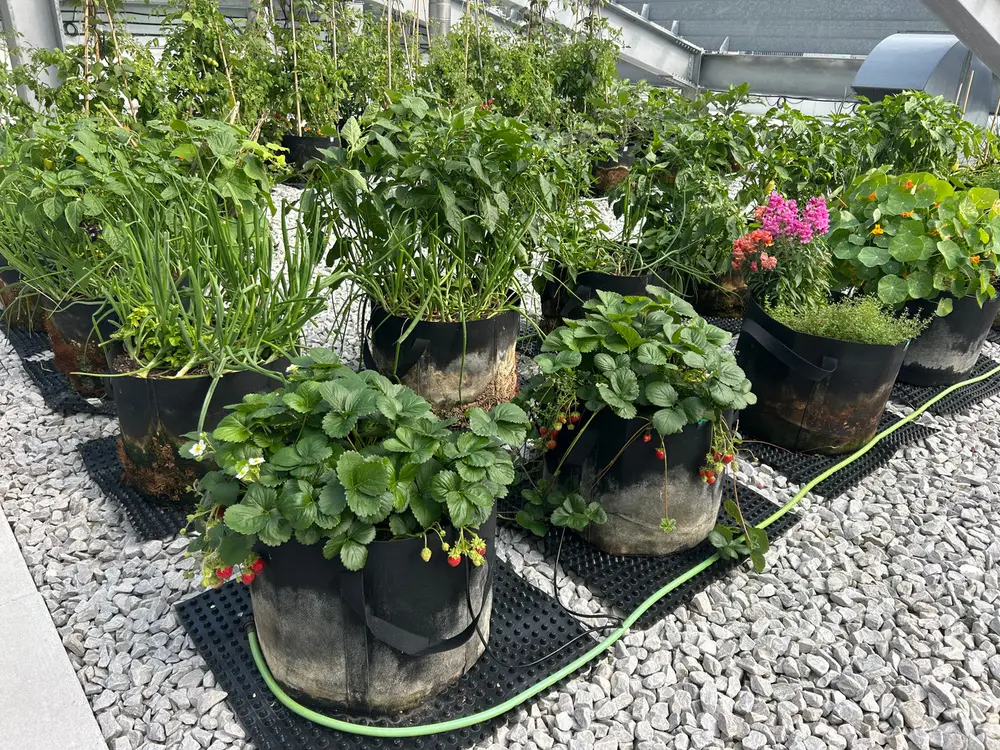
The roof is protected by agreeing, before installation, where containers may sit, what they sit on and how the roof’s condition is recorded at the start and the end. A container farm in fabric pots does not need to be fixed to the roof, but a container still concentrates weight, holds water and can block a drain if placed badly. Ask for placement rules that keep drains and walkways clear, protective mats under containers and a dated photo record of the membrane before anything goes up.
Weight is a question for the structural engineer; our guide to how much weight a roof can hold explains what they check. If the membrane is under a manufacturer’s warranty, ask your roofing contractor whether it sets conditions for anything placed on the roof. At the end of the contract, a removal and handover clause should say:
- who removes containers, growing medium, irrigation lines and signage, and by what date;
- what condition the roof must be in at handover, compared with the starting record;
- what happens to equipment between seasons in climates with a winter shutdown;
- how the contract transfers if the building is sold or its manager changes.
When should you review insurance and contract terms for 2027?
Review insurance and contract terms over the winter, before the spring installation window opens, so certificates, endorsements and access rules are settled before anyone carries a pot onto the roof. Start with the lease clauses on roof use, your property insurance requirements, any roofing warranty and last season’s records. Then send the provider’s draft contract and certificate to your broker and lawyer early enough for any endorsement to be issued before a spring 2027 installation.
Warmer climates run on a different growing cycle, so adjust the timing to your own season. Teams with several buildings can use one checklist and note the differences site by site; our page on urban farms for commercial real estate shows how a farm program fits a portfolio.
Frequently asked questions
Will a rooftop farm change our property insurance premium?
Only your insurer can answer that, and the answer depends on your policy and your building. Tell your broker about the farm and any planned activities before installation, so the new use of the roof is disclosed.
Who is liable if a participant is hurt at a harvest activity?
It depends on what happened, the contracts in place and the law where the building is located. That uncertainty is why supervision, group sizes and insurance should be agreed before the first activity, with your lawyer’s input.
Should participants sign a waiver or a registration form?
Some organizations use a registration form so they know who is on the roof. Whether a waiver has legal effect varies by jurisdiction, so ask your lawyer before relying on one, and remember that no form replaces supervision.
If you are planning a rooftop farm for spring 2027, send this checklist to your broker this winter and ask your provider for its certificate and draft contract early, so the paperwork is done before the season starts.