On this page
Quick answer: An urban farm impact report should measure what the farm produced and who took part: harvest weight by crop, donations picked, delivered and accepted, activities and attendance, site visits, dated observations and consented photos. Every figure needs a label saying whether it was measured or estimated, a named source and a reviewer before it reaches an ESG report.
In climates with a winter shutdown, the outdoor growing season has just ended, and the farm’s numbers are about to travel. They will end up in a sustainability report, a GRESB response, a tenant newsletter or a certification submission, usually copied there by someone who never saw the farm. An urban farm impact report is the document that carries them, and its value depends less on the size of the harvest than on how each figure was collected, labelled and checked.
This guide covers the measurement system behind those numbers: what to measure across the year, how to set the method before the season starts, who checks the figures and where they end up. Companion articles go deeper on the weekly record and on the End of Season Report. Mapping the farm to individual rating systems and disclosure frameworks is covered in our ESG urban farming guide.
What should an urban farm impact report measure?
An urban farm impact report should measure only what the farm can evidence: harvest weight, donations, activities and attendance, site visits, growing area and dated observations, with carbon handled separately and with care. In this guide, measured means weighed, counted or recorded when it happened, and estimated means calculated from other information.
The table shows how the usual metrics are collected, how they should be labelled and where they tend to be used. Treat it as a starting point for your own method, not a fixed standard.
| Metric | How it is collected | Measured or estimated | Where it is used |
|---|---|---|---|
| Harvest weight by crop | Weighed at the farm on harvest day and logged with the site visit | Measured; estimated only for harvests that were not weighed, with the method stated | End of Season Report, ESG report, tenant or employee updates |
| Donations | Weight recorded at pick-up; delivery and acceptance confirmed by the recipient | Measured at each stage; delivered is never assumed to equal accepted | Community section of a sustainability report, partner updates |
| Activities and attendance | Headcount or sign-in sheet at each activity | Measured if counted on the day; estimated if counted afterwards | Engagement reporting, internal communication |
| Site visits | A dated entry for every visit | Measured | Contract review, End of Season Report |
| Growing area | Measured at installation and updated when the layout changes | Measured | Report scope, certification evidence |
| Observations | Dated notes and photos taken at repeatable points | Observations, not a count of biodiversity | Biodiversity narrative, with its limits stated |
| Carbon | Not measured on a small farm; any figure comes from a model | Estimated (modelled), never a measured saving | Only with its method stated, never as a saving or an offset |
Outcomes are left out of the table on purpose. A farm program can record what was done and what was seen; a change in biodiversity, wellbeing or local food security would need its own method, a baseline and usually a specialist, and should not be read into these figures.
How do weekly records become season figures?
Weekly records become season figures when they are added up for a stated scope and period, so a season total is only as good as the visit entries behind it. The chain runs from the visit record, through the End of Season Report, to whatever your organization publishes.
At each visit, the essentials for reporting are the date, what was harvested and weighed, with the unit, where it went and anything observed. A harvest figure reconstructed in October from memory is an estimate, however confidently it is written down. Our guide to what your farm provider should report every week sets out what each visit should record and what to agree to receive from it.
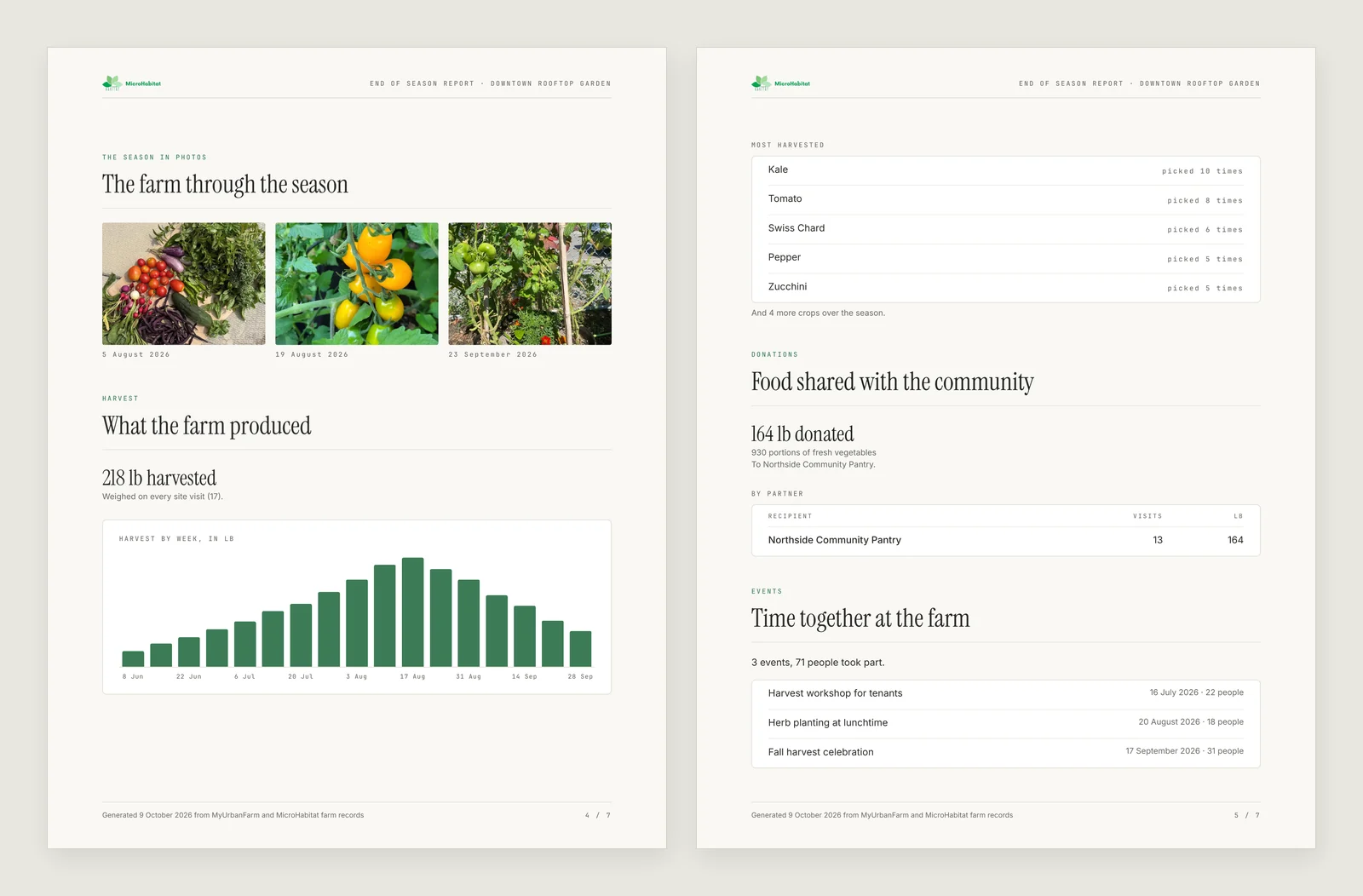
That adding-up happens in the End of Season Report, which should state its scope and period and keep measured figures and estimates apart. What it should contain, how to read it and what to ask if something is missing are covered in our article on what goes in an End of Season Report.
MicroHabitat’s urban farmers, for example, record every site visit in MyUrbanFarm. The client edition of the End of Season Report built from those records leads with the weighed harvest and shows any estimate separately, labelled as one. Between reports, clients follow the farm through regular posts and photos on its page.
Beyond the season report, measured farm data can also become part of the evidence in a certification report, a separate document that the certifying body reviews against its own requirements.
How do you set the measurement method before the season starts?
Write the method down before the first harvest: what is counted, in which unit, by whom, how each figure is labelled and how an estimate will be made if a measurement is missed. Rules agreed in advance keep a season’s figures consistent from first week to last.
There is a reporting reason too. The GRI 1: Foundation 2021 standard, which sets out the reporting principles of the GRI Standards, asks organizations to indicate which data has been measured and which has been estimated, and to explain the assumptions and techniques behind each estimate. An estimating rule agreed in spring is easy to explain; one invented in January to fill a gap is not.
A one-page method usually settles five points:
- Scope: which farm or farms, which dates and which growing area, and whether an indoor farm is reported on its own. Without a stated scope, a total cannot be compared with last year or with another site.
- Units: kilograms or pounds, chosen once and shown on every figure. Never mix the two in one column.
- Visit fields: the entries every visit record must carry, in the same form each time, so that the totals add up.
- Labels and estimates: the rule for calling a figure measured or estimated, and the method to use if a harvest cannot be weighed, decided before it happens.
- Sign-off: who reviews the season totals, on the provider’s side and on yours, before they are used.
Once the method is fixed, every report applies it, and the labels have to survive every copy. A figure moved into a slide or a newsletter keeps its label and its unit.
How should donations and participation be counted?
Count donations at each stage where the produce changes hands, and count participation as attendance at activities, without collecting more personal information than people have agreed to share. Both sound simple, and both are where totals drift most easily.
For donations, report the stage you can evidence and name it: picked, delivered or accepted. Our World Food Day article on harvest donations explains why those three figures differ and how to plan the handover with the receiving organization.
Avoid double counting: produce that went to a food bank is not also part of the tenant harvest. A cumulative figure such as MicroHabitat’s 59,400 lbs of produce donated to 35+ food banks is the sum of many single handovers, and a total like that only means something if each handover was recorded.
Be careful with conversions. Turning pounds of produce into meals, portions or people fed needs a conversion factor, and that factor belongs to someone. If a food bank gives you one, name it and label the result as an estimate. If nobody gives you one, report the weight.
For participation, record what was offered and how many people came: the activities held, the type of each activity and its attendance. Aggregate counts are usually enough. Names, photos and quotes need the person’s consent, and participation should never be linked to anyone’s performance review. If you want to know whether people valued an activity, a short, optional and anonymous question tells you more than a list of names.
How should observations and photos be used as evidence?
Observations and photos are supporting evidence: they show what was seen on a given date, not a measured change in biodiversity or wellbeing. Used that way, they make a report more credible; used as proof of an outcome, less so.
A useful observation is dated and specific: bees visiting the flowering herbs on a warm July morning, noted with where, by whom and in what conditions. A claim that the farm increased local biodiversity is a different kind of statement, and our article on building a credible biodiversity evidence plan explains what it would take to support one.
For photos, the reporting test is traceability. Keep the original file and its date with the visit record, so that a picture in a report can be traced back to the site visit it came from. Consent from anyone identifiable comes first, and published images should show no client branding or address details.
Can a small urban farm claim carbon savings?
In most cases, no: a small urban farm should not report a carbon saving, because the figure would rest almost entirely on assumptions that nobody measured. Leaving it out is more credible than including a number that cannot be defended.
Avoided transport emissions depend on which food the harvest replaced and how that food would have travelled, and neither is known. Carbon taken up by crops is short-lived, because the crops are harvested and eaten or composted within the season. The farm also has its own footprint, from materials and growing media to the trips needed to look after it. A credible carbon figure would need a recognized accounting method, a defined boundary and data that a small farm program does not produce.
What you can report instead is what you measured: growing area, harvest, donations, participation and observations, with any climate relevance described in words. If a report does show a modelled figure, such as carbon taken up by the plants, it should be labelled as an estimate, state its method and never be presented as a saving or an offset. Wherever you operate, ask your legal or compliance team to review any climate claim before it is published.
Who checks the figures, and when do they need to be ready?
The figures should pass three checks before they reach an ESG report: the urban farmer records them at the time, the provider reconciles them when the season is summarized, and your reporting lead reviews them before they are copied into anything published. Each check has a different job.
- At the site visit: the urban farmer records the harvest, its destination and any observations on the day, not from memory later.
- At the end of the season: the provider checks that the season totals match the weekly entries, flags gaps and labels any estimate.
- Before publication: your sustainability or reporting lead checks scope, units and labels, and keeps the original records available in case an auditor or assurance provider asks for them.
GRI’s verifiability principle describes the same idea: information should be recorded so that people other than those who prepared it can examine it, and its original sources should be identifiable. In practice, that means keeping the weekly records and photos, not only the season totals.
The timing matters this autumn. GRESB launched its 2026 Assessment results on 1 October, and participants can request a Results Performance Review until 30 January 2027, which makes this a natural moment for real estate teams to review their evidence and decide what to collect next year.
In the EU, EFRAG reports that the European Commission has published a delegated act on revised ESRS. The revised standards simplify and streamline the reporting requirements and are due to apply to financial years beginning on or after 1 January 2027. Whether your organization is in scope is a question for your reporting team. Either way, the method for 2027 should be agreed before the first harvest of the year, not after it.
Where the outdoor season has ended, winter is the time to settle that method with your provider. An indoor farm keeps producing through winter, so its weekly record continues while the outdoor farm rests. In warmer climates the season runs on a different cycle, but the order is the same: agree the method, then start counting.
Frequently asked questions
What should we do with past figures that were never labelled?
Do not relabel them as measured after the fact. Unless the original visit records show that a harvest was weighed, treat the figure as unverified and say so if you reuse it. When you start labelling, note the change of method, so a jump between years is not mistaken for a change on the farm.
Which farm records should we ask to receive?
That depends on your contract, so settle it before the next season starts. Ask the provider which records and photos you will receive, in what format, and what happens to them if the program ends. Your reporting team needs enough to trace each published figure back to its source, not only a finished document.
Can we compare our farm’s figures with another building’s?
Only with care. Growing area, crop mix, season length and the method behind each figure all vary between sites, so a raw comparison of totals says little. Compare totals only where scope, period and method match, and state the differences where they do not.
If your outdoor farm has just closed for the season, write down this winter what you will measure in 2027, and agree that method with your provider before the spring installation or restart.