On this page
Quick answer: An end of season garden report should cover the whole outdoor season in one document: harvest by crop, with weighed and estimated figures labelled separately; donations and the organizations that received them; activities and attendance; the site-visit log; dated photos; problems and how they were fixed; and the plan for next season.
Part of our guide: What an Urban Farm Impact Report Should Measure.
In climates with a winter shutdown, the outdoor growing season has now closed. The last crops are picked, the containers are cleared or protected, and the end of season garden report lands in someone’s inbox. Too often it is skimmed for one harvest total and filed. That wastes the most complete record the farm produces all year, arriving just as budgets, sustainability reports and next season’s plans are being written.
This guide treats the urban farm season report as a working document. Where the outdoor season runs on a different cycle, as it does in warmer climates, the same review applies whenever your main growing period ends.
How is an End of Season Report different from a certification report?
An End of Season Report is the farm’s own record of one season, written for the people who own, run and use the farm; a certification report is a submission built credit by credit against a certifying authority’s rules. The first describes what happened. The second argues that a building meets named requirements and attaches evidence to each one, as our guide to what is inside an audit-ready certification report explains.
The two are connected, but one does not replace the other. Measured figures from a season report, such as weighed harvest or dated photos, can later serve as evidence in a certification submission. The season report itself earns no points and proves no compliance.
It also differs from the record your provider keeps of each site visit. Those records cover one visit at a time; the season report adds them up and explains the pattern. Our article on what your farm provider should report every week covers that weekly layer.
What should an end of season garden report contain?
A complete End of Season Report has eight parts: a season summary, harvest by crop, donations, activities and attendance, the site-visit log, photos, issues and fixes, and the plan for next season. Each part answers a question someone in your organization will ask before spring. The table shows what each part should include and what deserves a second look.
| Part | What a good report shows | Worth questioning if |
|---|---|---|
| Season summary | First and last visit dates, number of site visits, growing area or number of containers, crops grown | Dates are missing, or the visit count does not match the site-visit log |
| Harvest by crop | Weight per crop, each figure labelled weighed or estimated | There is one total with no breakdown and no labels |
| Donations | Quantity, date and receiving organization, named only with its permission | Donations are mentioned but no recipient or date is recorded |
| Activities and attendance | Each activity with its date and a headcount | Attendance is given as sign-ups rather than people who came |
| Site-visit log | Every visit with its date and the main work done | Gaps of several weeks appear with no explanation |
| Photos | Dated photos across the whole season, taken with consent | Images are undated or show people who did not agree to be photographed |
| Issues and fixes | Pests, weather damage, access or watering problems, and what was done about each | No problems are listed at all |
| Next season | Crops to keep, drop or add, and changes to the schedule | Recommendations have no link to what happened this year |
Two rules apply to every part. The report should never name individuals, whether they took part in an activity or received donated food. And every figure should say where it came from, which is the subject of the next section.
How do you tell measured figures from estimates?
Each figure in the report should say whether it is measured, meaning weighed, counted or recorded when it happened, or estimated, meaning calculated from other information. Estimates should also say how they were worked out, and sit beside measured totals, never inside them. Mixing the two makes the report impossible to compare from year to year: next season’s total will rise or fall for reasons that have nothing to do with the farm.
Estimates are sometimes reasonable. A scale breaks, a storm cuts a visit short, or produce goes straight to a tenant event before anyone can weigh it. For illustration only, with invented figures that describe no real farm: a report could list tomatoes at 38 kg weighed across the season’s visits, then add, on a separate line, about 5 kg estimated for two visits when no scale was available, worked out from the average of the weighed visits. The reader can then decide which figure to quote, and in what words.
This follows the reporting principles in GRI 1: Foundation 2021, which ask that information be accurate, balanced and verifiable, meaning it is gathered and recorded so that its quality can be examined. The GRI Standards are written for whole organizations, not for one farm, but the same habits make a season report trustworthy.
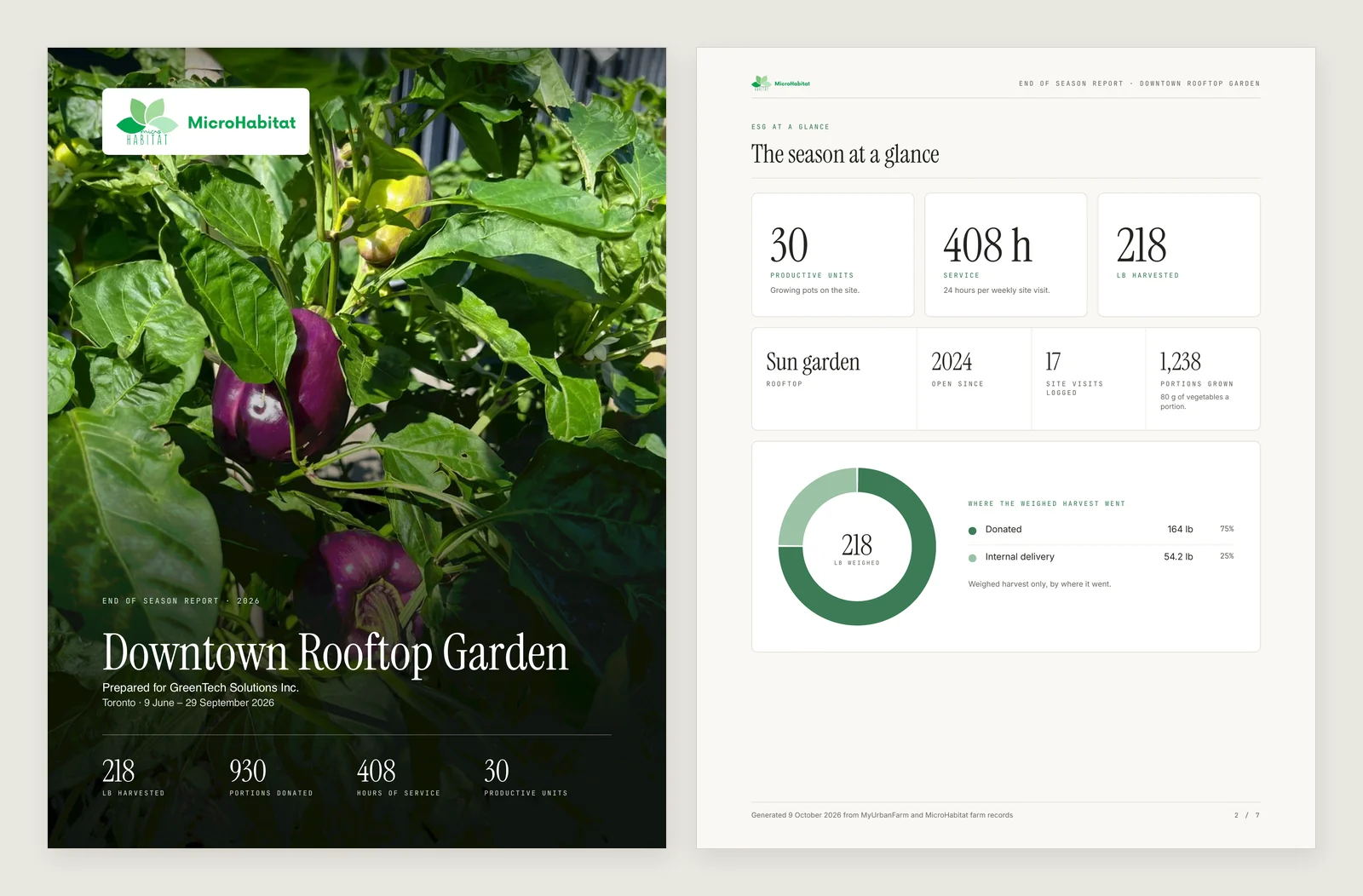
At MicroHabitat, urban farmers record every site visit in MyUrbanFarm, and those records feed the farm’s End of Season Report. The report keeps any estimate apart from the weighed harvest and labels it as one. During the season, clients follow the farm through posts and photos on its page in MyUrbanFarm.
How should you read the report when it arrives?
Read the report in a fixed order: the dates and visit count first, then the labels on the figures, then the comparison with last season, and the issues section last. That order catches most problems in a few minutes.
- Dates and visits. Check the visit count against the site-visit log and the visit schedule in your contract. A difference is not always a fault, but it should be explained.
- Labels. Find the line between weighed and estimated figures. If you cannot find it, ask before you quote any total.
- Comparison. If last season’s report exists, compare like with like: the same crops, the same growing area and the same basis for the numbers. A change in containers or crop mix explains many differences.
- Issues and fixes. Read this part slowly. It tells you what the farm needs from the building next year, such as water access, roof access or a change of schedule.
A report that lists no problems at all deserves more questions, not fewer. The balance principle in GRI 1 asks for a fair representation of negative and positive impacts, and a season on a roof rarely passes without a heat wave, a pest or a missed week. Seeing those named, with what was done about them, is what makes the good news believable.
How can you use the report over the winter?
The report is most useful in four places over the winter: sustainability or ESG reporting, communication with tenants or employees, the budget renewal and next season’s crop plan. Each use needs a different extract, not the whole document.
- Sustainability and ESG reporting. Quote measured figures as measured and any estimate as an estimate. For real estate teams that take part in GRESB, the 2026 results were released on 1 October 2026, and requests for a Results Performance Review can be made until 30 January 2027, according to the GRESB key dates. If your sustainability team reviews its evidence in that window, file the season report where they will find it.
- Tenant and employee communication. Use one or two figures, a dated photo, a thank-you to everyone who took part and the date the farm comes back. Property teams will find more on running a farm as a building amenity on our commercial real estate page, and employers on our page for corporations.
- Budget renewal. The report shows what the program delivered in plain terms. Our guide on how to budget an urban farm program for 2027 covers where that money usually sits and when it is decided.
- Next season’s crop plan. Crops that thrived, crops nobody wanted and the preferences of your donation partner all belong in the conversation with your urban farmer before seeds are ordered.
Keep each year’s report in the same place. Two or three seasons side by side tell you far more than any single report, provided the figures were labelled the same way each time. GRI calls this comparability: information reported consistently, so that changes over time can be analyzed.
What should you ask your provider if something is missing?
Ask the provider where the missing figure or section should come from, and ask now, while the season’s records are fresh and before budgets are fixed. Many gaps can be filled from records the provider already holds, and these questions cover the usual ones:
- Which visits does this harvest total cover, and on which dates?
- Which figures are estimated, and how was each estimate calculated?
- Which organizations received donations, and do we have their permission to name them in our own communication?
- What went wrong this season, and what changes next year as a result?
- Can we receive the underlying data in a format our sustainability team can use, and who owns it?
- When will the plan for next season be ready?
If you are choosing a provider for a spring 2027 installation, ask these questions before you sign rather than after the first season. An example report, with client details removed, shows you exactly what you will receive and how the provider separates measured from estimated figures.
Frequently asked questions
When should an End of Season Report arrive?
Aim for a few weeks after the last site visit, early enough to use it in budget discussions and year-end reporting. Agree the date in the contract so it does not depend on goodwill. Where the growing season ends at another time of year, set the date by the local calendar.
Can we share the report with tenants, employees or the public?
Share a summary rather than the full document. Remove anything that could identify a person, check that every named partner has agreed to be named, and keep estimated figures labelled as estimates in whatever you publish.
Does an indoor farm get an End of Season Report?
An indoor farm keeps growing through winter, so it has no natural end of season. Agree a fixed reporting period instead, such as your financial year or every six months, and ask for the same structure: labelled harvest figures, activities, visits, photos, issues and the plan ahead.
When your report arrives, read it with the four checks above and raise any gaps before budgets close. If you are planning a farm for spring 2027, agree this winter what its End of Season Report will cover.