Urban Farming FAQ: Your Questions Answered
Your urban farming FAQ answered: rooftop farm costs, ROI and profitability, the best plants, property-value impact, and how on-site farms are managed.
Quick answer: This urban farming FAQ answers the questions property owners and tenants ask most before installing an on-site farm — what a rooftop farm costs, whether urban farms are profitable, which plants grow best, how a farm affects property value, and how installations are managed. Each short answer links to a full deep-dive guide for the detail behind it.
This page is the hub for the most common urban farming questions we hear from property managers, sustainability officers, building owners, and tenant-experience teams. The answers below are deliberately short and direct: lead with the number, then point you to the full guide. Use the jump links to skip straight to what you need.
Jump to a question:
- How much does a rooftop farm or garden cost?
- Are urban farms profitable, and what's the ROI?
- What plants grow best on a rooftop or on-site farm?
- Do urban farms increase property value and help my building?
- How does Microhabitat install and manage a farm?
Costs & pricing: how much does a rooftop farm cost?
A managed rooftop farm is almost always a predictable annual service fee, not a one-time construction bill — most commercial buyers budget it as an operating line item rather than capital expenditure. The price scales with three things: the size of the space, the growing system (lightweight container beds versus an engineered green roof), and the service level (how often a professional farmer visits, whether you want events and harvests for tenants). Because Microhabitat farms are modular and container-based, they avoid the heavy structural and waterproofing costs that drive traditional green-roof budgets into the hundreds of dollars per square foot.
The right way to think about cost is per outcome, not per square foot in isolation. A small lobby-adjacent terrace activated for tenant engagement has a very different budget from a large rooftop run primarily for produce volume. For the full breakdown — what's included, what drives the range up or down, and a sample budget — see our detailed guide on how much a rooftop garden costs.
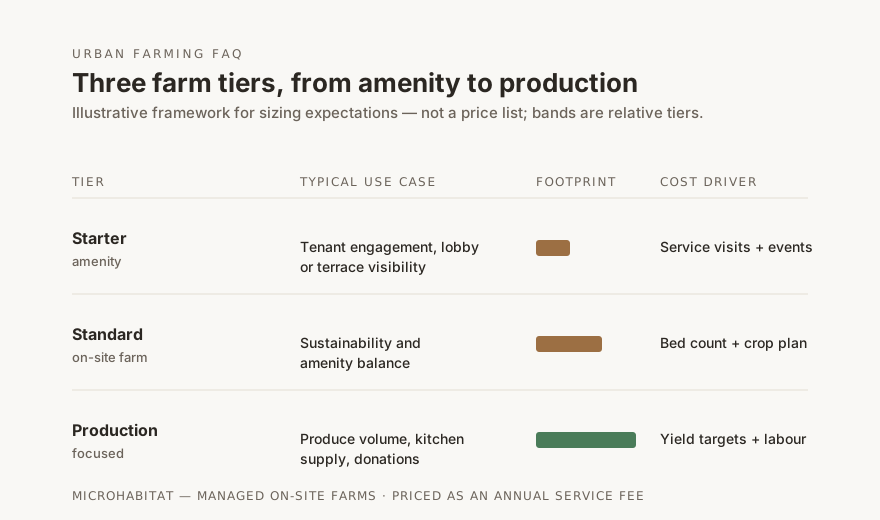
The table below is an at-a-glance framework for how cost, scale, and purpose relate. Treat the bands as relative tiers to size your expectations, then contact us for a quote against your actual roof.
| Farm tier | Typical use case | Relative footprint | Primary driver of cost | What you get |
|---|---|---|---|---|
| Starter / amenity | Tenant engagement, lobby or terrace visibility | Small | Service visits + events | Visible greenery, seasonal harvests, signage |
| Standard on-site farm | Sustainability + amenity balance | Medium | Bed count + crop plan | Regular harvests, biodiversity, ESG reporting data |
| Production-focused | Produce volume, café/kitchen supply, donations | Large | Yield targets + labour | Higher output, donation/CSR program, full data pack |
The single biggest cost mistake buyers make is comparing a turnkey managed service to a DIY build. A DIY rooftop garden looks cheaper on paper until you price in design, irrigation, the labour to keep it alive, crop losses, and the staff time nobody budgeted for. A managed service folds all of that — installation, planting, weekly care, and reporting — into one fee. For a deeper look at how those numbers compare, our rooftop garden cost guide walks through line by line.
ROI & profitability: are urban farms profitable?
For commercial buildings, urban farms generate return primarily through tenant retention, brand and ESG value, and amenity differentiation — not produce sales alone, and that's by design. The mistake is measuring an on-site farm like a wholesale produce business. A 1,000-square-foot rooftop will never out-earn a rural acre on vegetables, but that was never the point. The return shows up in the rent roll, the leasing brochure, the sustainability report, and the tenant-satisfaction survey.
Three value streams make the math work:
- Tenant attraction and retention. Amenities that get used reduce churn, and tenant turnover is one of the most expensive events in commercial real estate. A farm tenants visit, harvest from, and gather around is stickier than a logo on a wall.
- ESG and reporting value. A managed farm produces auditable data — biodiversity, local food, community engagement, waste diverted — that feeds frameworks like GRESB, LEED, and WELL. That data has real value to owners reporting to investors.
- Brand, PR, and CSR. Harvest donations to local food banks, tenant events, and a credible "we grow food on our roof" story generate goodwill and marketing reach that a paid campaign would cost real money to buy.
So "are urban farms profitable?" is the wrong question for a corporate building; "what is the return on this amenity and ESG spend?" is the right one. For the full ROI model — how to value retention, the ESG contribution, and a corporate payback framing — see our guides on whether urban farms are profitable and the specific rooftop garden ROI for corporate buildings. Across Microhabitat's installations in North America and Europe, the strongest performers consistently treat the farm as an engagement and ESG asset first, with produce as the visible proof.
Plants & growing: what grows best on a rooftop?
The best rooftop crops are fast-growing, shallow-rooted, high-visibility plants — leafy greens, herbs, cherry tomatoes, peppers, edible flowers, and pollinator plants — because they thrive in container depths, mature within a season, and look productive to tenants. Rooftops are bright, windy, and use lightweight growing media, so the winning crop plan favours plants that tolerate those conditions and deliver frequent, satisfying harvests rather than long-season field crops.
A good rooftop crop plan balances four jobs:
- Visual impact — greens, herbs, and flowering plants that read as "alive and abundant" from the first visit.
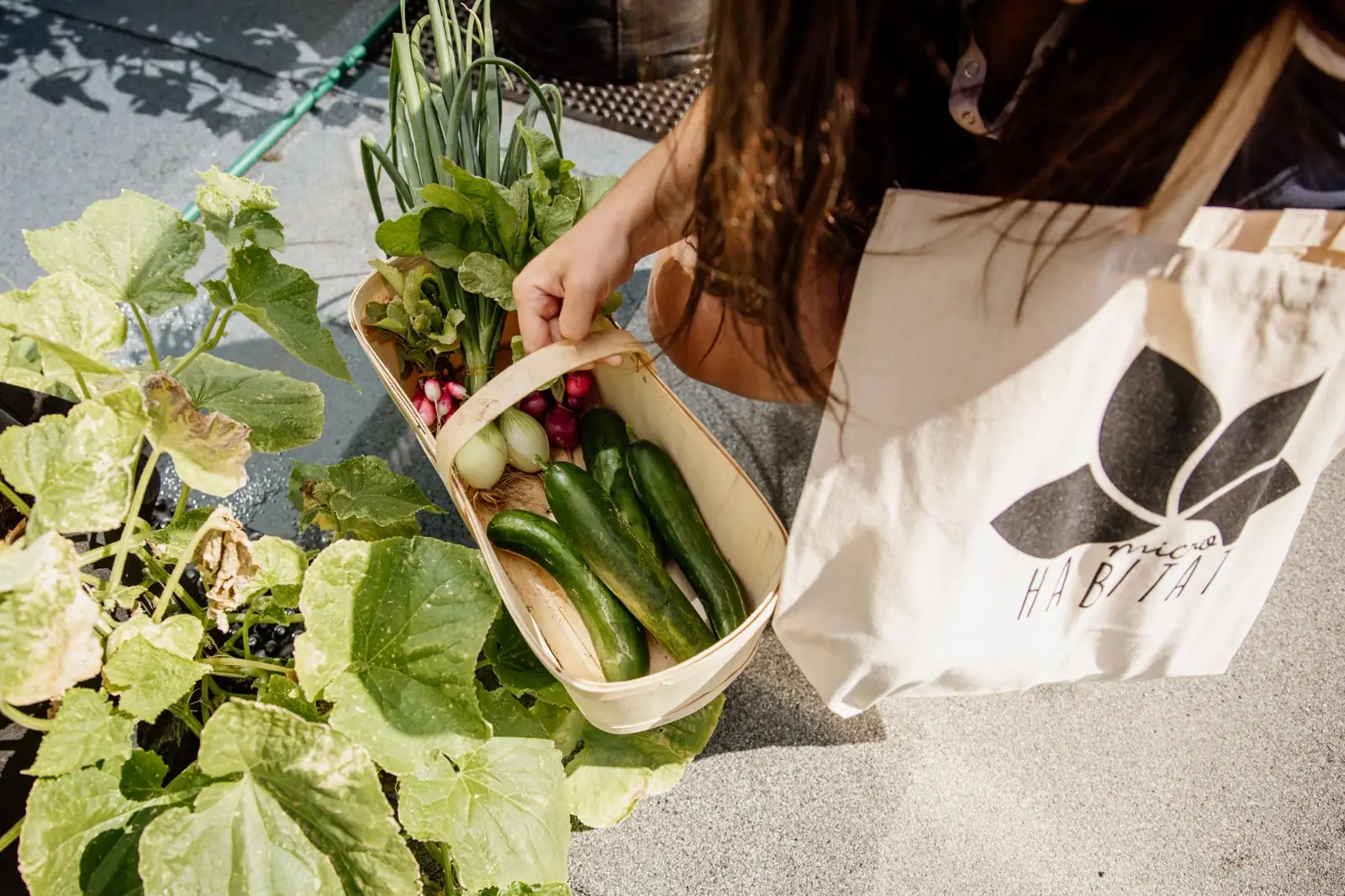
- Harvest frequency — cut-and-come-again greens and herbs so there's always something to pick at a tenant event.
- Pollinator and biodiversity support — flowering plants and native species that attract bees and beneficial insects, which strengthens the building's biodiversity story.
- Climate fit — selections matched to the local season and hardiness zone, rotated through the year so the farm is never bare.
Herbs (basil, mint, thyme, chives), salad greens (lettuce, kale, arugula), tomatoes, peppers, beans, and strawberries are dependable performers; the exact mix is tuned to your city, sun exposure, and goals. For the full season-by-season planting list and the reasoning behind each pick, see our guide on which plants grow best on rooftops. The U.S. USDA's urban agriculture program is a solid public reference for region-appropriate growing and food-safety practices.
Property & buildings: do urban farms increase property value?
Urban farms support property value indirectly but measurably — through stronger tenant amenity, sustainability-certification points, biodiversity and green-space credentials, and the heat-island and stormwater benefits of a vegetated roof. There's no single line-item "+X%" that applies to every building, but on-site farms move several of the levers that drive asset value and net operating income: leasing appeal, retention, certification performance, and ESG positioning with investors.
The building-performance case rests on well-documented mechanisms:
- Sustainability certifications. Vegetated, food-producing roofs and tenant-wellness programming can contribute toward LEED and WELL credits, which are increasingly tied to leasing premiums and investor expectations.
- Urban heat and stormwater. Green roofs reduce rooftop surface temperatures and absorb rainfall; the U.S. EPA notes green roofs as a recognized urban heat-island mitigation strategy, which can lower cooling load and ease stormwater management.
- Biodiversity and nature value. A planted farm adds habitat and pollinator support — credentials that matter as nature and biodiversity disclosure moves up the investor agenda.
- Amenity and brand. A distinctive, visible farm differentiates a building in a crowded leasing market.
So the honest answer is that an urban farm rarely "raises the appraisal" on its own, but it strengthens the inputs appraisers and tenants care about. For the evidence and how to present it to ownership, see our deep dive on whether urban farms increase property value.
A related question we get often: is this the same as a community garden? No — and the difference matters for a commercial building. A community garden is typically tenant- or volunteer-run, unmanaged, and amenity-only; a managed on-site farm is professionally maintained, produces reporting data, and carries no labour burden for the building. We compare the two models in urban farm vs community garden.
How Microhabitat works: installation and management
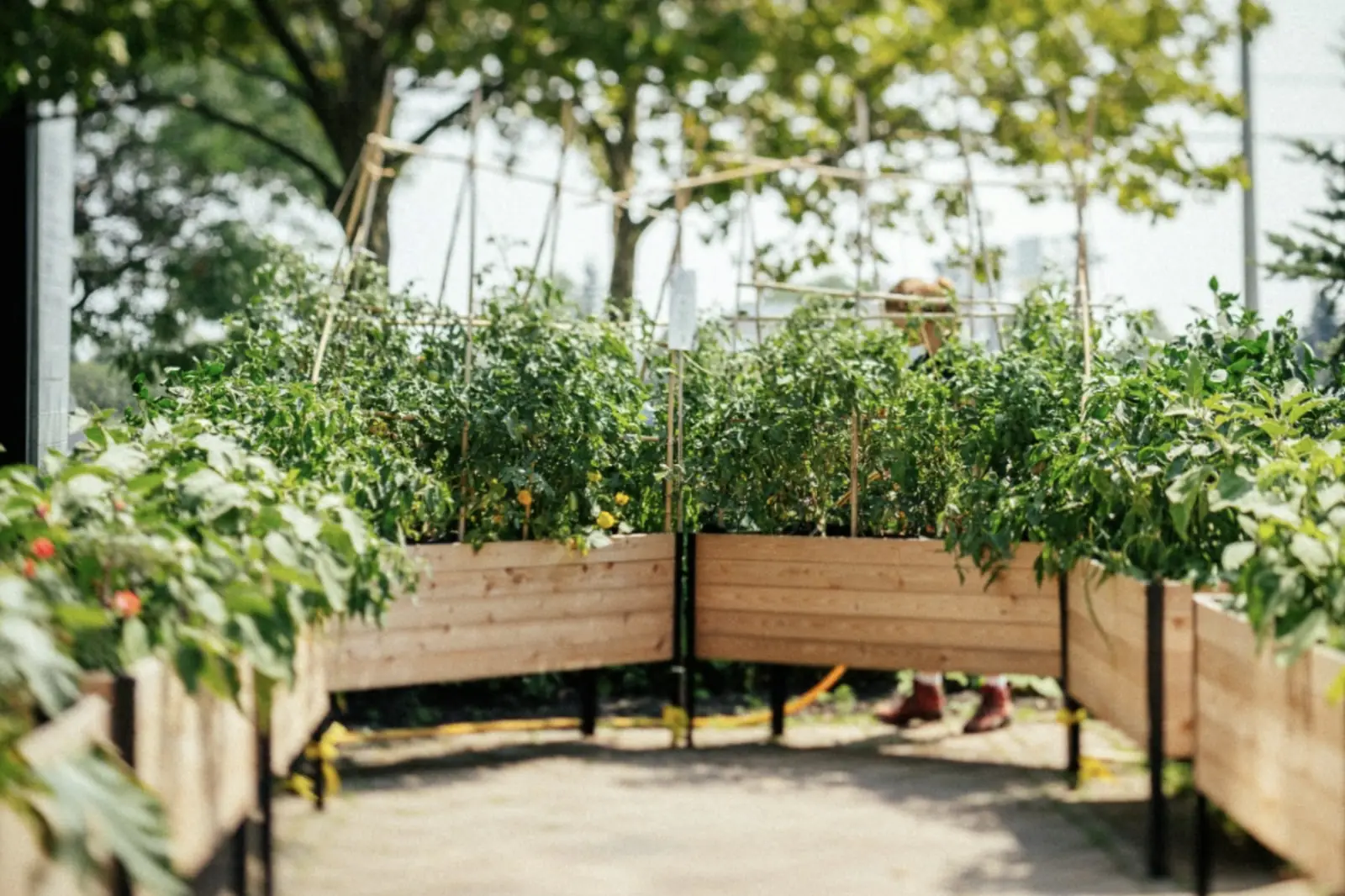
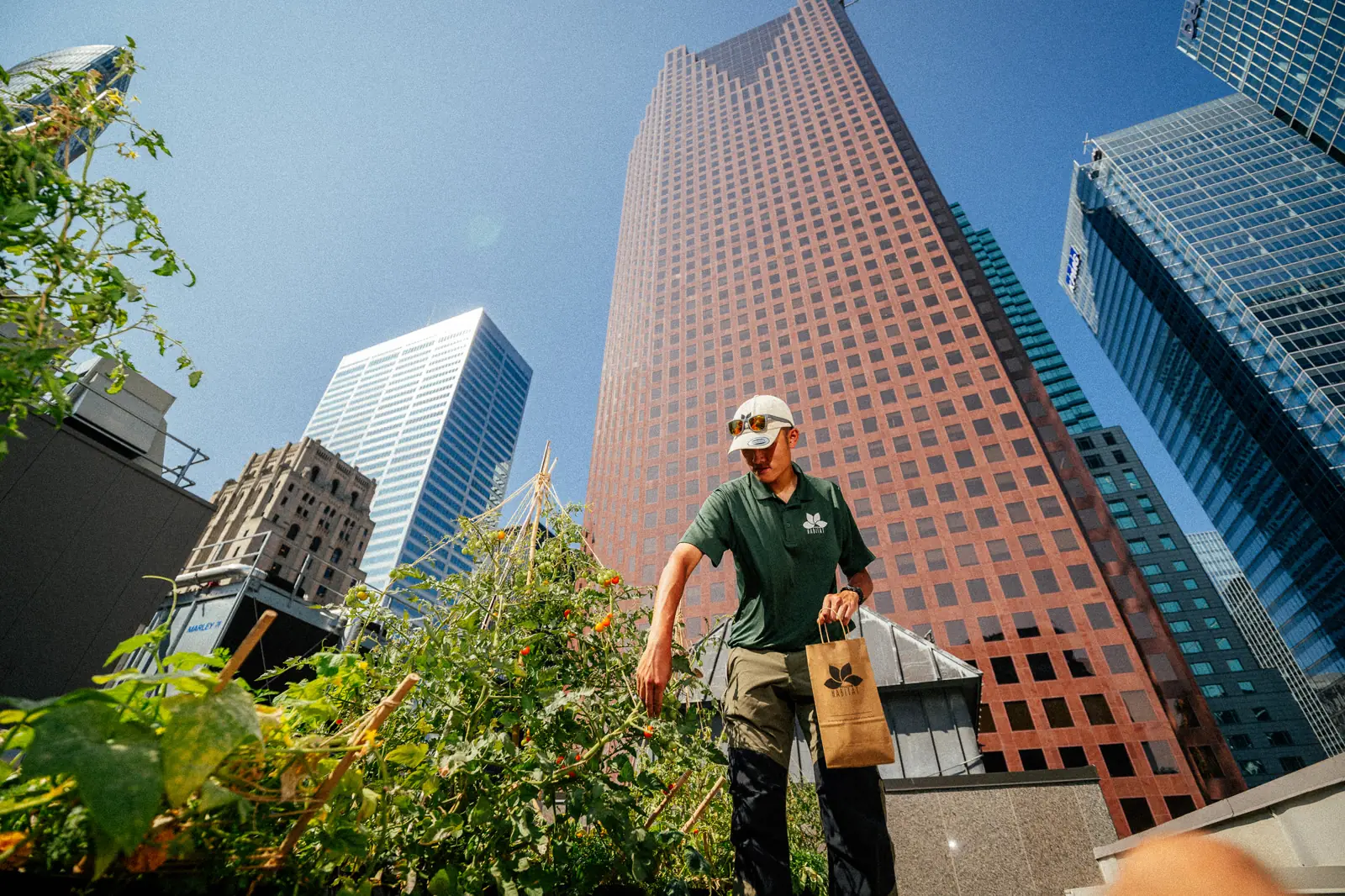
Microhabitat installs and fully manages turnkey on-site farms, so the building gets the greenery, harvests, and data without any of the gardening labour or operational risk. From the property team's perspective the farm is a service: we assess the space, design and install a modular container-based farm, then send professional urban farmers to maintain it through the season. You get the amenity, the produce, the events, and the ESG data — we handle everything that keeps it alive.
The typical engagement runs in clear steps:
- Site assessment. We evaluate the roof, terrace, or ground space — load, access, sun, water — and confirm what's feasible with no structural surprises.
- Design and proposal. We size the farm, propose a crop plan matched to your goals (amenity, production, or ESG-led), and give you a transparent annual quote.
- Installation. Lightweight modular beds and the growing system go in quickly, with minimal disruption — no heavy construction or waterproofing overhaul.
- Season-long management. Professional urban farmers visit on a regular cadence to plant, tend, harvest, and troubleshoot. Tenants can join harvests and events.
- Reporting and impact. You receive data — yields, biodiversity, engagement, donations — packaged for sustainability reporting and tenant communications.
This managed model is what separates an on-site farm from a DIY rooftop garden or a community plot: the building carries zero horticultural workload and zero "who's going to water it in August" risk. For the broader context on how on-site farms fit into a building's sustainability and amenity strategy, explore our main urban farming FAQ hub. To see what a farm would cost and produce on your specific property, the fastest path is a direct quote.
Urban farming FAQ: still have a question?
This urban farming FAQ covers the questions we hear most, and every short answer above links to a full guide — but the fastest way to get a number for your building is to ask us directly. We'll assess your space, propose a crop plan, and send a transparent quote — typically with an indicative cost range, expected harvests, and the ESG data you'd receive.
Ready for specifics? Contact us for a quote — tell us your building and city, and we'll come back with a tailored proposal.